Category Archives: *ESL CONVERSATION & DISCUSSION TECHNIQUES

These postings include conversation activities, teaching techniques, strategies for groupings and evaluations.

• Don’t Give Grades For These In Conversation Class. Do This Instead.

Cover shot don't grade pron

A former ESL student of mine, Teddy, came to my office for a chat. I asked him how his classes were going, and he showed me the mid-term exam grade from his intermediate-level speaking class that his teacher had just given him. First Bad eval form  I asked him how he felt about it. He said that he was feeling discouraged because he really tries to be active in conversation, not only telling his ideas and opinions but also responding to and including other. So he felt that he deserved a much better score than a 72%, which was a failing grade.

Then I asked him, from looking at this grade form, what he thinks he’ll need to do to improve his grade.

Grade three techniques

He felt confident that he could ask more questions and try to respond to others more with rejoinders.

But about the pronunciation and grammar grades, he said that he wasn’t sure.

Revised Grade just pron gram

He imagined that he might have some problems with “L” and “R” sounds.  And he thought that the grammar score was low because he always makes mistakes with prepositions. So he planned to think more carefully about those when talking.

The problem and the fix

Continue reading

• Pain-Free ESL Speaking Placement-Testing Process: Reliable, Time-Efficient and User-Friendly

Cover ppt shot

(This posting includes a handout which you are welcome to use with your colleagues.)*

At first, all the teachers wanted to administer the oral test for placing students into one of the four levels of conversation classes. But that enthusiasm waned once they discovered what this commercially-made placement test would entail.

Two major problems with many speaking placement tests (commercial and in-house)

1)  The testing process in labor intensive. The scoring rubrics are onerous, ineffective and require time-consuming training.

2)  Rather than just focusing on the skills being developed in speaking/conversation classes, the interviewers have to evaluate several peripheral aspects of speaking at the same time.

A Speaking Placement-Testing Process That Addresses Those Problems.

Continue reading

• Stimulating Small-Group Discussion Activity 8: Impulse Control: Don’t Look at Social Media while Studying


Cover read for discussion SHOT

*(This posting includes a handout which you are welcome to use with your students.)

 Some reasons why students seemed stimulated by this discussion:

1) They could relate to the two research studies about impulse control in the article.

2) They were interested to compare how they would have performed as subjects of the studies compared to their classmates.

3) They enjoyed sharing their experiences with controlling impulses and delaying gratifications in their everyday lives.

4) They were surprised by the effects the lack of impulse control can have on our lives and how it is affecting their classmates’ lives.

(This posting includes a handout which you are welcome to use with your students.)

Here is the basis for this discussion: Researchers believe that a person’s ability to delay gratification can carry many advantages, including better scores in school, fewer behavior problems, and reduced chance to be overweight and being more successful in jobs.

This and future discussion activities include four parts:

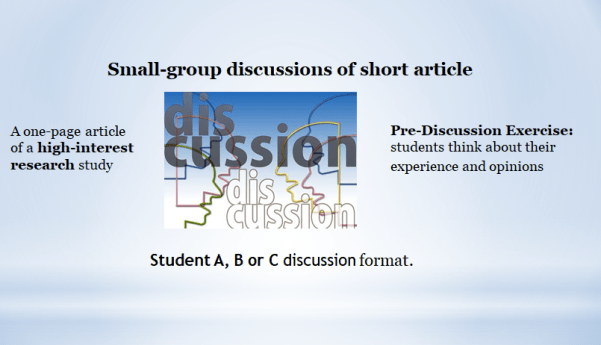
1) A one-page article usually including a brief summary of a high-interest research study.
2) Ten true-false comprehension questions.
3) Pre-Discussion Exercise in which students read and think about several questions about their experience and opinions about the topic before discussing them in groups.
4) Small-group discussions of the article in which each student is given a paper with different content/personal experience questions in the form of Student A, B or C.

Bonus writing activity. Included in the handout is a final writing activity to give students practice with paraphrasing and writing a reflection.

About Discussion Activity Activity 8: Impulse Control: Don’t Look at Social Media while Studying

Continue reading

• Helping Our Students Who Feel Invisible

triads

In the documentary, Becoming, about Michele Obama, Michele is asked about feeling invisible. Her description made me think more about how many of our ESL/International students probably feel invisible in classes, on campus and in society, and how we can help them.

My personal experiences with feeling invisible are quite trivial compared to what some of our students experience, but a recent episodes gave me a bit of a taste of how it feels.

I was talking to a colleague (we’ll say his name was Ben) outside the library when a young woman whom I didn’t know walked up to us with a smile on her face. The two of them obviously knew each other and started talking animatedly, without Ben introducing us. After a couple of minutes, they walked off together across campus.

That experience had little effect on me other than feeling a tad off balance or slightly irritated momentarily. But for International and minority students, being treated as invisible can be quite disheartening.

One young man described it this way, “The problem is that to many people, I am simply invisible. Nobody says ‘hello’ to me. Nobody nods to me. Nobody recognizes me as a person with something to say. Nobody listens to me. People make assumptions about me on the basis of my color and where I come from…But I am a person and have something to say — both as an individual and on the basis of my distinctive experience.”

In our classrooms, we can see the students who are probably feeling invisible. They are the ones who are not greeted by others who look past them and start talking to more familiar friends. Or the ones overlooked when their classmates are told to find a partner for an activity. Or the ones who sit silently seemingly unnoticed in group discussions.

How to help our ESL students feel visible.

Continue reading