
• Great Whole-Class Game for ESL Listening Skills (Revisited)

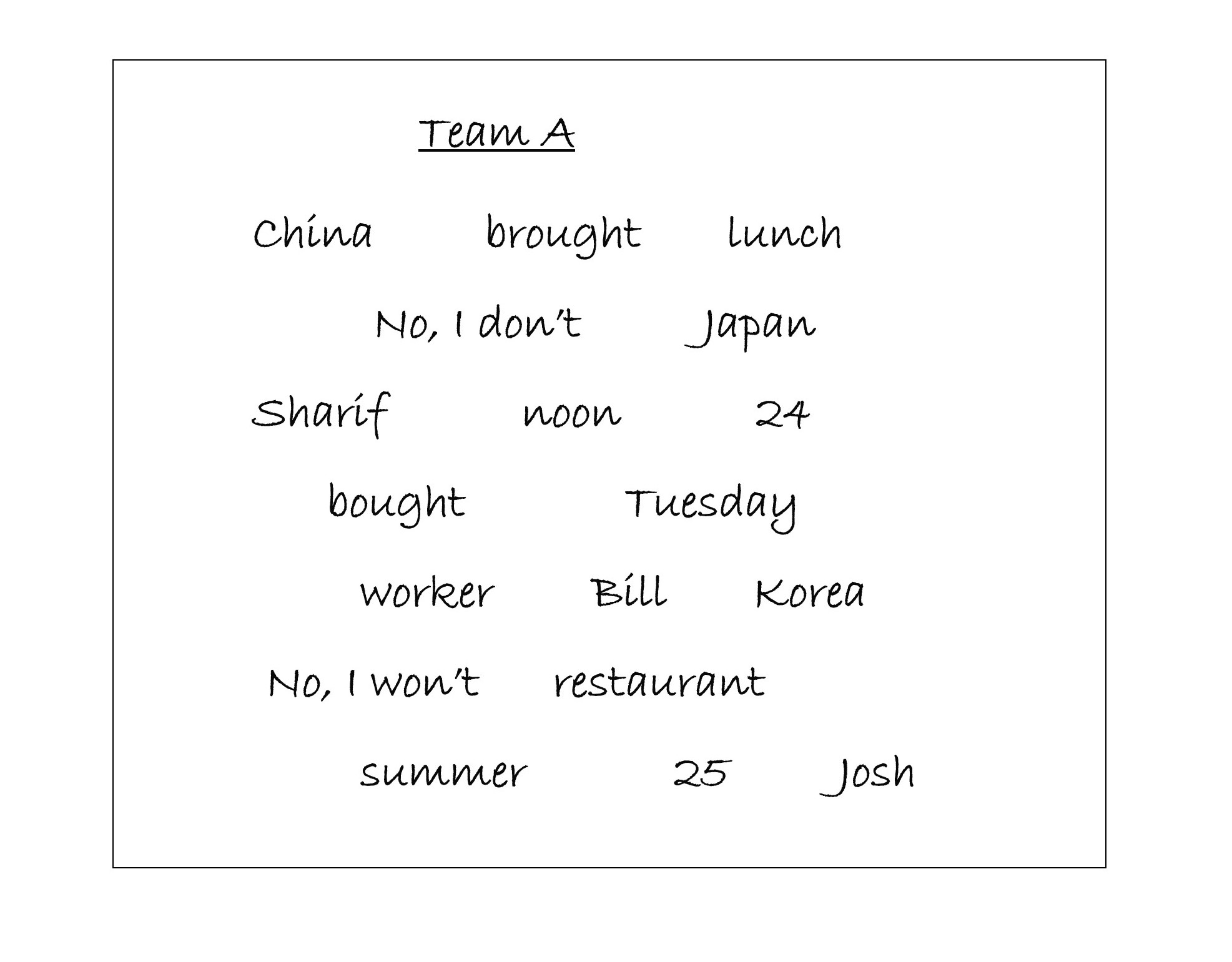
Cover Team A shot

This game has it all:

  • Motivates listening skills.
  • All students focused.
  • Students are up and out of their seats.
  • Easily customized to the interests and level of a specific class of students.
  • Organized with minimal teacher work.
  • Stimulating with a lot of laughing.

Here is how it works.

Continue reading

• Short, High-Interest Articles for Extensive Reading: # 14: “Why It’s Hard to Apologize”

(This posting includes a handout LINK AT THE END OF THIS POST which you are welcome to use with your students.) *

Last week, Emily took her driver’s test but failed. At dinner, she told her family but asked them all to promise not to tell anyone because she felt embarrassed. Yesterday, a friend, Jay, said to her, “Your sister, Kara, told me that you failed your driver’s test. Are you going to take it again?” That afternoon at home, Emily was upset and told Kara, “Kara, I asked you not to tell anyone one about my test, but Jay said that you told him.” At that moment, Kara knew she should say sorry, but she didn’t want to. There is a common saying, “Three of the most difficult words for people to say are, ‘I am sorry.’”

(See complete article below.)

For background information about these articles and for suggestions for how to use them with your students, see  • Introducing “Short, High-Interest Readings”  Also, I’ll be adding more of these articles in the right-hand column: ESL Reading> Short, High Interest Articles for Extensive Readings

Here is the 13th article. You can download the article for your students by clicking on the link at the end. Also included are three optional exercises: True-False Questions; Paraphrasing Exercise; Reflection Exercise.

Continue reading

• Fun Activity To Reduce Irritating Classroom Behavior

(This posting includes a handout which you are welcome to use with your students.)

 (This is a revision to an earlier posting: Enjoyable and Effective Awareness Activity for Changing ESL Students Classroom Behavior)

Most ESL students don’t do goofy things just to irritate the teacher. Usually, they are unaware of how they are coming across or unaware that they are acting differently from the other students or even what is expected of them.  These are some of the habits students tend to bring to our classes:

  • Chronically arriving to class late
  • Chatting with classmate
  • Text messaging during class
  • Not paying attention
  • Not participating in a group
  • Calling out answer before others get a chance
  • Sitting in the back of the room day-dreaming
  • No eye contact to teacher or classmates in a group
  • Speaking own language in a group
  • And more

An effective approach to circumventing these habits is one in which students become aware of the effects these habits have on the teacher and other students. In this post, I’ll explain how programs that I’ve taught in were able to help students see how their behavior is viewed by others. Not only was the process enjoyable for the students, but also, we noticed far fewer students engaging in these behaviors.

Here is how we did it. 

Continue reading

• Don’t Wastes Students’ Energy Teaching Certain Types of Vocabulary Words in Reading Class (Revisited)

Three Tiers

“Radiance,” “strike a deal,” “gorgeous” “ecosystem.” In my 40 years of teaching academic ESL, I’ve probably seen these word in a reading passage at most only once or twice.  And I’ve never seen a student use them in a writing task.  And yet, these words were  included in several vocabulary exercises in a textbook, and students were asked to write sentences with them.  Because the words were in a reading passage, the author of the textbook, for some reason, decided that these were important words for students to study and try to internalize.

I think most of us would agree that spending time on words so rarely used as “radiance” or “strike a deal” is probably not the best use of students’ precious time and mental energy if our true goal is to help them develop their reading skills.  At the same time, many of us who have studied a foreign language would agree that reading comprehension is enhanced by knowledge of a lot of vocabulary words.

At this point, two questions come to mind: (1) How do learners increase their vocabulary, and (2) which vocabulary words would perhaps be beneficial to study through exercises?

Continue reading