Category Archives: • Lower & Intermediate Levels

• They Don’t Want To Stop Talking During This Activity

(This posting includes a handout which you are welcome to use with your students.) *

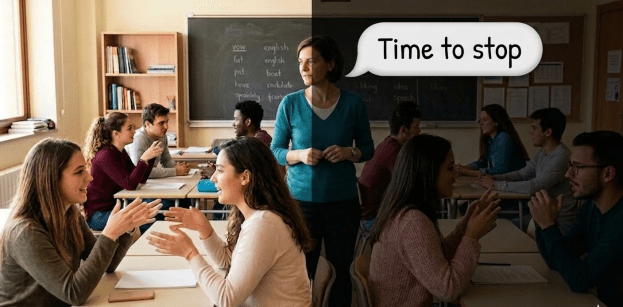
The lights in the classroom are off, but many of the students in pairs continue talking—in the dark!

For most of this class time, students were engaged in a special conversation-skill activity. The class was almost over, so I wanted to get everyone’s attention, “We’ll need to stop in three minutes.” No one seemed to notice me. After three minutes I said that it was time to stop. But hardly anyone flinched. After another three minutes, I turned the lights on and off. Still most continued to talk. So finally, I turned the lights off. Even then in the dark, some pairs continued talking.

This same phenomenon occurs when I’ve presenting this activity at ESL teacher conferences—to NATIVE-ENGLISH SPEAKERS!! Like my ESL students, the teachers continue to talk IN THE DARK!!

One of them even told me after a session, “I wish I could get my husband and son to use this!”

This activity is not only engaging, but it is also developing one of the most important conversation skills. (Below, I’ll attach a link to the activity that you can use to download and use with your students.)

Continue reading

• More Than Just Talking

(This posting includes a handout which you are welcome to use with your students.) *

I was so proud of myself (for a moment).  All the students in my conversation class were talking in pairs. Yes! My activity was working!  But then it wasn’t.

I noticed a similar pattern over the next few classes. I put them in pairs—Student A and B with different questions on their handouts. The energy and noise level in the class increase immediately. But then I noticed one pair briefly changing to a different language; another pair stopping and looking at one of their papers together; in another pair, one was doing most of the talking while the other just nodded their head. Soon a pair finished before the majority were still only half finished and just sat there.

These activities were missing the most important goal of any conversation activity: to help students develop specific techniques that they can use to keep communication flowing.

Beyond just talking

Since that realization, I’ve focused on building complete, ready-to-use activities that help students develop the ability to:

• Actively engage by reacting, asking follow-up questions, and responding with details.
• Keep a conversation going even when the topic is a challenge.
• Use simple signals to let others know how well they understand what is being said.
• Politely interrupt, correct others, or make requests and excuses.
• Participate fully in group discussions by sharing opinions and requesting details.

Continuing to Pay it Forward

Continue reading

• Teach Reduced Forms for Comprehension Not for Speaking (Revisited)

Cover reduced forms shot

*(This posting includes a handout which you are welcome to use with your students.)

Here is a link to a short video about this posting: Teach Reduced Forms for Comprehension NOT Speaking

A student, Tim, once came to my class all excited and asked me, “Hey David, wha ya gonna do di wee-en? I wanna gedouda taw.” 

I was pretty sure that he was trying to say something in English, but I had no idea what it was. After repeating the sentences several times, he became embarrassed and decided to write them down. “What are you going to do this weekend? I want to get out of town.”

He told me that the teacher in his previous class was doing lessons on reduced forms of speaking and had encouraged them to use them when speaking. So this student whose pronunciation was often hard to understand because he tended to drop final consonants of words (e.g. wee = week / taw = town) was being encouraged to do something that would make him even harder to understand.  Crazy!

How to work with reduced forms. (Handout exercise included)

Continue reading

• ESL Conversation Class: What If They Make Mistakes In Pairs? Myths About Pair Work. (REVISITED)

Myths pair work cover shot

A teacher once said that she avoided pair work during conversation lessons because she wouldn’t be able to monitor all the students to catch their grammar mistakes.  Is this a legitimate reason?  Researchers have studied what, in fact, happens when students work in pairs with other students and when they work with non-native speakers which can dispel some of the mis-assumptions about the drawbacks to pair work.

Continue reading