Category Archives: • Advanced & High-Intermediate Levels

Entering a Lesson with Predictions (Part 2: Pre-Discussion Activities) (Updated)

Cover pre speaking Pt 2 slide

(This article was originally published in MET (Modern English Teaching) in Spring 1986.)  MET website

In Part 1 ( • Entering a Lesson with Predictions (Part 1: Pre-Listening Activities) , I introduced how we can help student to focus on a particular day’s materials and to become personally involved in its content. We can do it through a “prediction process.” I also described two prediction activities as entries to listening activities.

In this Part 2, I’ll share two sets of “prediction activities” as entries to speaking/discussion activities. In the first one, the prediction activity is indirectly related to the speaking activity. In the second one, it is directly related to what they will be discussing in their groups.

Example of predictions as an indirectly-related “entry” to a speaking activity

Lesson plan:  The students were going to have group discussions about “fun.”

Prediction procedure (which preceded the discussion.) I found online a ranking of the 10 most fun countries in the world.

Step 1: A list of 10 countries in alphabetical order was given to each student. They then individually predicted the ranking of each one according to how fun the online survey found.  Next, they formed groups of three or four and shared their guesses (predictions) with the group members.

Step 2: The teacher read the rankings, as they had been listed in the online source. Students jotted the answers on their lists.

Step 3: Still in their groups, they compared how well they had predicted.

Step 4: The students then formed new groups of three or four. The students were given a list of discussion questions about “fun.” For example
1) Did you have fun last weekend
2) When you were a child, what did you do that was fun?
3) Do you think computers are fun?
4) Is there a country or city you want to go to for fun?
etc.

Observation: Even though the ranking of fun countries had no direct bearing on the discussion that followed, students appeared to automatically think broadly about the topic of fun.

Example of predictions as a directly- related “entry” to a speaking activity

Continue reading

• Managing the “Awkward Silence”: The Escape Technique

(This posting includes an attachment teacher’s script which you are welcome to use.)*

Many of us have been there: you call on a student during a whole-class discussion, and instead of an answer, you’re met with total silence.

Whether they don’t know the answer, are struggling to translate their thoughts, or simply lack the confidence to speak, the result is the same: the student feels stressed, the teacher isn’t sure whether to wait or move on, and the rest of the class starts to get restless.

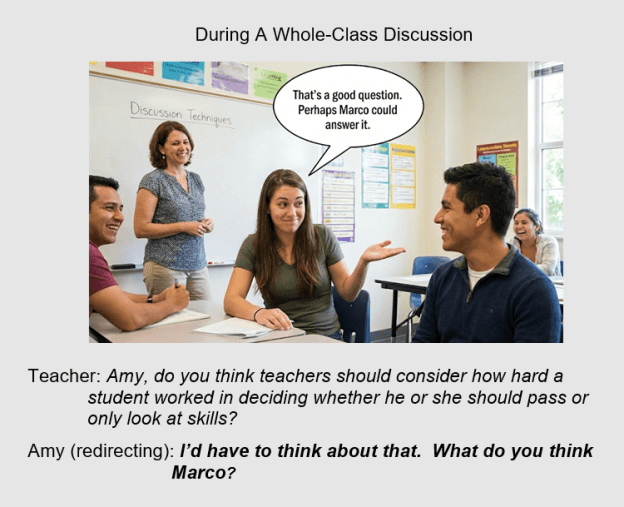
The “Escape Technique” provides students with a safety net. If they can’t answer within a reasonable amount of time, they are taught to use specific expressions to “pass the mic” to a classmate.

The “Escape” Phrases

  • That’s a good question. I’d like to think about it first. Perhaps (a classmate’s name) could answer it.
  • I’m not sure, but (classmate’s name), what do you think?
  • I have no idea. How about you, (classmate’s name)?

When students use this technique, it can actually turn into a humorous situation.  Almost any time a student has used one of these expression, it has elicited a lot of friendly laughter by the classmates and teacher.  The classroom tension is immediately released.

To help your students become comfortable with this technique, you can use the handout and attached script, which I’ll explain about below.

Continue reading

• Teach Reduced Forms for Comprehension Not for Speaking (Revisited)

Cover reduced forms shot

*(This posting includes a handout which you are welcome to use with your students.)

Here is a link to a short video about this posting: Teach Reduced Forms for Comprehension NOT Speaking

A student, Tim, once came to my class all excited and asked me, “Hey David, wha ya gonna do di wee-en? I wanna gedouda taw.” 

I was pretty sure that he was trying to say something in English, but I had no idea what it was. After repeating the sentences several times, he became embarrassed and decided to write them down. “What are you going to do this weekend? I want to get out of town.”

He told me that the teacher in his previous class was doing lessons on reduced forms of speaking and had encouraged them to use them when speaking. So this student whose pronunciation was often hard to understand because he tended to drop final consonants of words (e.g. wee = week / taw = town) was being encouraged to do something that would make him even harder to understand.  Crazy!

How to work with reduced forms. (Handout exercise included)

Continue reading

• Stimulating Small-Group Discussion Activity 2: Loneliness Might Not Be What You Think (Including Paraphrasing Exercises.) REVISITED

Cover read for discussion SHOT

(This posting includes a handout which you are welcome to use with your students.)*

Some reasons why students seemed stimulated by this discussion:

1) Since almost all the students were living away from home, they were able to relate to the challenge of connecting to new people.
2) They seemed interested in hearing how their classmates were coping with living away from home: some loved it and some felt lonely.
3) They enjoyed discussing how social media is both helpful and harmful especially concerning making connections to people.
4) They seemed surprised that some of their classmates are not especially connected to their family members.

Here is the basis for this discussion: According to research, loneliness has little connection to how many people are around us.  In his book,  Lost Connections,  Jonathan Hari explains that loneliness is caused by a loss of connection to others. To end loneliness, according Hari, we need two things: other people and a feeling that we are sharing something meaningful or something we care about with another person or other people.

This and future discussion activities include four parts:

1) A one-page article usually including a brief summary of a high-interest research study.
2) Ten true-false comprehension questions.
3) Pre-Discussion Exercise in which students read and think about several questions about their experience and opinions about the topic before discussing them in groups.
4) Small-group discussions of the article in which each student is given a paper with different content/personal experience questions in the form of Student A, B or C.

Bonus for this Discussion Activity 2: Paraphrasing exercise.

About Discussion Activity 2: Loneliness Might Not Be What You Think and the handout.

Continue reading