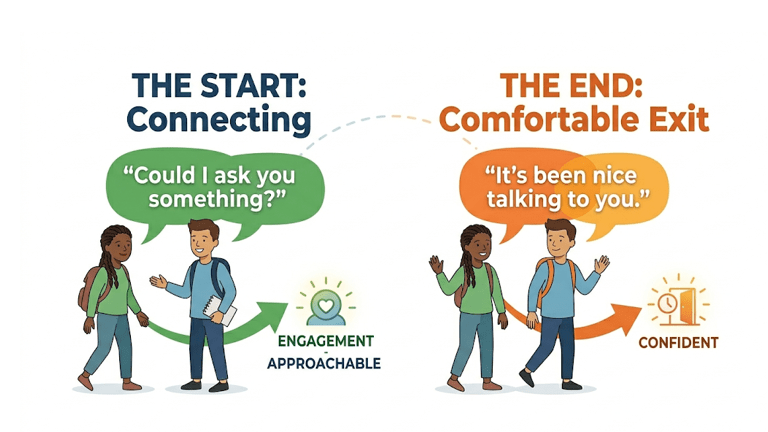
(This posting includes a handout which you are welcome to use with your students.) *
I couldn’t believe what I was seeing, or more accurately, what I was hearing.
One of my shyest students, Eri, sat down next to Liam and said, “I like your backpack.” Liam smiled, opened a secret compartment to show her, and by the time class began, Eri was beaming.
Later, as students were leaving, Anika stopped me and said, “It worked, David!” When I asked what she meant, she told me about waiting at the bus stop the day before. She’d noticed a friendly‑looking older woman and tried something new: “Excuse me. Could I ask you a question?” A short exchange about the Number 8 bus turned into a pleasant conversation about stores at the mall.
I shouldn’t have been surprised. These small but meaningful moments happen often after my students did the activity “Starting and Ending a Conversation.”
Helping students develop this strategy (including a downloadable activity to use with your students).
There are three important parts to make this activity effective:
- Part 1: The Why. The teacher briefly explains how this skill benefits the students.
- Part 2: The How. Students complete fill-in-the-blank exercises to internalize key phrases.
- Part 3: The Doing. Students practice the skill in pairs using structured roles.
More details
Part 1: They Why
Although this activity is very students-centered, I, as the teacher, do have a role: introducing it.
Teacher’s Introduction:
Many students tell me they want to talk to more people in English, but they’re not sure how to start a conversation—or how to end one without feeling uncomfortable. That’s totally normal.
I read about a study that shows this happens to a lot of people. Researchers talked to train passengers in Chicago and asked, “How many people on this train do you think would be willing to talk to you?” Most passengers guessed only about 40%.
Then the researchers asked some of them to try something: during the train ride, start a friendly conversation with a stranger sitting nearby. After the ride, the researchers talked to the passengers. And here’s the surprising part—every single stranger they talked to, 100%, was happy to chat. And the passengers who started the conversations said they enjoyed it much more than they expected.
So today, we’re going to practice some simple expressions that make starting—and ending—a conversation feel much easier.
Part 2: The How
In this part, students interact directly with the key phrases they’ll later use in conversation. Instead of simply reading dialogues—which many students do passively—learners invest in the language by completing short fill‑in‑the‑blank exercises. This helps them internalize the expressions and notice how they function in context.

Once students have interacted with the expressions and seen them in context, they’re ready for the most important stage: using the language in real‑time. Part 3 shifts from controlled practice to structured, communicative pair work.
Part 3: The Doing
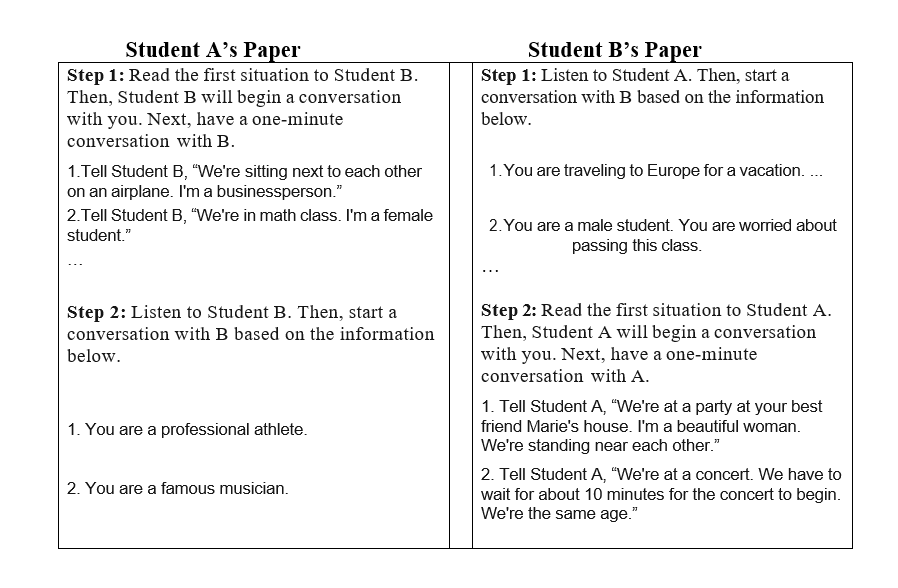
By this point, students are well‑prepared—and often eager—to try the strategy in a structured, communicative format. Students work in pairs, with one student using Student A’s paper and the other using Student B’s paper.
A key feature of this activity is that partners cannot see each other’s papers. This creates a natural need to listen, respond, and negotiate meaning—exactly what we want.
Below is a simplified version of the pair‑work structure:
Part 4 Keeping Everyone Engaged (When Pairs Finish at Different Times)
Teachers often face a familiar dilemma: a few pairs finish early while others are still deeply engaged. Do you stop everyone? Let early finishers sit quietly? Neither option feels ideal.
Part 4 solves this by giving students meaningful, open‑ended discussion questions they can transition into naturally. This keeps the energy in the room positive and productive.
Step 3: Choose a question and ask your partner. Then, have a conversation. Give reactions and ask follow-up questions. Take turns.
–In your culture, do you use these types of starting and ending conversation expressions?
-What famous person would you like to talk to?
…
What I like most about this activity is how quickly it changes the classroom atmosphere. Students who were once hesitant begin taking small risks. They try a new phrase, start a brief exchange, or end a conversation gracefully—and those moments build real confidence. As teachers, we can’t script every interaction our students will have outside class, but we can give them the tools to step into those moments with a little more courage. And when a student turns to you and says, “It worked!” you’re reminded why these small, practical strategies matter.
If you’d like to download the complete activity to use with your students, here is a link 2026 Start_End Conversation CS Unit 22
To download the Teacher’s Guide, which includes introductions to all 27 units, see Conversation Strategies Teacher’s Guide 2026
*About the free-download materials. Over my 40 years of teaching ESL, I was fortunate to work with so many colleagues who were incredibly generous with their time, advice, and materials. Now that I’m in the “Faculty Emeritus” stage of my journey, these downloads are my way of passing that spirit along and paying it forward to you and your students.

