Category Archives: 09 ❖ MOTIVATING ESL STUDENTS AND TEACHERS

These posting include techniques for motivating ESL students and perspectives for motivating teachers.

• Effective and Ineffective Praise of Students for Motivation

(This article was originally published in MET (Modern English Teaching) in the March/April 2026 issue.)  MET website

I realize now that I probably had been making a mistake over the past decade of teaching, according to research.

In my Advanced ESL Writing course, every term, I usually had one or two outstanding writers. I wanted to compliment those students at the end of the course with the hope that it could motivate them and give them a positive attitude going forward. On those students’ final essays, I often wrote. “You are a talented writer.” That was not a good idea. I recently learned why, and also, what kinds of compliments would be better.

Research has shown that complimenting students “appropriately” can motivate them and can strengthen our relationship with them.  However, certain types of compliments can unintentionally cause pressure on them.

In one study, after 117 undergraduates took a verbal reasoning test, they received one of three types of written feedback:

Continue reading

A Six-Word Phrase That Improves Students’ Cooperation

Early in the term, I realized one of the students, Benji, was the type of student who would have trouble following the social norms of the class—such as coming to class on time. I had heard that other teachers had struggled with him, and I could imagine how they approached him. I knew I was going to have to be creative.

One day, there was a loud lawn mower outside out room, so I asked Benji if he could do me a favor and close the window. He smiled, jumped up, closed it and returned to his seat. Then he looked at me and we smiled at each other. From that day on, I noticed Benji becoming much more cooperative, including coming to class on time.

I suddenly realized the power of the phrase, “Could you do me a favor?”

It seems logical that if we do a favor for someone–like lending them a pen–it will make them more likely to reciprocate and do us a favor, for example, make some photocopies for us. However, the Benji experience was the reverse. Psychologists call it the “Benjamin Franklin Effect.” Asking someone for a small, easily fulfilled favor (like borrowing a pen, asking for directions, or opening a window) is often more effective at building a connection than offering to do something for them, which can sometimes feel transactional or overwhelming.

Continue reading

• I Stopped Trying to Catch AI Plagiarism. Here’s What I Do Instead.

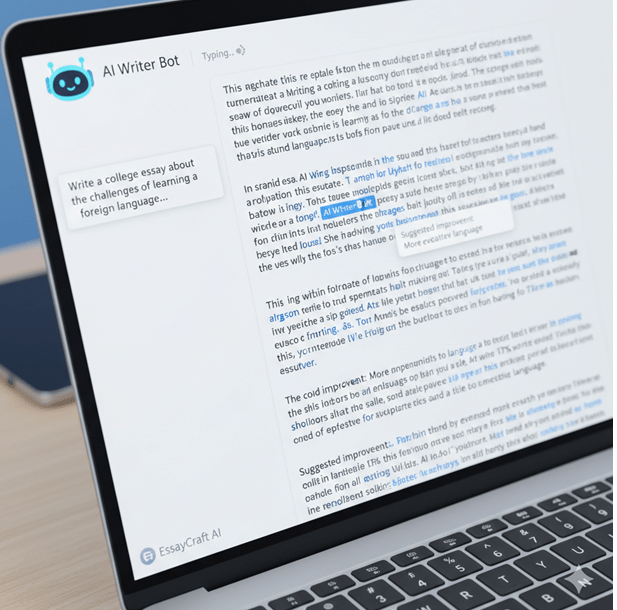
Dealing with students who plagiarize now seems like a piece of cake compared to ones who now use AI to write their papers. I could usually deter students from plagiarizing by demonstrating how easy it is for teachers to find it.

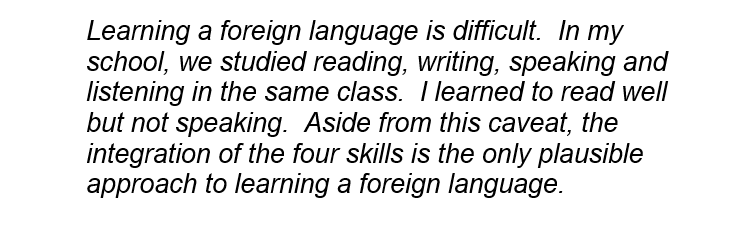
Early in a term, I would show this paragraph that may have been written by a student:

I’d ask them if they thought the writer had copied any of the sentences from a source. Unsurprisingly, they always spotted the last one. It was a clear signal: if a student can identify it, a teacher definitely can.

However, the rise of AI has shattered that approach.

Why the old technique doesn’t work anymore

Now, I can no long claim that it’s easy to find plagiarism using the sentence, “Aside from this caveat….” If a student plugged that into AI, it could come out as, “Even with this problem, I still think that learning the four skills together is the best way to study a foreign language.”

The vocabulary is simpler, the tone is conversational, and it is incredibly difficult to prove the student didn’t write it themselves.

According to reports from NPR and other outlets, many schools are spending thousands of dollars on AI-detection software. Yet, research shows these tools are far from reliable and frequently produce false positives. Few things are more discouraging for students than working hard on a paper and then being accused of not writing it themselves.

The “Incentive” Approach

Continue reading

• Fun Activity To Reduce Irritating Classroom Behavior

(This posting includes a handout which you are welcome to use with your students.)

 (This is a revision to an earlier posting: Enjoyable and Effective Awareness Activity for Changing ESL Students Classroom Behavior)

Most ESL students don’t do goofy things just to irritate the teacher. Usually, they are unaware of how they are coming across or unaware that they are acting differently from the other students or even what is expected of them.  These are some of the habits students tend to bring to our classes:

  • Chronically arriving to class late
  • Chatting with classmate
  • Text messaging during class
  • Not paying attention
  • Not participating in a group
  • Calling out answer before others get a chance
  • Sitting in the back of the room day-dreaming
  • No eye contact to teacher or classmates in a group
  • Speaking own language in a group
  • And more

An effective approach to circumventing these habits is one in which students become aware of the effects these habits have on the teacher and other students. In this post, I’ll explain how programs that I’ve taught in were able to help students see how their behavior is viewed by others. Not only was the process enjoyable for the students, but also, we noticed far fewer students engaging in these behaviors.

Here is how we did it. 

Continue reading