(This posting includes a handout which you are welcome to use with your students. The link is at the end of the post.) *
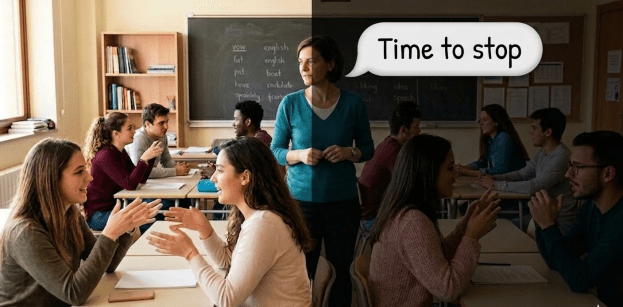
The lights in the classroom are off, but many of the students in pairs continue talking—in the dark!
For most of this class time, students were engaged in a special conversation-skill activity. The class was almost over, so I wanted to get everyone’s attention, “We’ll need to stop in three minutes.” No one seemed to notice me. After three minutes I said that it was time to stop. But hardly anyone flinched. After another three minutes, I turned the lights on and off. Still most continued to talk. So finally, I turned the lights off. Even then in the dark, some pairs continued talking.
This same phenomenon occurs when I’ve presenting this activity at ESL teacher conferences—to NATIVE-ENGLISH SPEAKERS!! Like my ESL students, the teachers continue to talk IN THE DARK!!

One of them even told me after a session, “I wish I could get my husband and son to use this!”
This activity is not only engaging, but it is also developing one of the most important conversation skills. (Below, I’ll attach a link to the activity that you can use to download and use with your students.)
The activity is called, “Using Follow-up Questions.” It’s more than just a language skill; it’s a social superpower. Research even backs this up—people who ask follow-up questions are seen as more likable and better listeners. (See • Want Your Students to Seem More Likeable? Research Says: Teach Them Follow-up Questions)
The activity is very student-centered. However, the teacher does play an important role at the very beginning.
Scaffolding the Exercise
The activity is highly student-centered, but it works best when the teacher sets the stage with a BRIEF introduction as to why the technique they will be practicing is useful.
Teacher’s introduction to the students: “Today, we are going to practice one of the most important conversation techniques. Here is an example of it. Let’s say you looked at my shoes and saw that I was wearing running shoes. So you ask me if I like to run. And I answer you, ‘Yes I do.’ Then you ask me a question about my answer. You ask, ‘How far do you run?’ In other words, you asked me a follow-up question about my answer. We use follow-up questions to talk more deeply about a topic. Also, by doing this, it shows that you are listening and are interested in what others are saying. You will use this technique in all the activities that we do in this class.” (See Conversation Strategies Teacher’s Guide 2026)
1. Fill-in-the-Blanks (Individual Prep)
Next, keeping the activity student-centered, the students individually complete a brief fill-in-the-blank activity which mirrors the type of pair work they will be doing.
2. Pair-Work Practice
Each student is given paper with either Student A (with one set of conversation questions) or Student B (with a different set of conversation questions). After the teacher briefly demonstrates how to do the activity most effectively, students pair up with one A and one B and practice by reading the questions on their paper and asking their own follow-up questions. This moves them from reading a script to active listening. This when it’s difficult for me to get their attention when I want to explain the next step. They don’t want to stop.
3. Customizing the Topics
This next step solves a huge problem that many ESL conversation activities and books have. How to keep the topics relevant. Students are especially interested in talking about current events or current movies or YouTube videos, or school events or even news about their classmates. It would be very hard or impossible for a teacher to know what topics a group of students would be most interested at that very moment. Every term, the topics change depending on what’s going on in the world or their town or even who their classmates are. So this is what we do:
To keep the topics relevant, we we have partners collaborate with their partners to write their own questions about current events, celebrities, or even news about their classmates and school. They then rotate partners and ask each other these new “personalized” questions and ask follow-up questions. Once again, it’s hard to get them to stop when the time is up. They just have so much they want to say and ask.
Here a link to the activity that you can use to download the follow-up question activity that you can use with your students: Follow up Quest from Conversation Strategies 2026
And best of all, this is an update version from the new 4th Edition of Conversation Strategies Conversation Strategies NEW 2026 Edition.
 To see a 7-minute video in which I discuss the amazing impact this technique can have on students in Conversation class, Reading class and even ESL Teacher Training classes, see https://youtu.be/3w0fxsun_bk
David Kehe
Faculty Emeritus
*About the free-download materials. Over my 40 years of teaching ESL, I was fortunate to work with so many colleagues who were incredibly generous with their time, advice, and materials. Now that I’m in the “Faculty Emeritus” stage of my journey, these downloads are my way of passing that spirit along and paying it forward to you and your students.

