
(This article was originally published in MET (Modern English Teaching) in the March/April 2026 issue.) MET website
I realize now that I probably had been making a mistake over the past decade of teaching, according to research.
In my Advanced ESL Writing course, every term, I usually had one or two outstanding writers. I wanted to compliment those students at the end of the course with the hope that it could motivate them and give them a positive attitude going forward. On those students’ final essays, I often wrote. “You are a talented writer.” That was not a good idea. I recently learned why, and also, what kinds of compliments would be better.
Research has shown that complimenting students “appropriately” can motivate them and can strengthen our relationship with them. However, certain types of compliments can unintentionally cause pressure on them.
In one study, after 117 undergraduates took a verbal reasoning test, they received one of three types of written feedback:
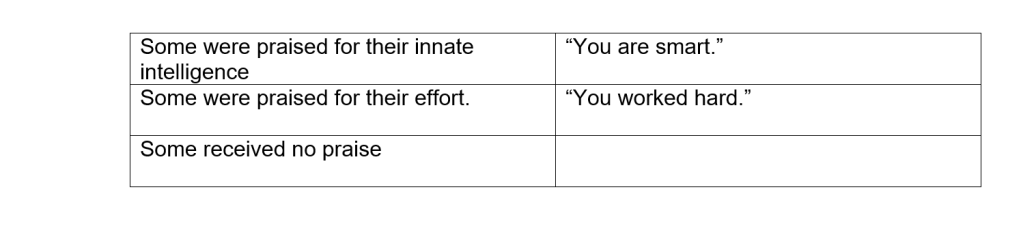
To ascertain the effectiveness of these, the participants were given a follow-up task of working on unsolvable puzzles. The results showed that those who had been praised for their effort showed more determination and stayed engaged. But the group who had been praised for their intelligence gave up sooner, suggesting that they were struggling with self-doubt when they were unable to solve the puzzles quickly. The group who had receive no praise didn’t persist as long as the “effort-praised” group but continued longer than the “intelligence-praised” group.
As we can see, there are effective ways and less effective ways to praise students.
Writing classes. Research shows that it’s most effective to give specific praise. If our goal is to motivate students, then the little extra time to write a few more words can be worth it.
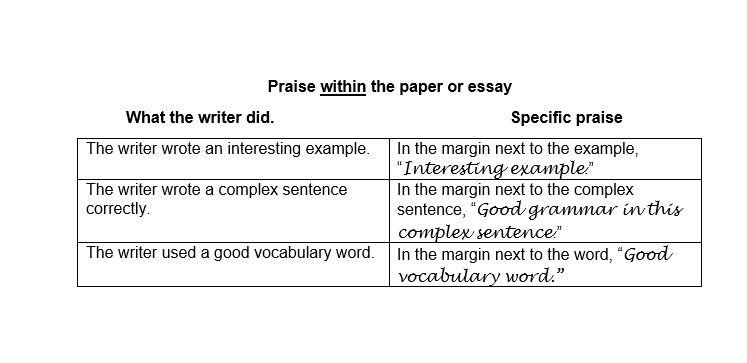
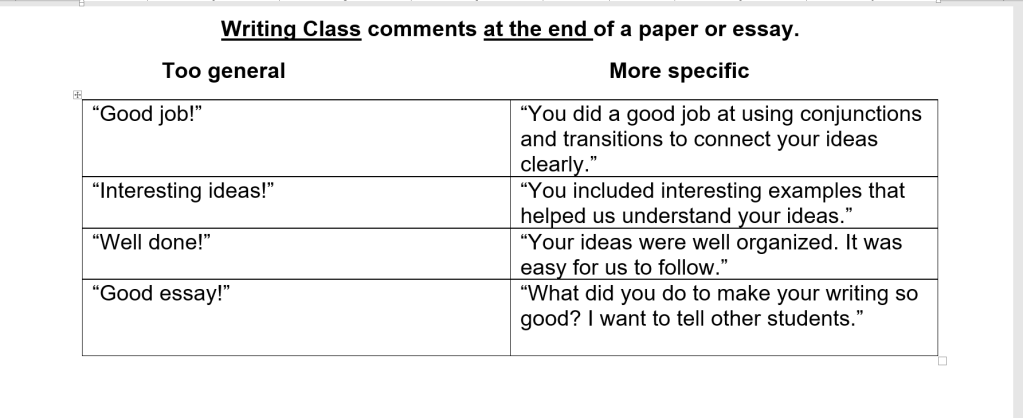
In reality, some teachers don’t have the time to write out comments like those above, especially in large classes. It’s still possible to easily give specific praise.
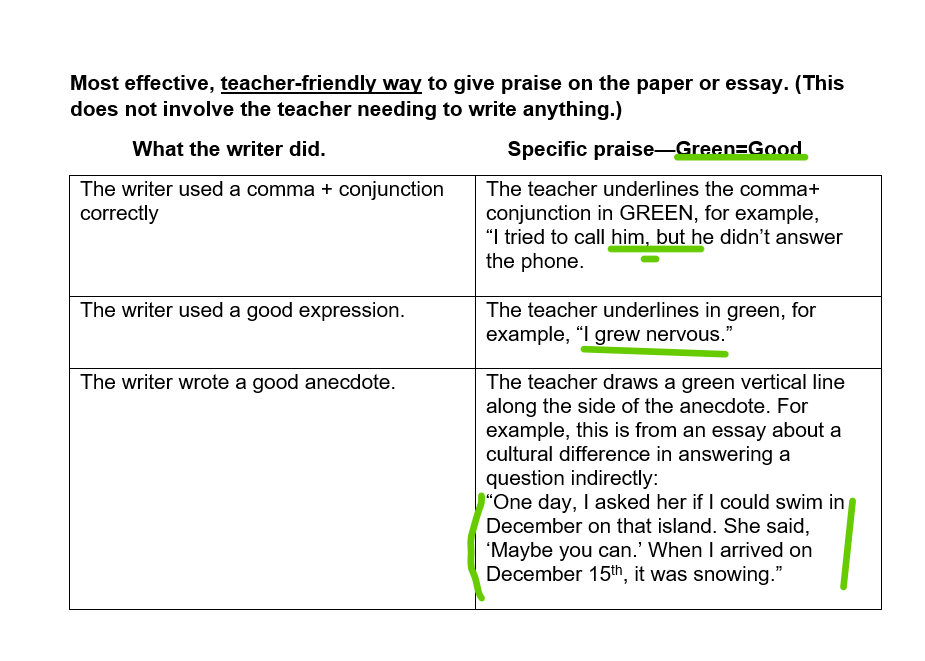
For more about this type of feedback, see • Writing class: Easy, focused, POSITVE feedback on essays. (REVISITED)
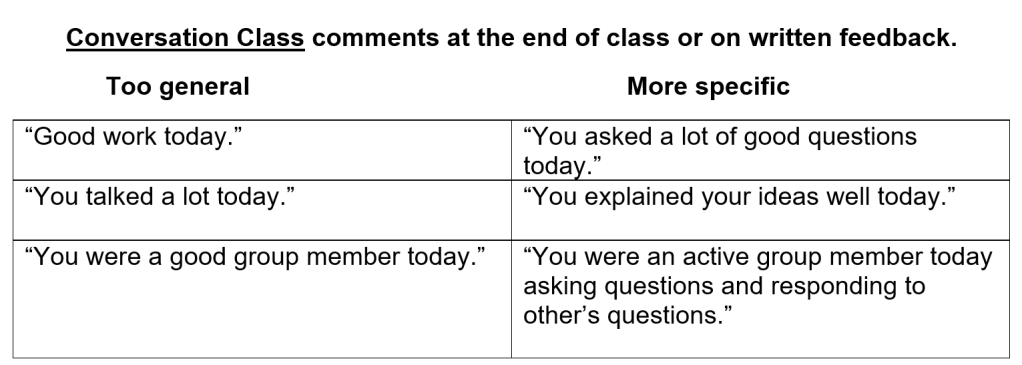
Conversation classes. We can also motivate students in Conversation classes by complimenting them individually at some point during the class or at the end. It’s not necessary to feel like we need to compliment each student every time we compliment one.
The benefits of effective praise
Research shows that praise that focuses on effort enhances motivation. It also has the effect of encouraging students to continue even when a task becomes more challenging. Students tend to be more willing to try to do something new.
It can strengthen the relationship between the teacher and student. In other words, it makes teachers seem more likeable. This is similar to the positive effect of having something in common. (See • Making a Connection With Each Student: Research-Based Technique)
Students tend to be more cooperative, for example, coming to class on time and doing assignments. For example, if a student who is often late comes on time, the teacher can say, “Thank you for coming on time. It really helps me and the other student.”
It can be useful when the student tells the teacher some bad news. For example, a student says, “I’m sorry that I can’t turn in my assignment. Someone stole my backpack with my assignment in it.” The teacher can say, “I hate when something like that happens to a good student like you.”
David Kehe
Faculty Emeritus

