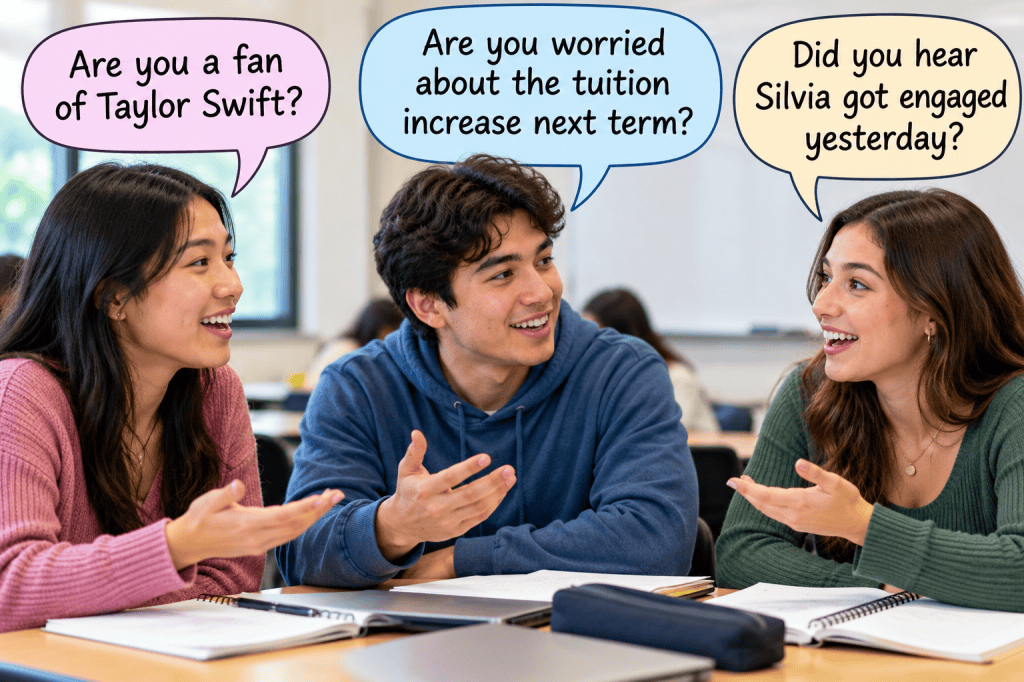
Imagine that you are teaching an ESL Conversation class. It is July 1, 2026. You put students in groups of three and give each member a different list of discussion questions to ask each other while practicing a specific conversation technique.
Which of these questions do you think would be most current, relevant and interesting to answer today, July 1, 2026?
Do you like watching football (soccer)?
Which countries do you hope will be in the World Cup final this month?
Or which of these two would be most current, relevant:
Do you worry about money these days?
Next term, our college’s tuition will increase. Will this be a problem for you?
Or which of these two would be most current, relevant:
What is the best age to get married?
Did you hear that our classmate, Silvia, got engaged yesterday?
Obviously, the most current and relevant questions today would not be very interesting for students the very next term.
Here is the challenge: We want items to be current and most relevant, but we also want to be able to reuse the handouts every term without have to always update them.
Here is the good news: We can have both—no added workload and still have relevancy.
Here is how we can do that.
To illustrate, we’ll look at an activity designed to practice responding to someone with some details. The technique involves responding to a question with and, but, so, because or two sentences. These are the steps leading to the goal here of talking about current and relevant topics.
Step 1: Model the technique.
Step 2: Practice the technique with general topics items in pairs.
Step 3: Continue practicing with current and relevant topics in new in groups of three.
Step 1: Model the technique
This is a simple individualized exercise. Students fill the blanks of short dialogs that mirror the practice in Steps 2 and 3.
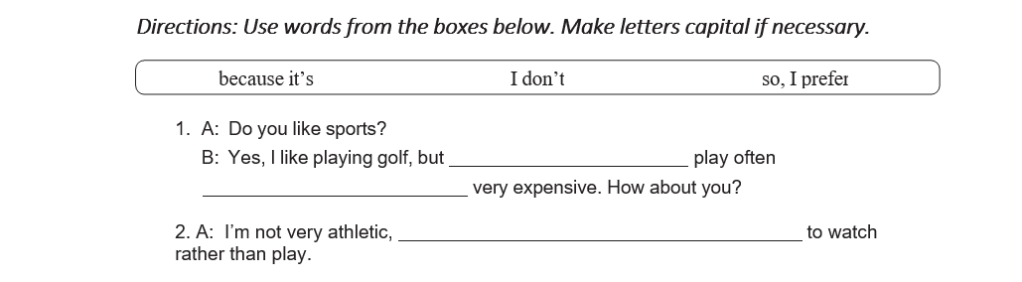
Step 2: Practice the technique with general topics items in pairs.
Notice, these questions are designed for practice. They are not customized. That will happened after they’ve practiced the strategy here.
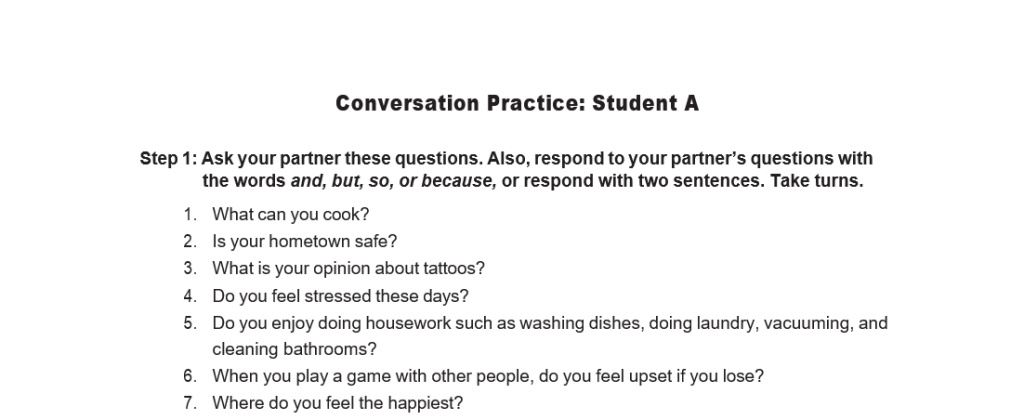
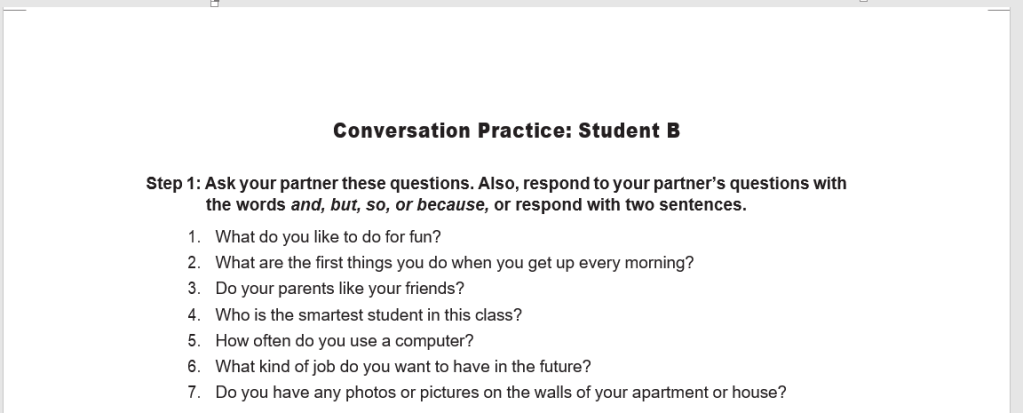
During this step, in addition to answering with details, we encourage them to ask follow-up questions to extend the conversations even more.
(See Conversation magic: Two most important conversation techniques (Part 2)
Step 2: Personalize the questions.
In this step, the partners in each group write a set of questions together about any topics. This is how the activity becomes current, relevant and personalized for the students without any added work for the teacher.

Here are some recent samples of what students have written.
- Have you seen Spider-Man: Brand New Day?
- Do you plan to attend the international talent show on campus tomorrow?
- Do your parents treat you like a friend?
- Are you worried about the heat wave that is supposed to come next week?
- Which of our classmates is the funniest: Steve, Danica, Malia or Lars?
It’s recommended that the teacher briefly look over the questions to make sure that they are appropriate before doing the next step. Then, each of the partners make a copy of the questions.
Step 3: Continue practicing with current and relevant topics in new groups of three.
In this step, the students form new groups of three or four. They ask their questions and respond to their partners with some details, just as they did in Step 2.

It is during this step that students’ focus seems to increase as they become curious not only about what questions their classmates have written but also about how their partners will answer theirs. Also, the volume of their voices tends to rise, and we can hear a lot of laughing.
This activity comes the new (4th) edition of Conversation Strategies. (See Conversation Strategies Kehe 2026 Edition )
To see the complete activity, see Responding with Details from Conversation Strategies
For samples of activities that include this personalized approach that you can use with your students, see:
Making the Perfect Mixture of Structure and Autonomy in Conversation Activities (Customizing Exercises) )
Customized Speaking/Listening “Game” (Actually, more than just a game.)
Conversation Technique: Don’t Kill the Conversation. What to Say When You Don’t Know What to Say.
Want Your Students to Seem More Likeable? Research Says: Teach Them Follow-up Questions
David Kehe
Faculty Emeritus
*About the free-download materials. During my 40 years of teaching ESL, I have had many colleagues who were very generous with their time, advice and materials. These downloads are my way of paying it forward.

