Category Archives: 02 ❖ ESL CONVERSATION & DISCUSSION

These postings include conversation activities, teaching techniques, strategies for groupings and evaluations.

• Teacher-Friendly Technique to Keep Conversation Items Current, Relevant and Personalized for Students

Imagine that you are teaching an ESL Conversation class. It is July 1, 2026. You put students in groups of three and give each member a different list of discussion questions to ask each other while practicing a specific conversation technique.

Obviously, the most current and relevant questions today would not be very interesting for students the very next term.

Here is the challenge: We want items to be current and most relevant, but we also want to be able to reuse the handouts every term without have to always update them.

Here is the good news: We can have both—no added workload and still have relevancy.

Here is how we can do that.

Continue reading →

• Effective and Ineffective Praise of Students for Motivation

(This article was originally published in MET (Modern English Teaching) in the March/April 2026 issue.)  MET website

I realize now that I probably had been making a mistake over the past decade of teaching, according to research.

In my Advanced ESL Writing course, every term, I usually had one or two outstanding writers. I wanted to compliment those students at the end of the course with the hope that it could motivate them and give them a positive attitude going forward. On those students’ final essays, I often wrote. “You are a talented writer.” That was not a good idea. I recently learned why, and also, what kinds of compliments would be better.

Research has shown that complimenting students “appropriately” can motivate them and can strengthen our relationship with them.  However, certain types of compliments can unintentionally cause pressure on them.

In one study, after 117 undergraduates took a verbal reasoning test, they received one of three types of written feedback:

Continue reading →

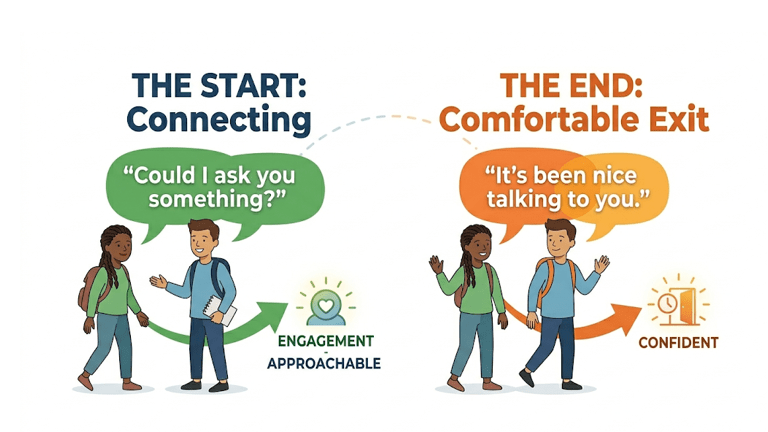
• “It Worked, David!” — A Practical Strategy for Starting and Ending Conversations (Updated for 2026)


(This posting includes a handout which you are welcome to use with your students.) *

Later, as students were leaving, Anika stopped me and said, “It worked, David!” When I asked what she meant, she told me about waiting at the bus stop the day before. She’d noticed a friendly‑looking older woman and tried something new: “Excuse me. Could I ask you a question?” A short exchange about the Number 8 bus turned into a pleasant conversation about stores at the mall.

Helping students develop this strategy (including a downloadable activity to use with your students).

Continue reading →

• Entering a Lesson with Predictions (Part 2: Pre-Discussion Activities) (Updated)

Cover pre speaking Pt 2 slide

(This article was originally published in MET (Modern English Teaching) in Spring 1986.)  MET website

In Part 1 ( • Entering a Lesson with Predictions (Part 1: Pre-Listening Activities) , I introduced how we can help student to focus on a particular day’s materials and to become personally involved in its content. We can do it through a “prediction process.” I also described two prediction activities as entries to listening activities.

In this Part 2, I’ll share two sets of “prediction activities” as entries to speaking/discussion activities. In the first one, the prediction activity is indirectly related to the speaking activity. In the second one, it is directly related to what they will be discussing in their groups.

Example of predictions as an indirectly-related “entry” to a speaking activity

Lesson plan:  The students were going to have group discussions about “fun.”

Prediction procedure (which preceded the discussion.) I found online a ranking of the 10 most fun countries in the world.

Step 1: A list of 10 countries in alphabetical order was given to each student. They then individually predicted the ranking of each one according to how fun the online survey found.  Next, they formed groups of three or four and shared their guesses (predictions) with the group members.

Step 2: The teacher read the rankings, as they had been listed in the online source. Students jotted the answers on their lists.

Step 3: Still in their groups, they compared how well they had predicted.

Step 4: The students then formed new groups of three or four. The students were given a list of discussion questions about “fun.” For example
1) Did you have fun last weekend
2) When you were a child, what did you do that was fun?
3) Do you think computers are fun?
4) Is there a country or city you want to go to for fun?
etc.

Observation: Even though the ranking of fun countries had no direct bearing on the discussion that followed, students appeared to automatically think broadly about the topic of fun.

Example of predictions as a directly- related “entry” to a speaking activity

Continue reading →