Category Archives: *ESL CONVERSATION & DISCUSSION TECHNIQUES

These postings include conversation activities, teaching techniques, strategies for groupings and evaluations.

• Helping Students Overcome Hesitancy to Volunteer an Answer in Group Discussions

Cover Vol shot

(This posting includes a handout which you are welcome to use with your students.)*

One day, I ran into an exasperated-looking colleague in the copy room at our school. She had just come from her ESL class in which she wanted to check some homework whole class. To do this, she asked, “What is the answer to Question 1?” Then she waited for someone to volunteer to answer, but nobody would.

Many of us ESL teachers have been in similar situations, especially with East Asian students. In his book, Behave, neuroendocrinology Robert Sapolsky gives a possible explanation for this by describing “… the archetypical experience of American Peace Corps teachers in [East Asian] countries—pose your students a math question, and no one will volunteer the correct answer because they don’t want to stand out and shame their classmates.”

[For more about the reasons for the differences among students from different cultures, see Best Subject for an ESL Integrated-Skills Class (Part 1 Overview)]

Needless to say, it’s not just East Asian students who are reluctant to volunteer answers. Students from other parts of the world who are basically shy or lack confidence in their speaking skills may also be hesitant.

Most of us would agree that a willingness to volunteer an answer during group discussions carries some great benefits in helping students take advantage of speaking opportunities. Once they become comfortable with this skill, there is often a carry-over effect in which they tend to be more will to volunteer in whole class situations. Also, perhaps more importantly, I’ve noticed an increase in students’ willingness to initiate a conversation with me before or after class and to ask for help on assignments and not just wait for me to offer.

How to help students feel comfortable volunteering an answer

Continue reading

• LINCS Discussion about Student-Centered Conversation Lessons.

Cover revised post discussion

Cover for Blog posting day 1

If you’d like to read the discussion about teaching conversation skills on LINCS, in which I was “interviewed” through posted Q & A for Dec. 6-9, here is the link: LINCS discussion about student-centered conversation lesson. 

David Kehe

• Starting and Ending a Conversation (Includes a Group Mixer Activity)

Cover Lrg start conv shot

(This posting includes a POWERPOINT presentation and HANDOUTS which you are welcome to use with your students.)*

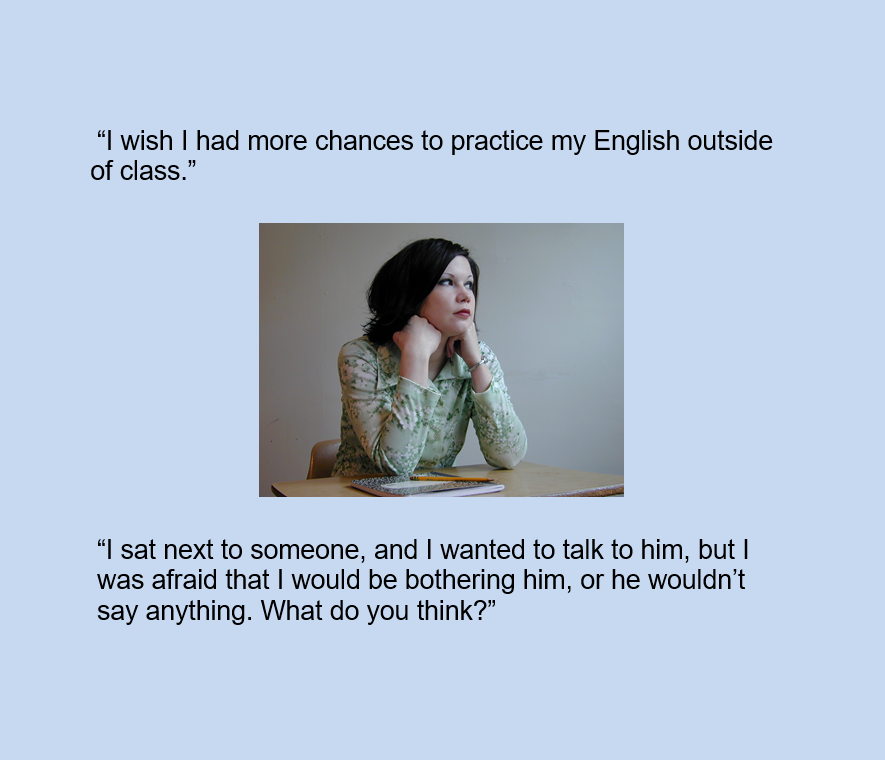
“I wish I had more chances to practice my English outside of class.”

“How can I meet some native-English speakers?”

“I went to a party last weekend. There were about 20 people there, but nobody seemed to want to talk to me. I just kind of stood in the corner looking at my cell phone. Why didn’t anyone talk to me?”

“I sat next to someone, and I wanted to talk to him, but I was afraid that I would be bothering him, or he wouldn’t say anything. What do you think?”

I’ve been asked these types of questions frequently by my students.  Naturally, some of them were low-level students with little confidence in their skills, but surprisingly, often more fluent ones also asked me for advice.

For students from some cultures, starting a conversation with someone they don’t know might be a new concept to them. (See Best Subject for an ESL Integrated-Skills Class (Part 2 of 4: Reading aspect) 

Exercises for starting-a-conversation skills Continue reading

• Stimulating Small-Group Discussion Activity 9: Comparing Life in Cultures with Strict Rules and Ones with Easy-Going Rules

Cover read for discussion SHOT

(This posting includes a handout which you are welcome to use with your students.)

 Some reasons why students seemed stimulated by this discussion:

1) They seemed interested in comparing the social rules in their countries and what happens to people who break them.

2) They had stimulating discussions how safe their hometowns were.

3) They were surprised by how tight or loose their classmates’ hometown and family rules were.

4) They enjoyed comparing how much or how little contact they had with people who were different from them (e.g. different race, religion, sexual orientation) and how open their neighbors would be to having them live next to them.

Here is the basis for this discussion: According to research, countries can be categorized as relatively tight or loose. Tight cultures, with stricter rules, tend to be safer more orderly, whereas, loose cultures tend to be more creative and more accepting of people who are different. After reading about the characteristics of different cultures, students compare their experiences and share their opinions about life in tight and loose cultures.

This and future discussion activities include four parts:

1) A one-page article usually including a brief summary of a high-interest research study.
2) Ten true-false comprehension questions.
3) Pre-Discussion Exercise in which students read and think about several questions about their experience and opinions about the topic before discussing them in groups.
4) Small-group discussions of the article in which each student is given a paper with different content/personal experience questions in the form of Student A, B or C.

About Discussion Activity 9: Comparing Life in Cultures with Strict Rules and Ones with Easy-Going Rules and the handout.

Continue reading