• ESL Students Can Increase Positive Emotions in Readers/Teachers with This Writing Technique

smiling teacher

(This posting includes a handout which you are welcome to use with your students.)

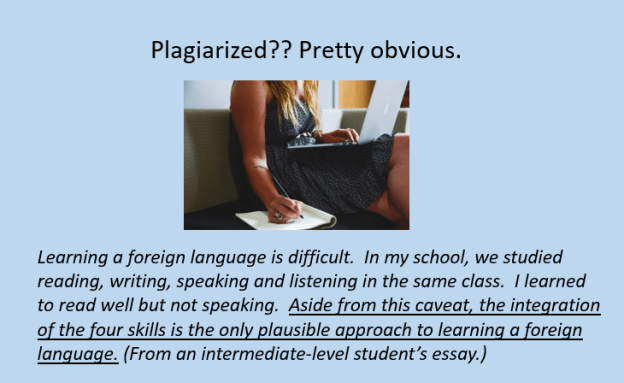
After reading Curry’s essays, I often came away feeling especially good. This kind of surprised me because she wasn’t among the top writers in my class. Her grammar tended to breakdown at times, and her sentence style could be a bit simple. And yet, there was something special about her papers.

Continue reading

• 9th Free Reading Unit.  Surprising Research About How Friendships Are Made.

Cover proximity shot

(This posting includes handouts which you are welcome to use with your students.)

See  Reading Units: Reading for Insights (Introduction)  for an introduction to these reading units.

Article & Study Guide for Proximity: The Most Important Factor in Making a Friendship is How Close You Are Physically (and excerpts)

Continue reading

• DON’T Teach This as an ESL Speaking Skill

Reduced Forms 2 Cover shot

(This posting includes a handout which you are welcome to use with your students and a link to a video.) *

In the video, I explain how ESL teachers can best help their students deal with reduced forms of speech. Some examples of reduced forms are
• whaddya (what are you)
• gonna (going to)
• din (didn’t)
• isn (isn’t)
•  cha > / t / + you) > I want you to start now.

It’s vital that we help students UNDERSTAND what OTHER PEOPLE are saying when they use these, but it’s COUNTER-PRODUCTIVE to tell students to use these when they speak.

The link to the video and two handout-activities

Continue reading

• Getting The Most Out of Information-Gap Chart Activities PART 2 (Vocabulary Reinforcement)

Cover info gap 2 shot

(This posting includes a handout which you are welcome to use with your students.)

You can see my video discussing Part 1 & Part 2 here: VIDEO Getting The Most Out of ESL Information-Gap Activities: Six Recommendations

I have found these information-gap chart pair-activities to be a great go-to interactive activity when I’d like to review and reinforce vocabulary words and conversation strategies. And best of all, they are quite easy to make and customize.

In my previous posting, PART 1, I shared a chart in which the categories were:

Relationship         Personality         Birth Year

Cover Info Part 1 shot

See • Getting The Most Out of Information-Gap Chart Activities PART 1

I had made that one because I wanted to review vocabulary for relationships like cousin, nephew, niece, and aunt, and for personalities like serious, cool, and funny.  Later in the course after students had developed more vocabulary, I revised the chart to so that they could review:

Slide 1 less familiar

I’ve also made charts that included some of these categories:

Slide 2 categories

Here are two sites that have been helpful for the vocabulary in these categories:

Continue reading