Category Archives: • During Class

• The Most Effective Classroom Organization for Reading Skills Development (Student-Centered)

Reading book

Here is what seems to be some well-kept secrets about reading classes.  The teacher doesn’t have to be the center of attention.  The teacher doesn’t have to “act” like a teacher, standing up front talking.

And most of all, students will not be bored or waste time if they are reading individually during class.

What students need from the reading teacher is someone who can help each individual student develop their reading comprehension skills.  A student doesn’t need to listen to a teacher explain to the class parts of a passage he/she already understands but that a classmate doesn’t.

Students can get the maximum benefits from a reading class and from a reading teacher through a reading workshop.  This student-centered workshop approach has proven effective at all levels and with students from over 40 countries.

One of the greatest advantages is that each student’s individual needs are addressed by the teacher during the class.  Another advantage is that students are working on reading by actually reading.  Also, they don’t have to wait for classmates to finish reading a passage or feel pressure to read faster to keep up with them.
Here is how a Reading Workshop can be effectively organized.

Continue reading

• For Large-Class Conversation Instructors, You Can “See” if Students are Using Techniques

Cover seeing shot

(This posting includes a handout which you are welcome to use with your students.)

You,the conversation teacher, are happy because the noise level in the room is high.  That means that the 12 pairs of students (24 total) are engaged in the conversation activity.   At the start of the next class, you want to give them feedback on their performance today, especially because you want to give positive comments to those who are very active.  There are also a couple of pairs who need some “re-direction.”

Needless to say, you’re not going to be able to give each student specific feedback specifically on what they said because you can’t actually hear them above all the talking.  But you can actually see whether or not they are using conversational techniques.

(See previous posts of two important techniques Conversation magic: Two most important conversation techniques (Part 1) and Conversation magic: Two most important techniques. (Part 2)

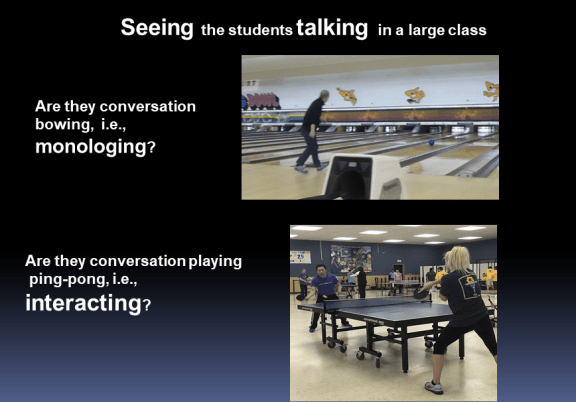
Even if you can’t hear them, you can see if they are engaging in a natural conversation; it looks like ping-pong, in which they are reacting to each other, asking follow-up questions and giving understanding responses.  You can also see if they are more like bowling, in which one monologs for a while while the other “zones out,” then the other monologs.  You can see if someone is dominating and if someone is very passive.  Interestingly, you can even see if they have switch from English to their native language; often when they do this, their voices lower and their faces aren’t as animated perhaps to “hide” from the instructor.

If you suspect that a pair isn’t using natural conversation techniques or isn’t speaking in English, there are things that you can do.

Continue reading

• Advice to a Student Who Needs to Repeat a Course (Using Peer Examples)

Advice to Ze failing course COVER shot

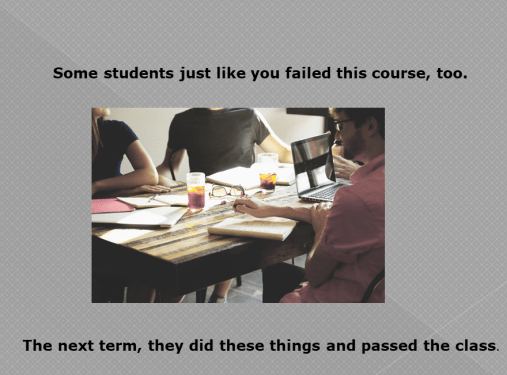
He was making bad decisions all term long, which resulted in failing the course.  In order for Edward to pass my advanced academic ESL course and move on to English Comp, he would need to repeat the course.  He would also need to change his habits such as coming late and forgetting assignments or doing them with little effort.

After he found out that he failed, I emailed him to let him know that I could give him advice about how he could pass next time.  To my surprise, he asked for it.

My first impulse was to make a list of all the things that he needed to change in his study habits.  Then I realized that there was a more positive approach that I could take to giving this advice.

I have found that students seem to be more affected by what other students do in a class than what an instructor tells them to do.

Continue reading

• ESL Teaching: Giving Your Course Credibility In The Eyes Of Your Students

Credibility cover shot

Motivating Tool

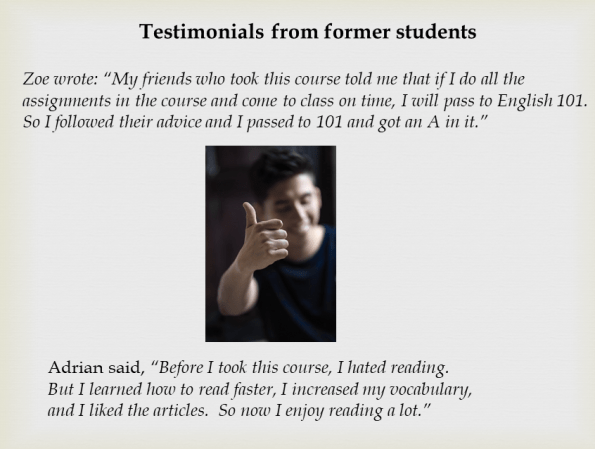
A very powerful tool for motivating your students is their belief that your course will help them develop their skills.  Just giving them a syllabus at the start of a term with a list of goals for the course seems to have little effect on the level of confidence students will have.  However, testimonies by previous students (your students’ peers) about how much your course has helped them can give your course a great deal of credibility.

Continue reading