Category Archives: *ESL CONVERSATION & DISCUSSION TECHNIQUES

These postings include conversation activities, teaching techniques, strategies for groupings and evaluations.

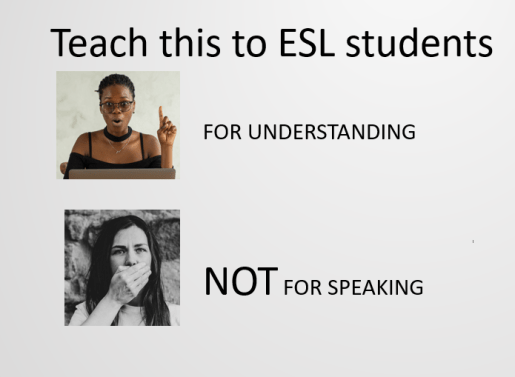
• DON’T Teach This as an ESL Speaking Skill

Reduced Forms 2 Cover shot

(This posting includes a handout which you are welcome to use with your students and a link to a video.) *

In the video, I explain how ESL teachers can best help their students deal with reduced forms of speech. Some examples of reduced forms are
• whaddya (what are you)
• gonna (going to)
• din (didn’t)
• isn (isn’t)
•  cha > / t / + you) > I want you to start now.

It’s vital that we help students UNDERSTAND what OTHER PEOPLE are saying when they use these, but it’s COUNTER-PRODUCTIVE to tell students to use these when they speak.

The link to the video and two handout-activities

Continue reading

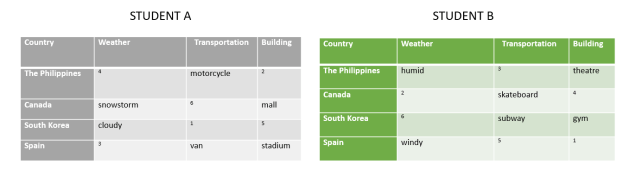
• Getting The Most Out of Information-Gap Chart Activities PART 2 (Vocabulary Reinforcement)

Cover info gap 2 shot

(This posting includes a handout which you are welcome to use with your students.)

You can see my video discussing Part 1 & Part 2 here: VIDEO Getting The Most Out of ESL Information-Gap Activities: Six Recommendations

I have found these information-gap chart pair-activities to be a great go-to interactive activity when I’d like to review and reinforce vocabulary words and conversation strategies. And best of all, they are quite easy to make and customize.

In my previous posting, PART 1, I shared a chart in which the categories were:

Relationship         Personality         Birth Year
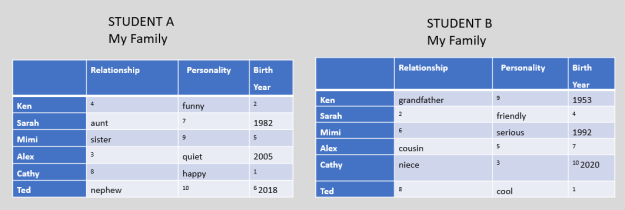
Cover Info Part 1 shot

See • Getting The Most Out of Information-Gap Chart Activities PART 1

I had made that one because I wanted to review vocabulary for relationships like cousin, nephew, niece, and aunt, and for personalities like serious, cool, and funny.  Later in the course after students had developed more vocabulary, I revised the chart to so that they could review:

Slide 1 less familiar

I’ve also made charts that included some of these categories:
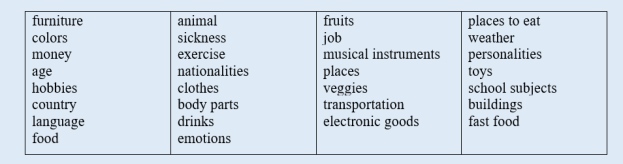
Slide 2 categories

Here are two sites that have been helpful for the vocabulary in these categories:

Continue reading

• Getting The Most Out of Information-Gap Chart Activities PART 1

Cover info Part 1 shot

(This posting includes a handout which you are welcome to use with your students.)

You can see my video discussing Part 1 & Part 2 here: VIDEO Getting The Most Out of ESL Information-Gap Activities: Six Recommendations

At first glance, these activities can appear to be just a fun way for students to interact with each other. However, the more I’ve worked with and developed them, the more I realize what an effective skill-building tool they can be.

For this PART 1 posting, I’ll…
1) briefly review what an information gap activity is.
2) describe three important ways to make these most effective for students and the mistakes that teachers sometimes make with these.

In my next posting, PART 2, I’LL …
3) explain ways to customize them to review and reinforce vocabulary words and conversation strategies.
4) include more samples of these types of information-gap activities.

Here is an example of an information gap activity and a common mistake teachers make with them.

Continue reading

• Creating Positive Tension during Group Work

Cover tension in group work

 I’ve gained important perspectives from students over the years. The following insight was shared with me by a student after a group-work activity, and it altered how I organized groups.

Typically, during my first year of teaching ESL, when I wanted students to get with a partner or form groups of three or four, I instructed them to do that and let them choose whomever they wanted to work with. However, early in my second year, this happened.

Continue reading