
(This posting includes a handout which you are welcome to use with your students.)
(This is a revision to an earlier posting: Enjoyable and Effective Awareness Activity for Changing ESL Students Classroom Behavior)
Most ESL students don’t do goofy things just to irritate the teacher. Usually, they are unaware of how they are coming across or unaware that they are acting differently from the other students or even what is expected of them. These are some of the habits students tend to bring to our classes:
- Chronically arriving to class late
- Chatting with classmate
- Text messaging during class
- Not paying attention
- Not participating in a group
- Calling out answer before others get a chance
- Sitting in the back of the room day-dreaming
- No eye contact to teacher or classmates in a group
- Speaking own language in a group
- And more
An effective approach to circumventing these habits is one in which students become aware of the effects these habits have on the teacher and other students. In this post, I’ll explain how programs that I’ve taught in were able to help students see how their behavior is viewed by others. Not only was the process enjoyable for the students, but also, we noticed far fewer students engaging in these behaviors.
Here is how we did it.
It involves short skits.
Location: In the auditorium or large room where the new-student orientation or a student workshop was being conducted
Stage: The “stage” is set up like a classroom with about 6-10 chair/desks in two or three rows facing a teacher’s table/desk.
Actors: About 6-10 “continuing” students and a teacher and a teacher-director. (We often invite some “continuing” students or ask for volunteers.)
How much time: About 2-5 minutes per skit and comments. Depending on how much time is available, we usually do between 5 and 10 skits.
Procedure:
We start with the director giving this short introduction: We are going to present a skit taking place in a classroom. You will see how students’ behavior in the class can make it difficult for other students to learn and for the teacher to teach a lesson. During the skits, I’ll hold up this sign (“What’s the problem?”) On your handout, you will (write) choose the correct answer.
Two examples:

For 11 skits that you can print out, see SKITS WORKSHOP DIRECTIONS
Preparation
In general, the preparation time for these skits is surprisingly short.
- A few weeks prior to the presentations, we send out a memo to the teachers soliciting suggestions for “problems.” (For a sample memo, see Skits Memo Requests . For a list of suggestions, see Irritation List .) This memo also includes a request for “continuing students” to be the actors. (As an alternative, instead of students as the actors, teachers can play these “student” roles.)
- After the problems have been decided, the students who volunteer meet with the teacher-actor and the teacher-director, decide who will play which roles and then rehearse (Ad lib). In other words, we don’t write out a complete script. It usually only takes about 45 minutes to do this and often includes a lot of laughing. We’ve always found it to be creative and good bonding exercises.
Options for “What’s the problem?” handouts (See this attachments for templates that you can use: What’s the Problem_ Sample forms for students )
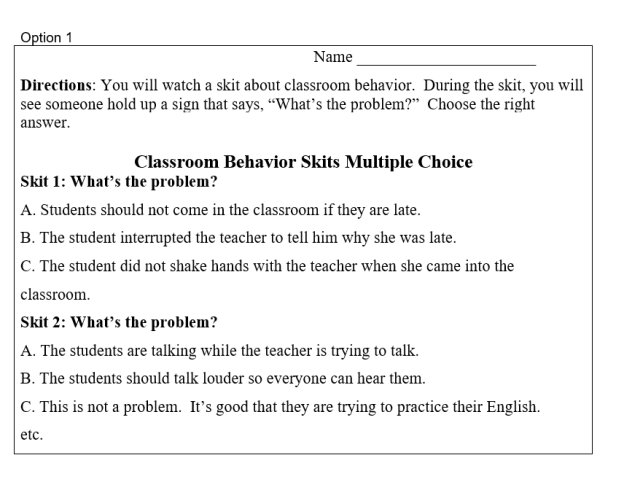
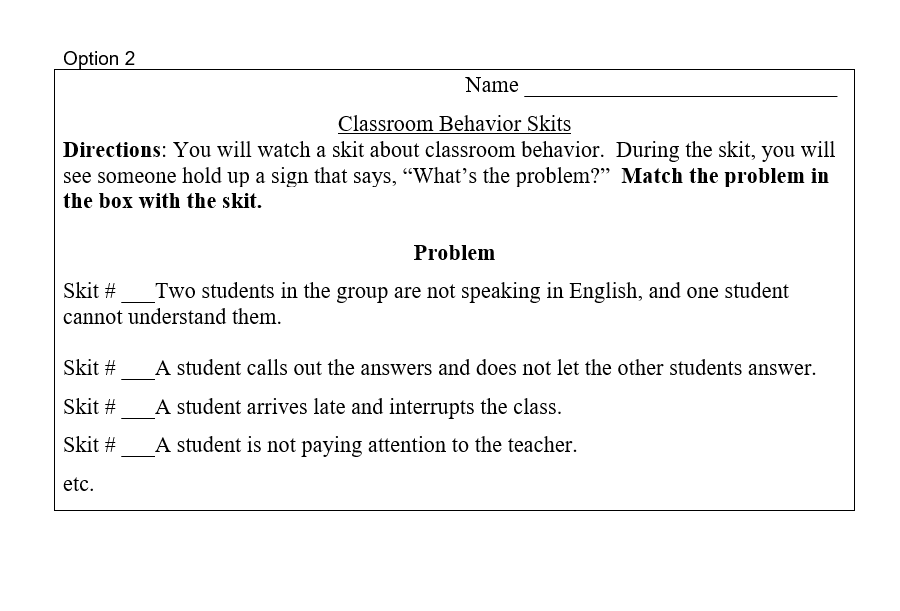
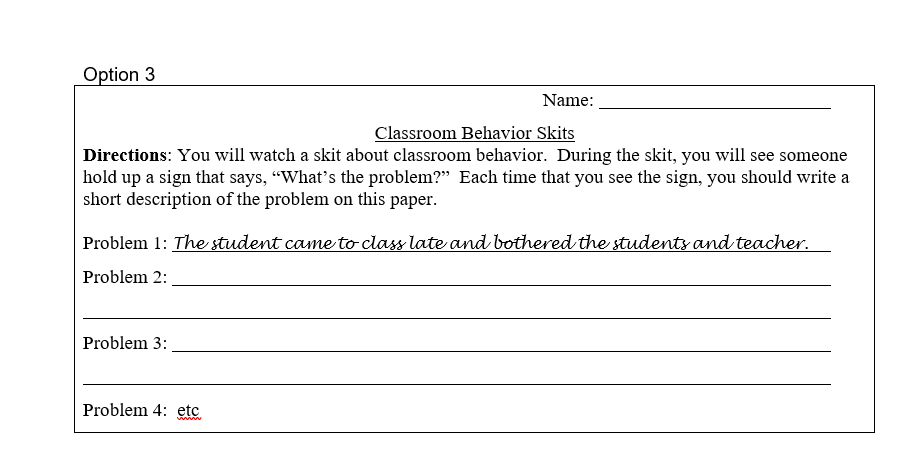
For more ideas about classroom management, see Most Important Tool for Classroom Management (First Case) and Most Important Tool for Classroom Management (Case two and Caveat)
David Kehe
Faculty Emeritus
*About the free-download materials. During my 40 years of teaching ESL, I have had many colleagues who were very generous with their time, advice and materials. These downloads are my way of paying it forward.
 Common Sense Teaching ESL