Tag Archives: handouts

• LINCS Discussion about Grammar (Handout Exercises)

LINCS logo

You don’t have to be a grammar expert to help your students with the grammar in their writing.

During the week of Jan. 15-19, 2018, each day, I was interviewed online at LINCS about teaching grammar. 

You can read the discussion at this link:  LINCS discussion about grammar

The topics were:
Jan. 15: Inductive teaching
Jan. 16: Importance of grammar terminology
Jan. 17: Ear-learners
Jan. 18: Leading students to finding grammar mistakes
Jan. 19: The connection between reading and learning grammar

Each day, I mentioned handout exercises related to that days topic, and I made these available in this posting below.

To see the handouts and read more information about the topics, please read below.
Continue reading

• Want Your Students to Seem More Likeable? Research Says: Teach Them Follow-up Questions

Likeable

(This posting includes a handout which you are welcome to use with your students.) ,*

This could be one of the most useful researched-backed techniques that your students can learn.  If they want to make a positive impression on others during a conversation, they should ask a lot of questions, especially a lot of follow-up questions.

Karen Huang and her research team at the Harvard Business School analyzed more than 300 online and face-to-face conversations between people getting to know each other.  In one study, participants engaged in a 15-minute conversation with a randomly assigned person.  Some of the participants were told to ask many questions (at least nine) and others were told to ask few questions (less than four).  After the conversations ended, the participants told the researchers how much they liked their conversation partner.  The results showed that the people who asked more follow-up questions were considered more likeable.

A second study and activity for students continues below.

Continue reading

• Most Effective Technique for Marking Grammar on Essays to Develop Self-Editing Skills

Cover codes in margin shot

(This posting includes a handout which you are welcome to use with your students.)*

Because this technique gives students a chance to discover their grammar errors, we have found students have greatly improved their self-editing skills.  And self-editing skills will be of great value to them as move beyond ESL courses.

Here is a description of the technique along with a handout exercise that will introduce students to it.

Continue reading

• For Large-Class Conversation Instructors, You Can “See” if Students are Using Techniques

Cover seeing shot

(This posting includes a handout which you are welcome to use with your students.)

You,the conversation teacher, are happy because the noise level in the room is high.  That means that the 12 pairs of students (24 total) are engaged in the conversation activity.   At the start of the next class, you want to give them feedback on their performance today, especially because you want to give positive comments to those who are very active.  There are also a couple of pairs who need some “re-direction.”

Needless to say, you’re not going to be able to give each student specific feedback specifically on what they said because you can’t actually hear them above all the talking.  But you can actually see whether or not they are using conversational techniques.

(See previous posts of two important techniques Conversation magic: Two most important conversation techniques (Part 1) and Conversation magic: Two most important techniques. (Part 2)

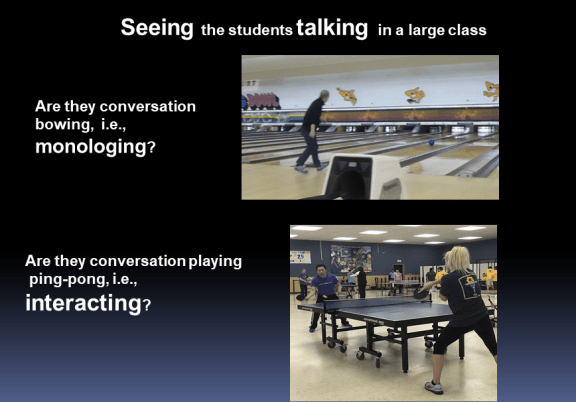
Even if you can’t hear them, you can see if they are engaging in a natural conversation; it looks like ping-pong, in which they are reacting to each other, asking follow-up questions and giving understanding responses.  You can also see if they are more like bowling, in which one monologs for a while while the other “zones out,” then the other monologs.  You can see if someone is dominating and if someone is very passive.  Interestingly, you can even see if they have switch from English to their native language; often when they do this, their voices lower and their faces aren’t as animated perhaps to “hide” from the instructor.

If you suspect that a pair isn’t using natural conversation techniques or isn’t speaking in English, there are things that you can do.

Continue reading