Tag Archives: handouts

• Stimulating Small-Group Discussion Activity 5: Who Affects Us More: Parents or Peers?

Cover read for discussion SHOT

(This posting includes a handout which you are welcome to use with your students.)*

Some reasons why students seemed stimulated by this discussion:

1) Before reading this article, many students just assumed that parents affected us more than peers.

2) They seemed interested to hear about the relationship their classmates had with their parents and peers when they were younger.

3) They were surprised by the findings of the research in the article about how peers affect each other.

4) They enjoyed comparing, agreeing and disagreeing with their classmates about this controversial topic.

Here is the basis for this discussion: psychologist Judith Harris, in her book The Nurturing Assumption, discusses research which she believes shows that our actions, beliefs and preferences are influenced more by our peer than by our parents.

This and future discussion activities include four parts:

1) A one-page article usually including a brief summary of a high-interest research study.

2) Ten true-false comprehension questions.

3) Pre-Discussion Exercise in which students read and think about several questions about their own experiences about the topic.

4) Small-group discussions of the article in which each student is given a paper with different questions in the form of Student A, B or C.

About Discussion Activity 5: Who Affects Us More: Parents or Peers? (and the handout).

Continue reading

• Common Grammar Mistake: “She hopes him to get a haircut.”

Questions

(This posting includes a handout which you are welcome to use with your students.)*

I recently put my students in small groups, gave them a list of sentences and asked them to identify which were incorrect and to correct those. Several of the groups either thought that this sentence was correct or believed that there was something wrong with it but couldn’t correct it:

  • She doubted him to go to the party on Friday.

Surprisingly, these were advanced-level students who were stymied by this. In fact, when they asked me to explain the problem, some of them asked me, “Are you sure it’s wrong? It sounds right to me.” I imagine that the reason for their confusion is because they are familiar with the pattern of Subject + Verb + Object:

Actually, this is not a difficult grammar structure for students to learn, even lower level students. Basically, I tell them that after certain verbs, they should write “that” + subject + verb.  (Technically, the word “that” is optional, but to keep it simple, I tell them to write “that.”)  Although the formal term of this structure is “noun clauses, I don’t expect them to remember that. If they can remember which verbs are followed by this structure, they’ll be fine.

These are some examples of this kind of mistake:

Mistake: She doubted him to go to the party on Friday.
Correct: She doubted that he would go to the party on Friday.

Mistake: His parents worry their kids to get into an accident.
Correct: His parents worry that their kids will get into an accident.

Avoiding unnecessarily complicated explanations (and handout exercises)

Continue reading

• Whole Class Conversation Mixer Activity: Good for Students’ Skills, Brains and More

Cover mixer shot

(This posting includes a handout which you are welcome to use with your students.)*

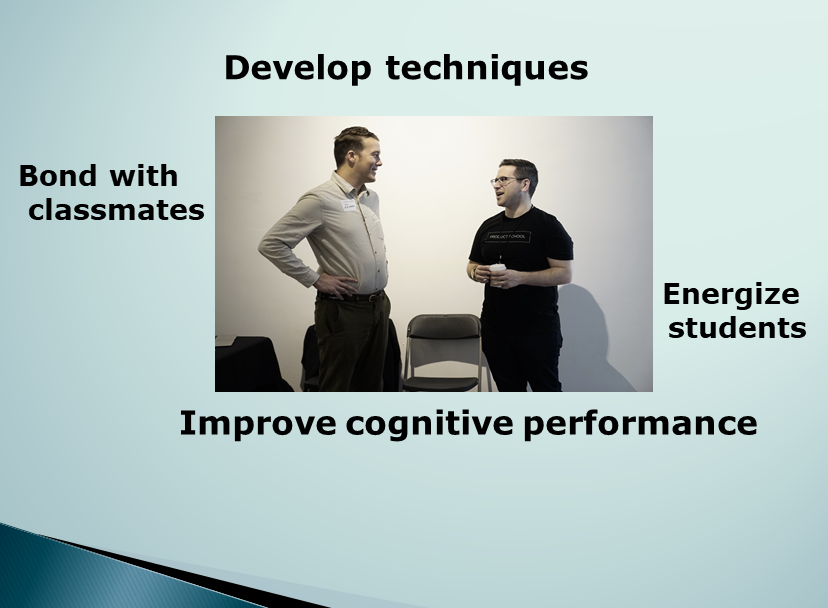
Develop techniques, bond with classmates, improve cognitive performance all in one activity!

The first time I used this type of activity, I was a relatively new ESL Conversation teacher and just wanted something to get my students talking.  Over the years, I’ve developed it more to involve additional conversational techniques.  And from cognitive psychology, I discovered why students are so energized by it.

You may be familiar with a simple version of this activity called “Find someone who” in which students are given a list of items and directed to talk to their classmates and find someone who has that item or has done that activity.  For example, find someone who has a pet or has lived in Europe or has gone backpacking.  However, that simple version has limited value.

A much improved version of this type of activity with great benefits (and handout)

Continue reading

• Getting Students to Write More Interesting and Unique Ideas in Essays

Argumentation list

(This posting includes a handout which you are welcome to use with your students.)*

After your students do this exercise, reading their essays will be much more stimulating for you.

I felt a bit deflated while reading an essay by Jojo, one of my higher-level students. His title was “It’s Best to Marry Someone from a Foreign Country.” From reading his previous essays, I knew he had the potential to be a very good writer with interesting ideas, but on that essay, he just supported his opinion with content that I would expect from students at lower levels.  For example, here is his list of simple support for marrying someone from a foreign country:

  • We can learn a foreign language more easily.
  • We can enjoy eating different kinds of food.
  • We can go easily to a foreign country for vacations.

Although I don’t believe that we, as ESL instructors, should expect our students to keep us stimulated with deep ideas,  (see my posting “Wow” is not Necessarily the Goal in Students’ Essays) we should encourage those students who have the potential to push themselves to write beyond the mundane. This is especially true for our students who are planning to take English Comp and other academic classes with native speakers.

An exercise to help students develop awareness for writing more advanced and unique ideas (handout)

Continue reading