Tag Archives: handouts

• Getting The Most Out of Information-Gap Chart Activities PART 1

Cover info Part 1 shot

(This posting includes a handout which you are welcome to use with your students.)

You can see my video discussing Part 1 & Part 2 here: VIDEO Getting The Most Out of ESL Information-Gap Activities: Six Recommendations

At first glance, these activities can appear to be just a fun way for students to interact with each other. However, the more I’ve worked with and developed them, the more I realize what an effective skill-building tool they can be.

For this PART 1 posting, I’ll…
1) briefly review what an information gap activity is.
2) describe three important ways to make these most effective for students and the mistakes that teachers sometimes make with these.

In my next posting, PART 2, I’LL …
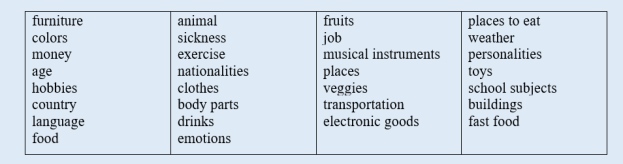
3) explain ways to customize them to review and reinforce vocabulary words and conversation strategies.
4) include more samples of these types of information-gap activities.

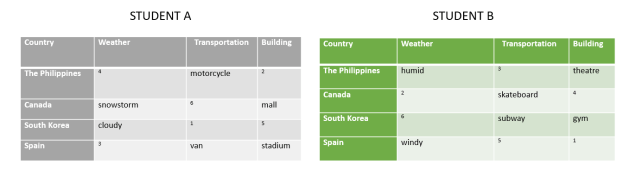
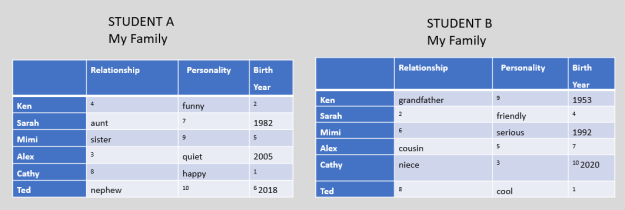
Here is an example of an information gap activity and a common mistake teachers make with them.

Continue reading

• Don’t Give Points. Give Green Instead. Save Time from Counting and Recording Points.

Cover grade book shot

While working at my computer, I heard my officemate, Nadya, sigh. She had a stack of homework papers that she was in the midst of marking, counting points and recording. She told me that she was starting to feel burned out from all the paper work and wondered if I felt the same.

She showed me how she was evaluating her students’ homework. They had written 10 items, and next to each one, she had written points. For example, a 2/2 meant that the student did that item correctly, a ½ meant it wasn’t completely correct, and 0/2 meant it was completely incorrect.

That morning she was in the process of (1) totaling the points, (2) writing a score at the top, and (3) recording the scores in her grade book.  She said that she didn’t have time to write anything more specifically about the reason for the points on the students’ papers.

I then showed her a set of papers that I had recently marked. I don’t write points next to each item, but instead, I marked each with green or blue. Then I explained that by doing that, I’m able to specifically reinforce what they did correctly or point out what was incorrect. At the same time, I don’t need to write and record points, which saves me a tremendous amount of time.

Here are samples of our different approaches to marking assignments:

Continue reading

• Helping Students Overcome Hesitancy to Volunteer an Answer in Group Discussions

Cover Vol shot

(This posting includes a handout which you are welcome to use with your students.)*

One day, I ran into an exasperated-looking colleague in the copy room at our school. She had just come from her ESL class in which she wanted to check some homework whole class. To do this, she asked, “What is the answer to Question 1?” Then she waited for someone to volunteer to answer, but nobody would.

Many of us ESL teachers have been in similar situations, especially with East Asian students. In his book, Behave, neuroendocrinology Robert Sapolsky gives a possible explanation for this by describing “… the archetypical experience of American Peace Corps teachers in [East Asian] countries—pose your students a math question, and no one will volunteer the correct answer because they don’t want to stand out and shame their classmates.”

[For more about the reasons for the differences among students from different cultures, see Best Subject for an ESL Integrated-Skills Class (Part 1 Overview)]

Needless to say, it’s not just East Asian students who are reluctant to volunteer answers. Students from other parts of the world who are basically shy or lack confidence in their speaking skills may also be hesitant.

Most of us would agree that a willingness to volunteer an answer during group discussions carries some great benefits in helping students take advantage of speaking opportunities. Once they become comfortable with this skill, there is often a carry-over effect in which they tend to be more will to volunteer in whole class situations. Also, perhaps more importantly, I’ve noticed an increase in students’ willingness to initiate a conversation with me before or after class and to ask for help on assignments and not just wait for me to offer.

How to help students feel comfortable volunteering an answer

Continue reading

• 8th  Free Reading Unit.  Scarcity: Not Having Enough of Something (can effect mental capacity)

Excerpt from the article

Revised Cover shot

(This posting includes handouts which you are welcome to use with your students.)

See • Reading Units: Reading for Insights (Introduction)  for an introduction to these reading units.

Article & Study Guide for Scarcity: Not Having Enough of Something (and excerpt) Continue reading