Category Archives: *MOTIVATING ESL STUDENTS AND TEACHERS

These posting include techniques for motivating ESL students and perspectives for motivating teachers.

• Getting Students to Write More Interesting and Unique Ideas in Essays

Argumentation list

(This posting includes a handout which you are welcome to use with your students.)*

After your students do this exercise, reading their essays will be much more stimulating for you.

I felt a bit deflated while reading an essay by Jojo, one of my higher-level students. His title was “It’s Best to Marry Someone from a Foreign Country.” From reading his previous essays, I knew he had the potential to be a very good writer with interesting ideas, but on that essay, he just supported his opinion with content that I would expect from students at lower levels.  For example, here is his list of simple support for marrying someone from a foreign country:

  • We can learn a foreign language more easily.
  • We can enjoy eating different kinds of food.
  • We can go easily to a foreign country for vacations.

Although I don’t believe that we, as ESL instructors, should expect our students to keep us stimulated with deep ideas,  (see my posting “Wow” is not Necessarily the Goal in Students’ Essays) we should encourage those students who have the potential to push themselves to write beyond the mundane. This is especially true for our students who are planning to take English Comp and other academic classes with native speakers.

An exercise to help students develop awareness for writing more advanced and unique ideas (handout)

Continue reading

• The Eyes Have It: Keeping Students Focused During Group Work

Eyes image

I once had a colleague who was feeling distraught because her students didn’t seem to take group work seriously.  Her students tended to chat instead of doing the task and often finished early without completing it.  She asked me to observer her class to see if I could come up with any suggestions.

Within a few minutes of observing her class, I was reminded of a social psychology study that seemed related to her situation.  As you read the summary of the study below, you may wonder how this could be connected to ESL students working in groups.  Bear with me.

The study

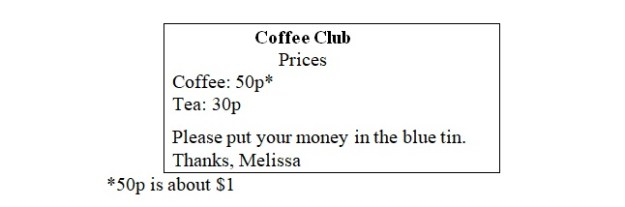
The Psychology Department at Newcastle University conducted this interesting study using their coffee station.  There was a sign above the coffee station:

Smaller coffee station screenshot

As you can see, it operates on an honor system.  For the 10-week study, researchers taped a picture of flowers for a week over the coffee station and then switched to a picture of a pair of staring eyes for a week.  They continued to alternate these pictures each week.

This is where it gets interesting

During the weeks that the poster of the eyes was staring, coffee and tea drinkers contributed almost three times as much money as in the weeks that the flower picture was on the wall.  What’s so amazing is that it was just a PICTURE of eyes, not an actual person, which seemed to make people more honest.

The researchers conducted a similar study to see if the flowers or eyes pictures could motivate people to clean up after their meals.  In that study, the number of people who cleaned up doubled when the eye picture was present compared to when the flower picture was.

How this social psychological study is connected to teaching ESL

Continue reading

• One of Best Uses of an ESL Program’s Funds—And a Giant Help to Teachers.

Reading Journals

This is one of the best things we’ve implemented in programs where I’ve taught for three reasons:

1. It has helped students improve their reading and writing skills, and grammar, and vocabulary.
2. It adds NO EXTRA WORK for teachers.
3. It costs relatively little money.

As most teachers in the field already know, one of the best ways for students to improve their skills is to do more reading.  (See A True Story to Motivate Students to Read More for a detailed example).  However, adding more reading assignments usually means more work for the teacher—in the form of worksheets or quizzes or  feedback in some way—because students need to be held accountable for actually doing the assignments.

Here is the Perfect Solution

Continue reading

• One of the Worst Mistakes Conversation Teachers Make

Cover worst mistake conv shot

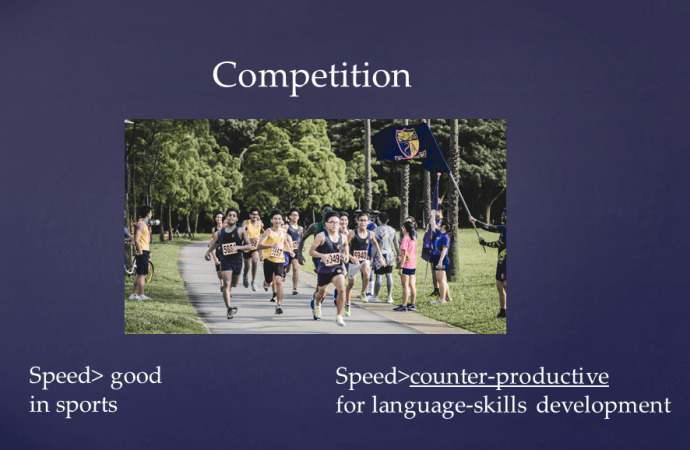
For some strange reason, some ESL instructors think they can improve any activity by making it as some kind of competition between students or between groups.  Unfortunately, doing this can be counterproductive and actually discourage the most serious students.

To illustrate, consider an information-gap activity like the one from a previous posting Another Conversation Activity: Listen to Partner and Ask Questions to Complete Information-Gap Chart  In this, pairs of students fill in missing information in a schedule by talking, asking questions, and using clarification strategies.

Imagine the teacher tells the students that he will give a prize to the pair who finishes the schedule first.  This is what will happen and how students will miss out on the skills that the activity is meant to develop.

Continue reading