Category Archives: • After Class

• “Read-Aloud” Method for Collaborating with Colleagues to Assess ESL Students’ Writing Level

Cover read aloud evals

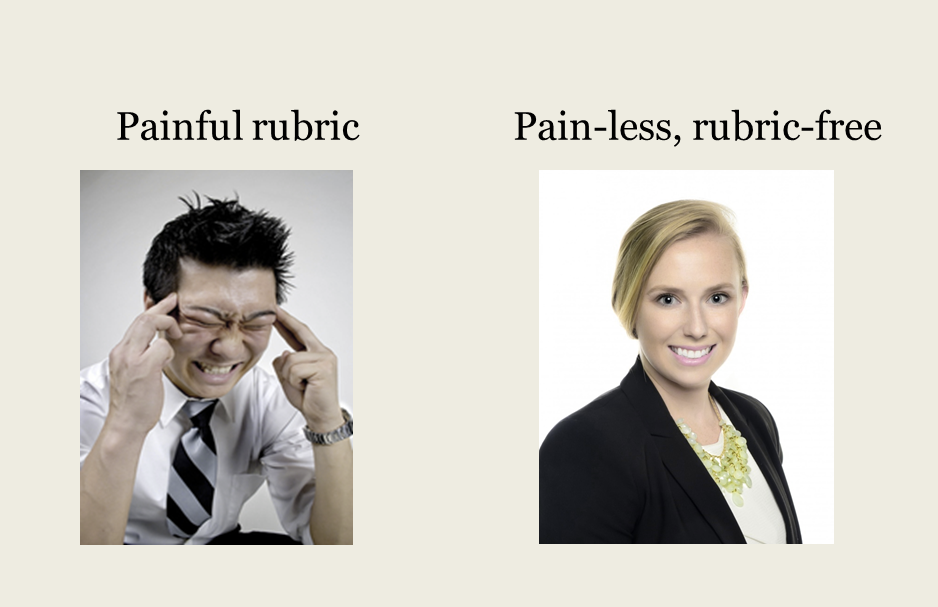
Traditionally, when evaluating students’ writing levels, the “evaluators” silently read the essays in their offices, oftentimes fill out a rubric and come up with a score. Most of us would agree that such a process is onerous and often results in students being misplaced.

The method that I’ll describe here has important benefits for teachers and the ESL program as a whole. I’ve used this in several ESL programs for two situations(1) determining which students should be promoted to the next level at the end of a term, and (2) placement of new students. It’s especially helpful for determining the proper Writing-class level of borderline students, in other words, ones whose writing levels are not obvious.

To demonstrate how the method works, let’s look at those two situations.

Continue reading

• Terrible Advice to Novice Teachers From a Teacher-Trainer

Cover terrible advice shot

One day a teaching intern asked me for some advice about a listening-skills class that she was struggling with. Her internship was for three-month, and she had been assigned to our ESL program. The lesson in the textbook for the class didn’t seem to address a skill that the students needed, but she had an idea for an exercise. However, she didn’t know if she should spend an hour or two or more developing a more relevant activity. Then she added this: “The professor in my TESL Methods class told us that we shouldn’t spend time writing exercises during our internship unless we know that we’ll be able to use them in the future.”

It made me want to cry.

The most obvious reason why this advice is so wrong is that none of us in the field of Teaching ESL can know when an exercise will come in handy in the future. But, besides that, there are more paramount reasons for teachers to write exercises.

Continue reading

• An Early Course Correction: Making Sure You Are Evaluating Your Students’ Writing Accurately Before It’s Too Late

Early course correction Cover

This posting is directed specifically to teachers in these categories:

  • You have experience teaching ESL Writing, but you have been assigned to teach a new level.
  • You have just been hired to teach in an ESL program and are assigned a Writing class.
  • You have been teaching an ESL Writing class for a few terms, but this term you have some students who have “unusual” writing characteristics.

Imagine that it’s the third week of the term. You just picked up your students’ first writing sample (e.g. a paragraph or essay) and are starting to mark/evaluate them. (See Most Effective Technique for Marking Grammar on Essays to Develop Self-Editing Skills)

You start with Adey’s essay and soon some questions come to your mind:

Next, you read Naomi’s essay and wonder about this:

  • She uses complex sentences, but sometimes her grammar breaks down, especially word forms. Would these kinds of mistakes disqualify her from passing to the next level? How “perfect” must a students’ grammar be to pass?

Another student, Dante had this characteristic:

  • His ideas seemed quite simplistic; he doesn’t develop them with enough details. What is the expectation for students passing to the next level concerning idea development?

Help is on the way!

Continue reading

• Pain-Free ESL Speaking Placement-Testing Process: Reliable, Time-Efficient and User-Friendly

Cover ppt shot

(This posting includes a handout which you are welcome to use with your colleagues.)*

At first, all the teachers wanted to administer the oral test for placing students into one of the four levels of conversation classes. But that enthusiasm waned once they discovered what this commercially-made placement test would entail.

Two major problems with many speaking placement tests (commercial and in-house)

1)  The testing process in labor intensive. The scoring rubrics are onerous, ineffective and require time-consuming training.

2)  Rather than just focusing on the skills being developed in speaking/conversation classes, the interviewers have to evaluate several peripheral aspects of speaking at the same time.

A Speaking Placement-Testing Process That Addresses Those Problems.

Continue reading