Category Archives: *ESL WRITING

These postings include writing activities, teaching techniques and strategies for evaluating writing skills.

• Getting Backed Up with ESL Paperwork: Effective Solution

Cover shot

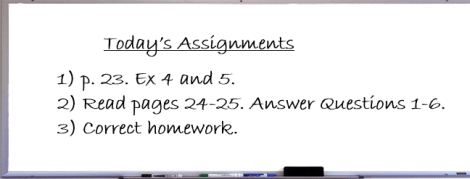
There seems to be certain times during a term when we can feel a bit overwhelmed by the amount of paperwork coming in. During those times, it makes sense to establish some priorities concerning how we approach “marking” the various assignments.

It’s sometimes tempting to rationalize not giving any feedback on or returning some homework assignments by thinking that there are intrinsic benefits for students to just do the exercises. We say to ourselves that it’s not absolutely vital that they get them back quickly (or even, in some cases, ever). Thus, we might consider doing a “triage” with assignments. Essays might get top priority for our time and attention with “lesser” assignments just filed away or held off until sometime in the future when we are all caught up.

Surprisingly, this feeling of being overwhelmed can actually open up a motivation to respond to homework assignments in a way that is more effective than how we would “normally” do it when we have plenty of time.

Continue reading

• LINCS Topic 5: What are your recommendations for teaching writing to higher-level learners who have academic goals?

Cover 5 higher levels REV

 (This posting includes a handout which you are welcome to use with your students.) 

This posting is a more detailed response to my interview question on Day 5 .LINCS Discussion: Student-Centered Approach to Teaching Writing Skills. .

Below in blue, you’ll find the details that I’ve added to the Day 5 LINCS’ posting.

My top recommendation is to develop a clear understanding of the type of writing students will do in English Comp and academic class after they leave our classes.

With this as our starting point, we can apply our knowledge of language learning to help them develop the skills they will need.

In a survey of 360 college faculty members (of mainstream courses), it was found that, when asked to prioritize the most important components of an effective piece of writing produced by their ESOL students, the respondents chose, as their top three priorities (1) organizing content to express major and supporting ideas, (2) using relevant examples, and (3) demonstrating command of standard written English (Hinkel, 2004). 

I have found similar results from my face-to-face interviews of more than 40 mainstream college instructors in 8 different subject areas who assign papers in their first-year courses. Ten of these were English Comp instructors.

Here are some recommendations based on research.

Continue reading

• LINCS Topic 4: What are some ways that we can include interactive activities in ESOL Writing class?  

Cover 4 interactive REV

 (This posting includes a links handouts which you are welcome to use with your students.) 

This posting is a more detailed response to my interview question on Day 4 LINCS Discussion: Student-Centered Approach to Teaching Writing Skills. .

Below in blue, you’ll find the details that I’ve added to the Day 4 LINCS’ posting.

I have some interactive activities that I include during each writing unit.

They do give variety to a writing class, but more importantly, they are effective in helping students develop their writing and editing skills.

1) Writer-in-control peer editing. Type 1: Writers prepare questions.

In traditional peer-editing activities, the students read a classmate’s essay and give feedback by filling out a teacher-provided questionnaire, rubric or checklist. (For example, “Is the topic sentence clear?” “Are the verb tenses correct?”)

For this non-traditional approach below, the writers have control over the type of feedback they want. Here are the steps:

Step 1: (A model) Sample essay and peer editing questions. In order to demonstrate to students how they will peer-edit with a classmate and the type of questions that they can ask, they work with a model essay with peer editing questions that the “writer” has asked.
(See link to a model exercise below.) After working with a sample, they then apply this technique to their own essays, starting with the Preparation Step.

Step 2: Preparing for Peer Editor. After students have written their essays, they identify specific parts of it in which they’d like a peer’s advice.  These could be about the grammar in some sentences, clarification of an example, a need to add details etc. On a separate piece of paper, they write questions about these parts that they will ask a peer-editor. For example, “Look where I wrote #1. Is my example clear?” “Look where I have #4. Is there a problem with this sentence?” “Look at #8. How can I improve my conclusion?”

Continue reading

• LINCS Topic 3: What can you recommend for offering effective feedback on writing? How can teachers manage the amount of time it takes to give feedback?

Cover 3 Feedback REV

(This posting includes a handout which you are welcome to use with your students.) 

This posting is a more detailed response to my interview question on Day 3 .LINCS Discussion: Student-Centered Approach to Teaching Writing Skills. .

Below in blue, you’ll find the details that I’ve added to the Day 3 LINCS’ posting.

Giving feedback to students on their writing is such a rewarding aspect of our job.

However, it’s important to do it in a way that is meaningful to students yet user-friendly for the teacher. Here is how we can do it.

Giving meaningful feedback in in a manner that is time and energy efficient

In general, we’d like to give three types of feedback on a piece of writing:
1) Indicate what they did well.
2) Lead them to discover their grammar mistakes.
3) Point out where they could improve their content.

1) Indicate what they did well.

Imagine that you are a student and just received your paper with this positive feedback from the instructor at the end of the essay:

This was a good essay.  Your ideas were interesting.  You used advanced sentence styles, and some of your examples helped me understand your main points.

Will these comments actually help you, as a student, apply how you wrote to future writing tasks?  Which specific ideas were interesting?  Which specific sentences was the teacher referring to as advanced and which examples were helpful?

A time-consuming alternative that some teachers turn to is to write the comments in the margin next to noteworthy places in the essay.  The drawback to this, especially when commenting on paper, is that it is time consuming, there is little space to write them, and the handwriting needs to be clear.  Also, one wonders whether students will actually read the comments.

Before describing an easy, efficient and effective method for giving focused positive feedback, it’s important to understand the reason why we want to give positive feedback.  What we are trying to do is to encourage them to continue to use writing techniques which have made their writing assignments coherent, cohesive and interesting.

This means we’d like to point out, for example, where they have effectively used…

Continue reading