Category Archives: *ESL WRITING

These postings include writing activities, teaching techniques and strategies for evaluating writing skills.

• A Question From a Reader: “Mario is supposed to study.” What is the Verb? Is “to study” an Infinitive?

Questions

Somehow, I managed to teach ESL for over 10 years before I learned what this is.  The expression “is supposed to” is called a semi-auxiliary verb.  In the sentence in the title, “study” is the main verb.

The expressions below are all called semi-auxiliary verbs.  They are followed by the main verb.

  •  (have) to

  •  (be) supposed to

  •  (be) able to

  •  (be) going to

Continue reading

• One of Best Uses of an ESL Program’s Funds—And a Giant Help to Teachers.

Reading Journals

This is one of the best things we’ve implemented in programs where I’ve taught for three reasons:

1. It has helped students improve their reading and writing skills, and grammar, and vocabulary.
2. It adds NO EXTRA WORK for teachers.
3. It costs relatively little money.

As most teachers in the field already know, one of the best ways for students to improve their skills is to do more reading.  (See A True Story to Motivate Students to Read More for a detailed example).  However, adding more reading assignments usually means more work for the teacher—in the form of worksheets or quizzes or  feedback in some way—because students need to be held accountable for actually doing the assignments.

Here is the Perfect Solution

Continue reading

• Tools for Describing Someone with Details: Inductive Writing Exercises (Low-Intermediate to Intermediate Level)


Describe someone Cover shot2

(This posting includes handouts which you are welcome to use with your students.)*

When written with enough details by students, a person description can be fascinating for teachers to read and can give them great insight into their students’ lives.

And, best of all, after they have learned some specific tools, students tend to have a lot of fun writing these.

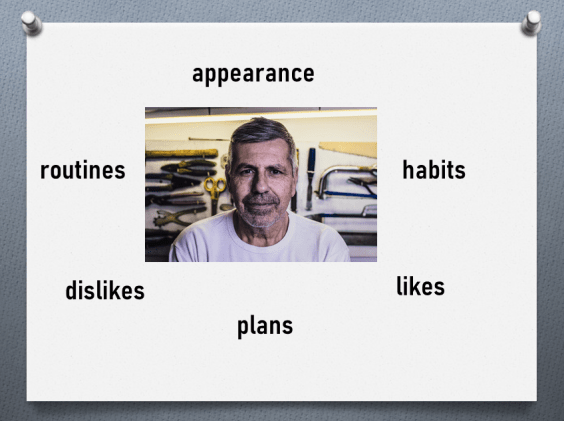
Needless to say, when we talk about a person-description writing assignment, most people first think about physical appearance.  However, that is only one aspect of a person that students can include in their papers.  There are several other characteristics that they can describe, for example, habits, routines, plans, likes, and dislikes.

Teaching These Tools Inductively

Continue reading

• Common Teacher Myth: Students Don’t Like to See Red Marks on Their Papers.

This posting is discussed in this short video: Myth: Students Don’t Like to See Red Marks on Their Papers.

I conducted a survey of 48 students to find out how they felt about getting red marks, which indicated grammar mistakes, on their writing assignments.  I was motivated to do this after some colleagues had told me students get upset or dejected when they see these, so they only marked a few mistakes, and one even changed to a different color, thinking that, like her, students associated red marks with something negative.

Three types of marks on students papers

When I give students feedback on their writing assignments, I want them to notice three things:

  1. Good writing points.  These are ideas, details, examples, expressions, sentence styles, grammar that they did well.  I underline these in GREEN to indicate good.  (See Students’ Positive Responses to this Teacher Technique  for more details.)
  2. Weak grammar points.  These are grammar mistakes or wordings that they should revise to improve their papers.  I try to indicate these in a way that seem like a puzzle that can be stimulating for students to discover. I use RED to indicate these.  (See Most Effective Technique for Marking Grammar on Essays to Develop Self-Editing Skills  for more details.)
  3. Places to improve content.  These are places where students could improve their papers by adding details and/or including examples. I use BLUE to indicate these.    (See “Wow” is not Necessarily the Goal in Students’ Essays and The Huge Advantage International Student Writers Have Over Their American Classmates for more details.)

The survey question to students: If you could only have one type of mark on your papers, which one would you choose?

Color code survey

If those colleagues who thought students were upset by red marks (grammar mistakes) were right, then it would seem that the students would not choose that option, and in fact, probably prefer the Green (good parts) option.   Spoiler Alert: that didn’t happen.

Continue reading