Category Archives: • Advanced & High-Intermediate Levels

• Stimulating Small-Group Discussion Activity 1: Which Is More Effective– I’m Calm or I’m Excited?

(This posting includes a handout which you are welcome to use with your students.)*

Some reasons why students seemed stimulated by this discussion:

1) They were surprised that they were currently feeling different emotions on that day.
2) They seemed interested to hear about different ways they coped with stress.
3) They were surprised by the findings of the research in the article and how they could apply that to their future.
4) They enjoyed comparing experiences giving speeches or performing.

Here is the basis for this discussion: Researchers have found that when we are in a stressful situation, we will be better at handling it if we say to ourselves that we are excited rather than try to calm ourselves down.

This and future discussion activities include four parts:

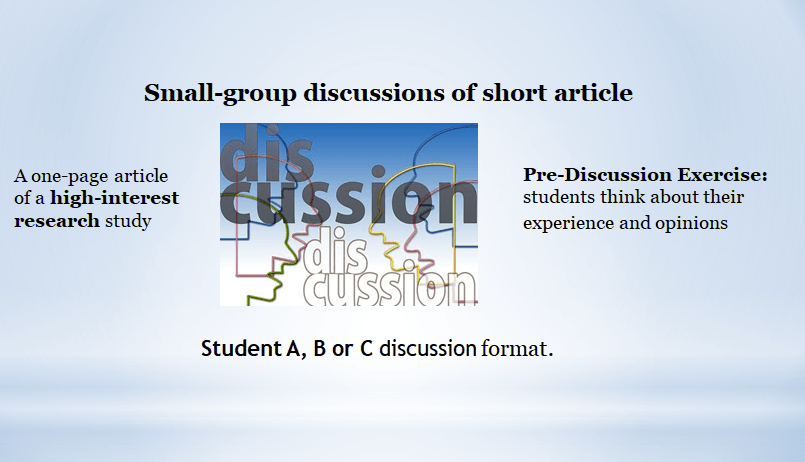
1) A one-page article usually including a brief summary of a high-interest research study.
2) Ten true-false comprehension questions.
3) Pre-Discussion Exercise in which students read and think about several questions about their experience and opinions about the topic before discussing them in groups.
4) Small-group discussions of the article in which each student is given a paper with different content/personal experience questions in the form of Student A, B or C.
5) Optional writing reflection activity.
About Discussion Activity 1: Which Is More Effective–I’m Calm or I’m Excited? and the handout.

Continue reading

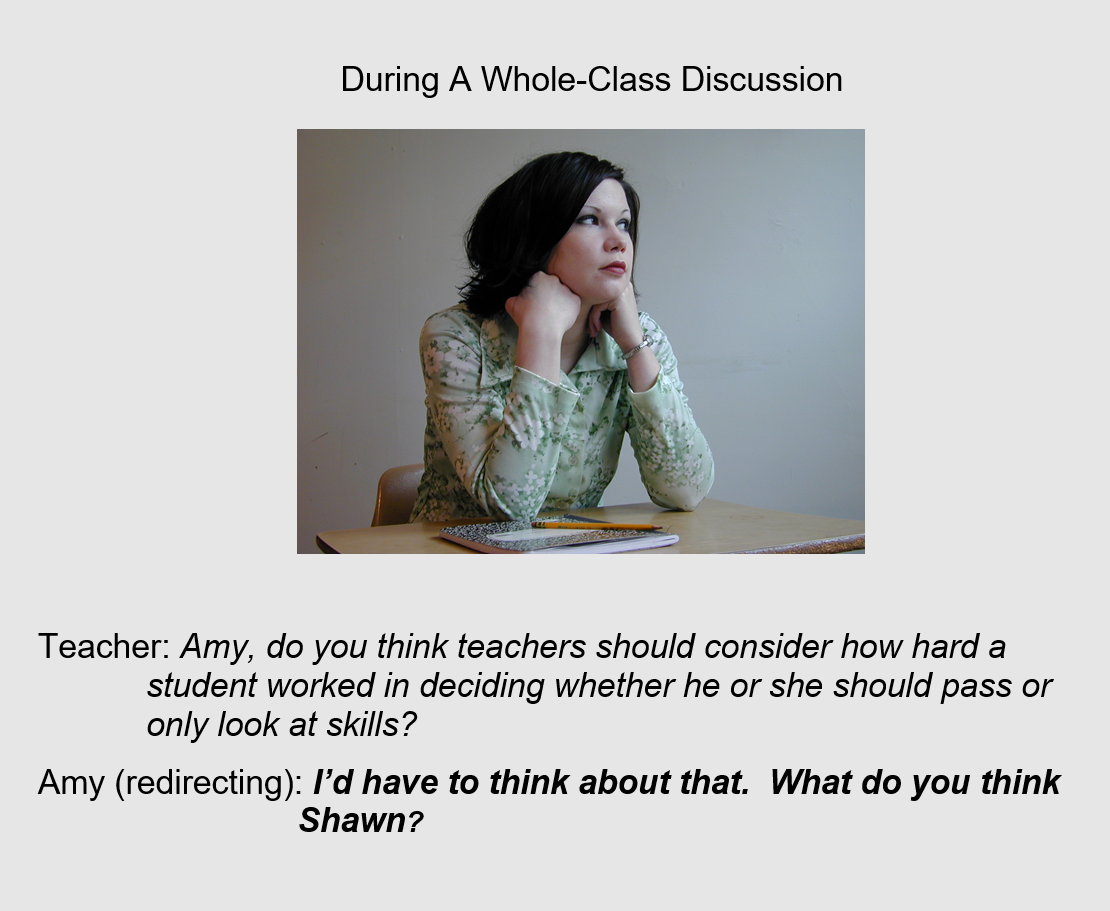
• Guaranteed Active Whole-Class Discussions (3rd Technique: Redirecting a question to a classmate when you don’t know what to say)

Screen Redircting Rev shot

(This posting includes an attachment teacher’s script which you are welcome to use.)*

As mentioned in the previous two previous posting about the first two techniques, whole-class discussions can be an alien concept to some students.  When trying to conduct a discussion with the whole class, it’s not unusual for the teacher to call on a student to answer but the student for some reason is unable to answer in a timely manner.  It could be because he doesn’t know what to say, or how to formulate the answer in English, or isn’t confident in his oral skills.  This can result in some awkward moments as the student is clearly experiencing stress and/or embarrassment, and the teacher doesn’t know whether to give him more time to answer, to ask some leading questions or to just move on to a different student. Meanwhile, the rest of the class might begin to become restless.

This technique is a kind of “escape” for students in that kind of situation.  If, for some reason, they can’t answer within a reasonable amount of time, they can use one of these expressions:

  • That’s a good question. I’d like to think about it first. Perhaps (a classmate’s name) could answer it.
  • I’m not sure, but (classmate’s name), what do you think?
  • I have no idea. How about you, (classmate’s name)?

When students use this technique, it can actually turn into a humorous situation.  Almost any time a student has used one of these expression, it has elicited a lot of friendly laughter by the classmates and teacher.  The classroom tension is immediately released.

To help your students become comfortable with this technique, you can use the handout and attached script, which I’ll explain about below.

Continue reading

• Discussion Technique to Get Quiet Students Involved (Part 2)

(This posting includes a handout which you are welcome to use with your students.)

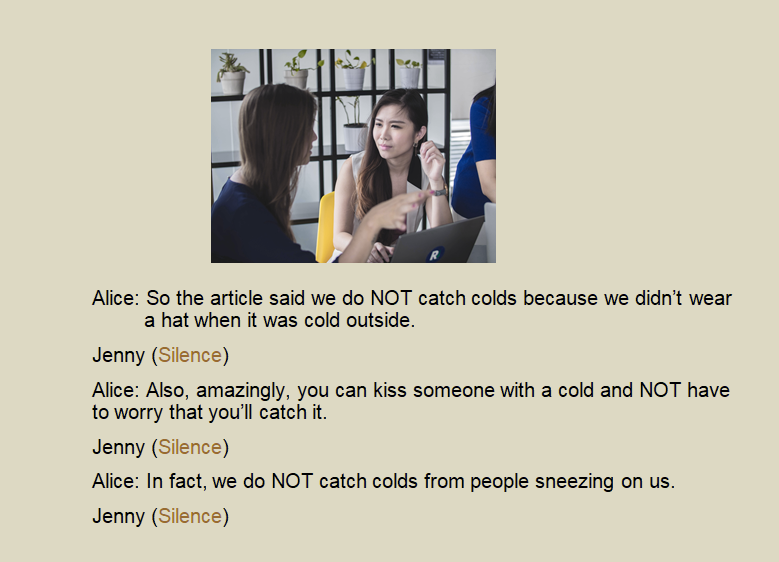
Quiet student pt 1 Cover shotMost of us have had experience like this with an ESL student: Someone is talking for a half a minute or more, and the student is just looking at the person.  When the person stops, the student just nods his/her head.  The speaker isn’t sure if the student really understood. 

There is a technique which students, both the listener and speaker, can uses in conversations to avoid that type of situation.

The technique expands on the one introduced in Part 1. Discussion Technique to Get Quiet Students Involved (Part 1) Instead of asking a clarification after each paragraph, in this one, the listener summarizes in one sentence what s/he thinks was said.

By doing this, the speaker is able to feel confident that s/he is being understood correctly and the listener can confirm his/her understanding.

Just as with the technique introduced in Part 1, after students have used the two attached handout-activities, they usually find the technique to be a “tool” that they can use not only in group discussions but also when interacting with teachers and others outside the classroom.

Continue reading

• Guaranteed Active Whole-Class Discussions (2nd Technique: Volunteering to Answer)

Class discussion

As mentioned in the previous posting “1st Technique: Responding to others,” Guaranteed Active Whole-Class Discussions (First Technique: Responding to Others)  whole-class discussions can be an alien concept to some students.   This is the second technique.

International students in Western-style classes often feel ignored during whole-class discussions if the instructor doesn’t directly call on them.  In some of the classes, instructors expect students to freely offer their comments or ask question.  Also, some hesitate to call on International students because they think those students might feel uncomfortable speaking to the whole class.

This technique, Volunteering an Answer, is very effective in helping even passive students involved in whole-class discussion, and in the process, impressing their instructors.

To help you students become comfortable with this technique, you can use the attached script, which I’ll explain about below.  (Notice: for this technique, there is no handout for the student, just a teacher’s script.)

Continue reading