Author Archives: commonsenseesl

• Most Effective Technique for Marking Grammar on Essays to Develop Self-Editing Skills

Cover codes in margin shot

(This posting includes a handout which you are welcome to use with your students.)*

Because this technique gives students a chance to discover their grammar errors, we have found students have greatly improved their self-editing skills.  And self-editing skills will be of great value to them as move beyond ESL courses.

Here is a description of the technique along with a handout exercise that will introduce students to it.

Continue reading

• Pleasure of teaching ESL (Part 1)

Cover pleasure of teachingThree experiences in the past week that reminded me about why teaching ESL is such an entertaining job.

First experience:  After class, I was reading a passage in which one of my Vietnamese students had written.  She was describing a time when she had a close call while driving.  “Suddenly, a car which was coming toward me crossed over into my lane.  It scared the hell out of me!

Second experience:  A few weeks into the term, one of my more out-going Indonesian students entered the room and said, “Wassup!”

Third experience: I was handing back some homework to my students before class started.  As I gave one of my Taiwan female students her paper in which there were some mistakes marked, she looked at it and said, “What the fu!”  Then she smiled and asked me, “Is it OK if I say that to a teacher?”  I asked her if she knew what that meant, and she said she didn’t, but she had heard someone say it in a movie and thought it would be fun to try out.

To many people in the outside world, our job for teaching ESL looks like a lot of fun.  People have told me, “It must be so interesting working with students from different countries and cultures every day.”  And most of us would agree.  But what they are imagining is only a tiny part of what makes this such a great job.  We can never predict what our students will come up with next as they learn and try out the language.

David Kehe

• A True Story to Motivate Students to Read More

Reading while eating

Reading every chance you get.

An international student, Emily, was really struggling with the grammar in her writing assignments.  Even though she worked with a tutor, she was continuously making basic mistakes.  In the fall, the program reluctantly promoted her to my higher-level Writing course.  I found her to be the third lowest of 17 students in the class in being able to apply grammatical accuracy to written work.  Ten weeks later, she was the second best.  I was totally amazed!

At the end of the Fall term, she passed my class and then took English Comp (English 101) during the Winter term.  She got an A.

I had a chance to talk to her about her remarkable turn-around.  What she did is not beyond what other students can do.  After that opportunity that I had to talk to her, every term, I share with all my students her story.

Here is the PowerPoint that I use to do this in case you’d like to tell your students about how a peer of theirs was able to improve the grammar in her writing in a relatively short time.  ppt True Story Read to Impove Grammar

I’ll summarize what she had done below.

Continue reading

• For Large-Class Conversation Instructors, You Can “See” if Students are Using Techniques

Cover seeing shot

(This posting includes a handout which you are welcome to use with your students.)

You,the conversation teacher, are happy because the noise level in the room is high.  That means that the 12 pairs of students (24 total) are engaged in the conversation activity.   At the start of the next class, you want to give them feedback on their performance today, especially because you want to give positive comments to those who are very active.  There are also a couple of pairs who need some “re-direction.”

Needless to say, you’re not going to be able to give each student specific feedback specifically on what they said because you can’t actually hear them above all the talking.  But you can actually see whether or not they are using conversational techniques.

(See previous posts of two important techniques Conversation magic: Two most important conversation techniques (Part 1) and Conversation magic: Two most important techniques. (Part 2)

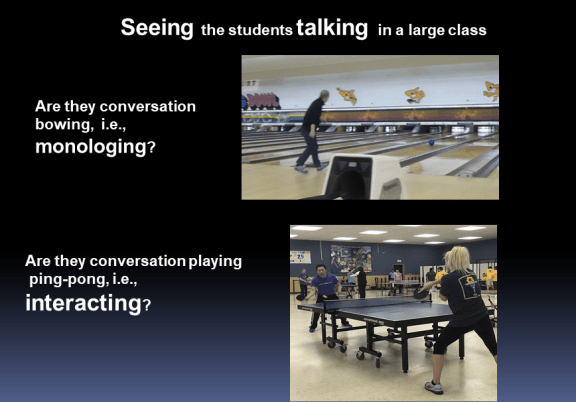
Even if you can’t hear them, you can see if they are engaging in a natural conversation; it looks like ping-pong, in which they are reacting to each other, asking follow-up questions and giving understanding responses.  You can also see if they are more like bowling, in which one monologs for a while while the other “zones out,” then the other monologs.  You can see if someone is dominating and if someone is very passive.  Interestingly, you can even see if they have switch from English to their native language; often when they do this, their voices lower and their faces aren’t as animated perhaps to “hide” from the instructor.

If you suspect that a pair isn’t using natural conversation techniques or isn’t speaking in English, there are things that you can do.

Continue reading