Author Archives: commonsenseesl

• Most Stimulating and Engaging but Often Over-Looked Essay Mode

Cover Def Essay shot

(This posting includes a handout which you are welcome to use with your students.)*

A frequent type comment by teachers, “I always look forward to reading these essays.  They often give me new insights into my students and their cultures.”

A frequent type comment by students, “When I heard that we would write a complete essay about one word, I thought it would be impossible.  But after I chose a good word, I really enjoyed writing this.”

Another frequent type comment by students, “This was the most challenging essay for me, but in the end, it was the most rewarding.”

Many ESL Writing books and instructors overlook this essay mode because they don’t realize its secret potential.  It’s the Definition Essay.  The potential lies in the type of words that the students write about.

Traditional Definition essays can be very unstimulating for the students to write and for the teachers to read.  There are two major reasons for this:

(1) The category of topics from which to choose provides little opportunity for ESL students to feel truly invested in it.
(2) The students are given few specific or poorly designed techniques which they can use.


The Dynamic Definition Essay: Category of Topics and Specific Techniques

Continue reading

• EASY Needs Analysis for What ESL Teachers Should Teach (Needs Analysis) Part 2

Interview 2 students

In general, teachers can lose credibility in the eyes of their students by asking them what they want to learn.  The teacher is the professional in the room and should know what the students should study.

However, there are situations in which former students’ insights can be valuable.  Surveying these students about what would have been helpful for them to have learned in our classes from their new perspective can give us an awareness of students’ needs beyond our classrooms.

Example of needs-analysis surveys of former students

Continue reading

• 3rd Free ESL Reading Unit. Science of Shopping

Cover shopping

Excerpt

1 Sixty-five percent of men who take jeans into a fitting room of a store will buy them, but only 25% of women will do that.

2 Four percent of people shopping for computers on a Saturday morning will buy one, compared to 21% who will buy one after 5 p.m.

3 Eight percent of shoppers in a store that sells houseware use shopping baskets.  Also, 75% of the people who use a basket will, in fact, buy something, as opposed to 34% of the shoppers who don’t use a basket.

4 Information about customers’ shopping patterns like those that are described above can help store owners make decisions that improve the sales in their stores.

(This posting includes handouts which you are welcome to use with your students.)*

See Select Category > ESL Reading Units Free: Reading for Insights (Introduction) for an introduction to these reading units. Reading Units: Reading for Insights (Introduction)

Article & Study Guide for  Science of Shopping (and excerpts)

Continue reading

• Most Important Process that You can do for Yourself, Your Students, Your Program (Part 1)

Cover Most important process

This process will give you, your colleagues, administrators, and most of all, your students great confidence in what you and your colleagues are teaching your students.  It will serve as a legitimate basis for the goals and outcomes of your courses.

This empowering process is called a needs analysis.  It is one of the most important things I have ever done as a professional, and I’ve done this everywhere I’ve taught.

And on top of all that, it can be stimulating and rewarding to do.

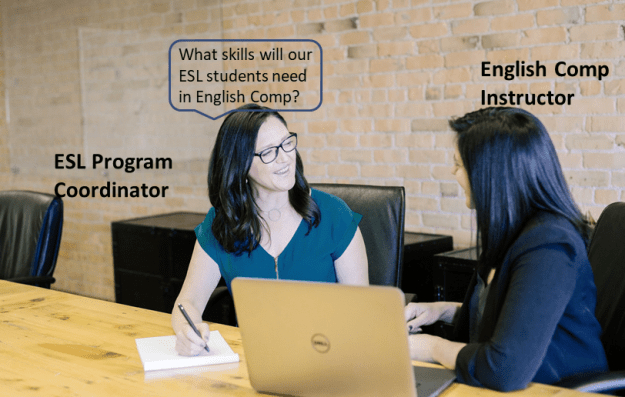
In brief, a needs analysis in an ESL context means finding out what skills students will need in order to be successful in the future.  The future can be the following term when they will be in the next level of a program; it can be when they finish their ESL instruction and will be in college courses (e..g. English Comp); it can be when they are traveling abroad; it can be when they enter the workforce.

These range from simple surveys of a small group of former students to more involved interviews with college instructors.

How to find out what skills students need to know once they leave our course or our program

Continue reading