Author Archives: commonsenseesl

• Common Teacher Myth: Students Don’t Like to See Red Marks on Their Papers.

This posting is discussed in this short video: Myth: Students Don’t Like to See Red Marks on Their Papers.

I conducted a survey of 48 students to find out how they felt about getting red marks, which indicated grammar mistakes, on their writing assignments.  I was motivated to do this after some colleagues had told me students get upset or dejected when they see these, so they only marked a few mistakes, and one even changed to a different color, thinking that, like her, students associated red marks with something negative.

Three types of marks on students papers

When I give students feedback on their writing assignments, I want them to notice three things:

  1. Good writing points.  These are ideas, details, examples, expressions, sentence styles, grammar that they did well.  I underline these in GREEN to indicate good.  (See Students’ Positive Responses to this Teacher Technique  for more details.)
  2. Weak grammar points.  These are grammar mistakes or wordings that they should revise to improve their papers.  I try to indicate these in a way that seem like a puzzle that can be stimulating for students to discover. I use RED to indicate these.  (See Most Effective Technique for Marking Grammar on Essays to Develop Self-Editing Skills  for more details.)
  3. Places to improve content.  These are places where students could improve their papers by adding details and/or including examples. I use BLUE to indicate these.    (See “Wow” is not Necessarily the Goal in Students’ Essays and The Huge Advantage International Student Writers Have Over Their American Classmates for more details.)

The survey question to students: If you could only have one type of mark on your papers, which one would you choose?
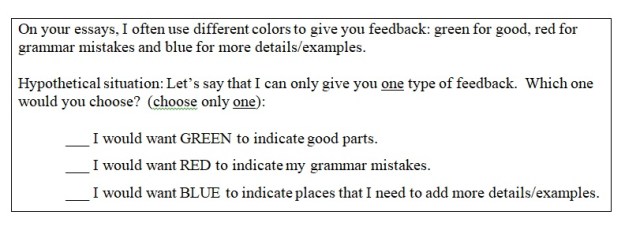
Color code survey

If those colleagues who thought students were upset by red marks (grammar mistakes) were right, then it would seem that the students would not choose that option, and in fact, probably prefer the Green (good parts) option.   Spoiler Alert: that didn’t happen.

Continue reading →

• Did you sign up to follow Common Sense ESL but are not getting notifications of new postings??


WHY

I recently got emails from some of you that you had clicked on “Follow this Blog” and entered your email address but haven’t been getting notifications of new postings.

I asked WordPress about this, and they said that they always send a verification email to everyone who signs up to follow the blog, and these recipients need to click reply to the email to confirm this.  Sometimes the verification email goes to Spam, so they recommended that I mention this to followers: please check you Spam.

Thank you all who have contacted me.

David Kehe

• Another Conversation Activity: Listen to Partner and Ask Questions to Complete Information-Gap Chart

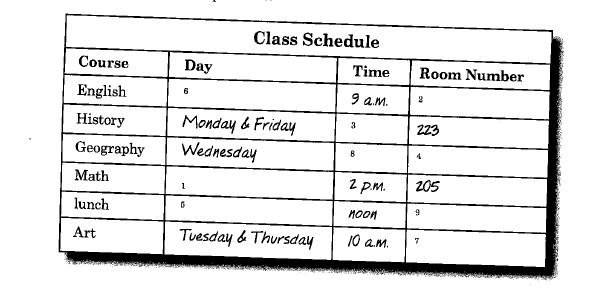
image schedule chart

(This posting includes a handout which you are welcome to use with your students.)*

At first, this pair-work activity looks like it’s about getting students to talk a lot by filling information in a chart.  But that’s not the most important value of it.

Yes, students will talk a lot during this.  But by including a short pre-exercise, they will see how they should ask clarification questions when they need more information or if they didn’t understand.  Asking clarification questions is the strategy that they can use in future conversation situations in and outside the classroom.

In this activity, the students will be filling in information about a class schedule.  They’ll need to listen to their partners tell them the name of courses, days, times and room numbers.  They’ll have many chances to ask questions, especially if they don’t understand.

There are three steps in this activity:

  • Step 1: Brief work with a model showing how to do Step 2.
  • Step 2: Pair activity (Student A/ Student B)
  • Step 3:  Exercise to do if they finish before other pairs have finished.

Continue reading →

• Advice: Don’t Say These 4 Things to Your Students

Cover Advice don't say these 4 things shot

YouTube This posting is discussed on my YouTube video Don’t Say These 4 Things to Your ESL Students

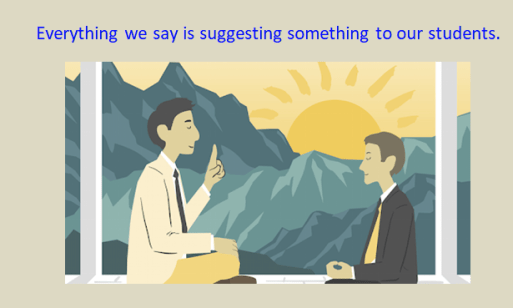
Everything that we say to our students can have a big impact.  For us ESL instructors that can be exhilarating, but it’s also a big responsibility.  Unfortunately, without realizing it, some instructors are sending the wrong message to students with “innocent” comments.  These are four statements that are in this category.

1) Teacher’s statement: The teacher doesn’t want students to feel stress, so just before handing out the quiz, she says, “This quiz will be easy.”
Message that students get: If a student starts the quiz and notices that it isn’t easy, he’s likely to think, “Wow!  I must be stupid.  This quiz is supposed to be easy.  My classmates probably know all this.”
What the message should be: This is what we can say instead to help them understand the purpose of the quiz: “This quiz will help us see how well you’ve developed your skills so far and what we’ll need to practice more.”

2) Teacher’s statement: The teacher wants to reward students, so he says, “You have all worked so hard this week, so I won’t give you any homework.  I want you all to just enjoy your weekend.”
Message that students get: “Homework is painful.  It just interferes with free time.  It’s best if we can avoid it.”
What the message should be: What we really want to do is give students confidence in our homework assignments, so we can say, “I’ve prepared a homework assignment that will lead you to developing your skills more.  It’s going to help you do well on our assignments  next week and in the class that you will be in next term.”

Continue reading →