Author Archives: commonsenseesl

• Smiling and Eye-Contact Behind Your Mask Has Benefits For You, Your Students And Even Strangers


Mask Cover image

*(This posting includes a handout which you are welcome to use with your students.)

These days when I go for a run with my mask on, I find myself falling out of a habit that I had had pre-pandemic: smiling at other runners and walkers on the trails. With the mask covering my mouth, a smile seemed silly.

However, neuroscience researchers say–No, it’s not silly.  In fact, a smile, even if it is unseen, can have a positive effect on our emotions and on those people whom we are smiling at.

As our campuses slowly open up to more face-to-face contact with colleagues, students and others we come across while still wearing masks, we’ll have opportunities to increase a feeling of connectedness and well-being with just a little effort behind our masks.

Continue reading

• 6th Free ESL Reading Unit. Click: The Power of Similarities (Names)

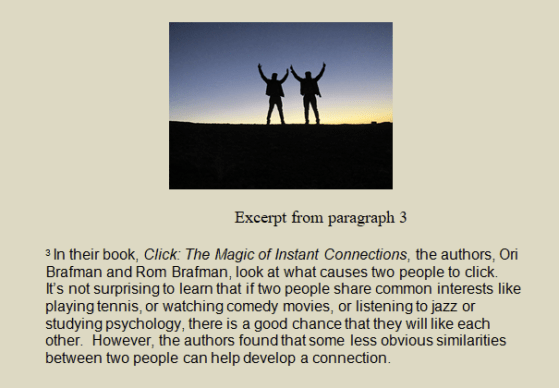
Click cover excerpt shot

*(This posting includes handouts which you are welcome to use with your students.)

See Select Category > ESL Reading Units Free: Reading for Insights (Introduction) for an introduction to these reading units. Reading Units: Reading for Insights (Introduction)

Article & Study Guide for Click: The Power of Similarities (Names)

Continue reading

• Making It Easier For Your Colleagues And Students To Agree With You.

I could see from my roster for the upcoming term that the infamous Eddie would soon be attending my Advanced ESL Writing class. Eddie was slowly making his way through our academic ESL program and was well-known for his sense of humor and for continually arriving late to class. Having heard from his previous teachers about the unsuccessful strategies they had tried to use to get him to come on time, I decided to try a different approach.

Coincidentally, around this time, I was preparing to make a proposal to our program director and instructors and was trying to decide how best to present it. To get our Writing Course students to read more, I decide to recommend that we assign them to read for an hour a week and write a brief reading journal.  And in order to not add more work for the teachers, I was hoping we could hire a person or two be a “Reading Journal Reader” who would read and write comments on the journals.  (For more details about using a “Reading Journal Reader,” see One of Best Uses of an ESL Program’s Funds—And a Giant Help to Teachers. )

Fortunately, I had recently listened to Psychologist Adam Grant’s podcast “Worklife” in which he tells about a skill we can use when we’re trying to initiate a request.  It’s counter-intuitive, but I’ve found, it’s quite effective.

Continue reading

• The Grammar Aspect with Most Mistakes by Language Learners: Prepositions

*(This posting includes handouts which you are welcome to use with your students.)

I discuss this posting about prepositions in this short videoGrammar Aspect with Most Mistakes: Prepositions

According to Brain Briefs by Bob Duke and cognitive scientist Art Markman, “… adults who learn a new language make more mistakes with prepositions than with just about any other aspect of speech.”

Most ESL teachers have probably been asked questions like this one that I had from one of my students, Camila, from Mexico: “Why do we say ‘I’m confused about’ rather than ‘I’m confused at’?”

It seems futile to try to explain the reasons or give rules for when to use certain prepositions. And even if we could formulate some, it seems unimaginable that students will stop while speaking or writing and ask themselves, “Now what was the rule for the preposition here?” Just the preposition “on” has 10 definitions.

How to learn prepositions

Markman and Duke summarize what many professionals (e.g. Krashen) in the teaching ESL field  have said about how to learn prepositions: “… the best way … is to hear them, use them, and allow your brain to recognize which ones are appropriate in different circumstances by taking into account both the meaning and the statistics of when they are used.  This kind of implicit learning requires a lot of exposure to the language …” (p. 127).

This doesn’t mean that the only role that a teacher plays in this is to just provide meaningful input through reading and listening.

Three ways teachers can facilitate students’ learning of prepositions

Continue reading