(This posting includes an attachment teacher’s script which you are welcome to use.)*
Many of us have been there: you call on a student during a whole-class discussion, and instead of an answer, you’re met with total silence.
Whether they don’t know the answer, are struggling to translate their thoughts, or simply lack the confidence to speak, the result is the same: the student feels stressed, the teacher isn’t sure whether to wait or move on, and the rest of the class starts to get restless.
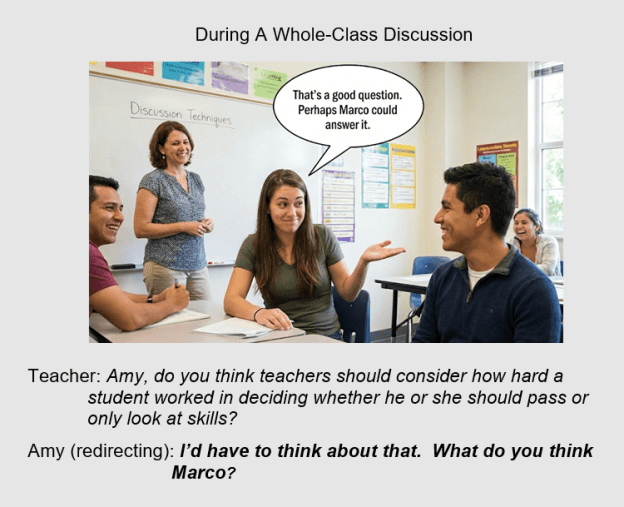
The “Escape Technique” provides students with a safety net. If they can’t answer within a reasonable amount of time, they are taught to use specific expressions to “pass the mic” to a classmate.
The “Escape” Phrases
- That’s a good question. I’d like to think about it first. Perhaps (a classmate’s name) could answer it.
- I’m not sure, but (classmate’s name), what do you think?
- I have no idea. How about you, (classmate’s name)?
When students use this technique, it can actually turn into a humorous situation. Almost any time a student has used one of these expression, it has elicited a lot of friendly laughter by the classmates and teacher. The classroom tension is immediately released.
To help your students become comfortable with this technique, you can use the handout and attached script, which I’ll explain about below.
The handout is composed of two pages: Whole Class Techn Redirecting
Page 1 is the Students’ handout which introduces the technique “Redirecting a question to a classmate when you don’t know what to say.” Also, it includes the above mentioned three commonly used expressions for doing this. This page also describes the two exercises that the class will do together to practice this technique.
Page 2 is the Teacher’s Script. This has two exercises:
Exercise 1: General-Topic Questions. The teacher reads one of the questions (e.g. “What will you probably eat for dinner tonight?”) He/She chooses a student to answer. However, instead of answering the question, that student says one of the expressions to redirect the question to another student, who then answers the question.
Exercise 2: The teacher asks discussion questions about a reading passage. In this handout, you will notice the questions are about the first unit in Cultural Differences. However, these can easily be changed to discuss a different reading passage that you would like your students to discuss whole class.
You can find the first two techniques for “Guaranteed Active Whole-Class Discussions” here:
Guaranteed Active Whole-Class Discussions (2nd Technique: Volunteering to Answer) and
Guaranteed Active Whole-Class Discussions (First Technique: Responding to Others)
If you are curious about Cultural Difference that is in part of the handout above, see this link for a sample. Best Subject for an ESL Integrated-Skills Class (Part 1 Overview)
David Kehe
Faculty Emeritus
*About the free-download materials. During my 40 years of teaching ESL, I have had many colleagues who were very generous with their time, advice and materials. These downloads are my way of paying it forward.
 Common Sense Teaching ESL