Tag Archives: handouts

• Another Conversation Activity: Listen to Partner and Ask Questions to Complete Information-Gap Chart (REVISITED)

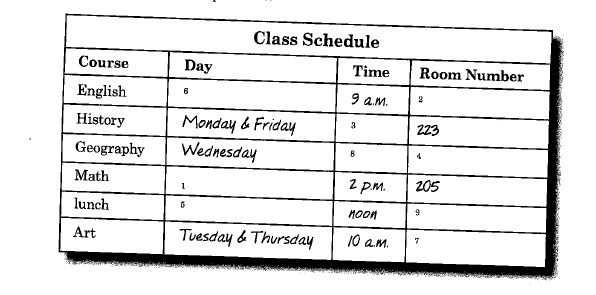
image schedule chart

(This posting includes a handout which you are welcome to use with your students.)*

At first, this pair-work activity looks like it’s about getting students to talk a lot by filling information in a chart.  But that’s not the most important value of it.

Yes, students will talk a lot during this.  But by including a short pre-exercise, they will see how they should ask clarification questions when they need more information or if they didn’t understand.  Asking clarification questions is the strategy that they can use in future conversation situations in and outside the classroom.

In this activity, the students will be filling in information about a class schedule.  They’ll need to listen to their partners tell them the name of courses, days, times and room numbers.  They’ll have many chances to ask questions, especially if they don’t understand.

There are three steps in this activity:

  • Step 1: Brief work with a model showing how to do Step 2.
  • Step 2: Pair activity (Student A/ Student B)
  • Step 3:  Exercise to do if they finish before other pairs have finished.

Continue reading

• Fluency Writing: Reading, Speaking In Triads, And Listening Culminating In A Writing Task (REVISITED)

Cover fluency shot

                                          Integrating the four skills

(This posting includes a handout which you are welcome to use with your students.)*

This is the perfect activity for integrating four skills into one activity.  And it culminates in a writing task in which students focus on controlling their grammar and on their sentence style.  It’s also one in which students can practice those two aspects of writing without having to spend time thinking about what to write.

These fluency activities can be used throughout a term when instructors would like to have students work on their grammar in a writing context and/or when they would like to add some group work in their writing classes.  Also, it’s a good lead-in to teaching paraphrasing skills.

Continue reading

• Short, High-Interest Readings: # 4: “Starting a Conversation With an Attractive Stranger”

Cover start conv shot

(This posting includes a handout LINK AT THE END OF THIS POST which you are welcome to use with your students.) *

You are standing with a couple of friends at a party talking. Across the room, you notice someone who looks kind of attractive, and you think that you’d like to meet that person. Maybe if he or she likes you, you’ll be able to get a phone number, or perhaps have a date. You feel a bit excited but also nervous about approaching this good-looking person.

Feeling nervous is a common emotion in this kind of situation. We are often afraid that if we try to start a conversation, the other person will reject us. According to Jean Smith, a social and cultural anthropologist, fear of rejection is the most common reason why we decide not to start a conversation with an attractive person whom we’d like to meet.

However, according to Smith, we can overcome that obstacle if we think in a different way about our goal of being liked or of getting a phone number or having a date. (See complete article below.)

For background information about these articles and for suggestions for how to use them with your students, see  • Introducing “Short, High-Interest Readings”  Also, I’ll be adding more of these articles in the right-hand column: ESL Reading> Short, High Interest Articles for Extensive Readings

Here is the fourth article. You can download the article for your students by clicking on the link at the end. Also included are three optional exercises: True-False Questions; Paraphrasing Exercise; Reflection Exercise.

Continue reading

• Short, High-Interest Readings:# 3 “Why Some Products Are Less Likely To Make It To The Recycling Bin”

Recycle over shot

(This posting includes a handout LINK AT THE END OF THIS POST which you are welcome to use with your students.) *

A researcher used to get upset. He often saw people throwing things in the wastebasket, for example soda cans or gum wrappers, that they should have put in the recycling bins. Then he became interested in why they do that. As a result, he set up some experiments.

In one study, 150 volunteer students were asked to give their opinion about a pair of scissors. (The students thought the study was about the scissors, but actually, the researchers were secretly studying recycling.)  They gave each of the students a sheet of paper. They told half of them to practice with the scissors by cutting the paper into eight pieces. The other half were told to just hold and practice squeezing the scissors but not cut the paper. (See complete article below.)

For background information about these articles and for suggestions for how to use them with your students, see  • Introducing “Short, High-Interest Readings”  Also, I’ll be adding more of these articles in the right-hand column: ESL Reading> Short, High Interest Articles for Extensive Readings

Here is the third article. You can download the article for your students by clicking on the link at the end. Also included are three optional exercises: True-False Questions; Paraphrasing Exercise; Reflection Exercise.

Continue reading