Tag Archives: handouts

• Stimulating Small-Group Discussion Activity 1: Which Is More Effective– I’m Calm or I’m Excited?

(This posting includes a handout which you are welcome to use with your students.)*

Some reasons why students seemed stimulated by this discussion:

1) They were surprised that they were currently feeling different emotions on that day.
2) They seemed interested to hear about different ways they coped with stress.
3) They were surprised by the findings of the research in the article and how they could apply that to their future.
4) They enjoyed comparing experiences giving speeches or performing.

Here is the basis for this discussion: Researchers have found that when we are in a stressful situation, we will be better at handling it if we say to ourselves that we are excited rather than try to calm ourselves down.

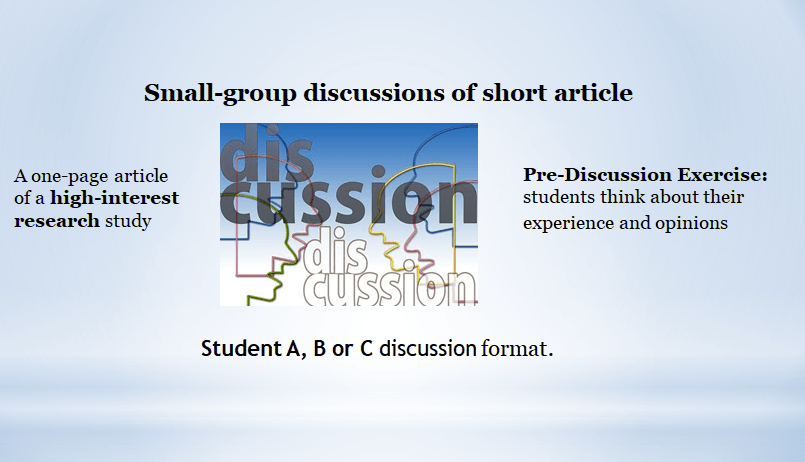
This and future discussion activities include four parts:

1) A one-page article usually including a brief summary of a high-interest research study.
2) Ten true-false comprehension questions.
3) Pre-Discussion Exercise in which students read and think about several questions about their experience and opinions about the topic before discussing them in groups.
4) Small-group discussions of the article in which each student is given a paper with different content/personal experience questions in the form of Student A, B or C.
5) Optional writing reflection activity.

About Discussion Activity 1: Which Is More Effective–I’m Calm or I’m Excited? and the handout.

Continue reading

• Tools for Describing Someone with Details: Inductive Writing Exercises (Low-Intermediate to Intermediate Level)


Describe someone Cover shot2

(This posting includes handouts which you are welcome to use with your students.)*

When written with enough details by students, a person description can be fascinating for teachers to read and can give them great insight into their students’ lives.

And, best of all, after they have learned some specific tools, students tend to have a lot of fun writing these.

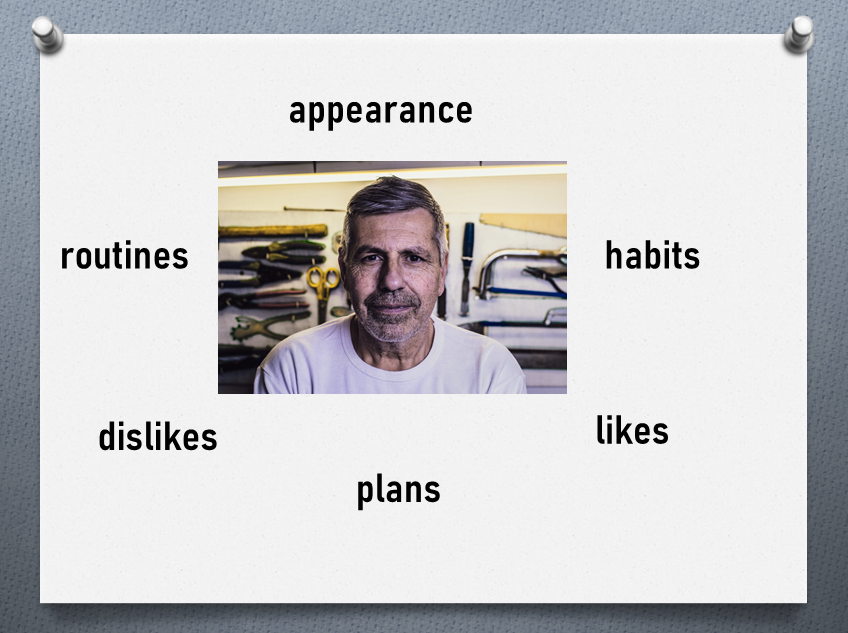
Needless to say, when we talk about a person-description writing assignment, most people first think about physical appearance.  However, that is only one aspect of a person that students can include in their papers.  There are several other characteristics that they can describe, for example, habits, routines, plans, likes, and dislikes.

Teaching These Tools Inductively

Continue reading

• One of the Worst Mistakes Conversation Teachers Make

Cover worst mistake conv shot

For some strange reason, some ESL instructors think they can improve any activity by making it as some kind of competition between students or between groups.  Unfortunately, doing this can be counterproductive and actually discourage the most serious students.

To illustrate, consider an information-gap activity like the one from a previous posting Another Conversation Activity: Listen to Partner and Ask Questions to Complete Information-Gap Chart  In this, pairs of students fill in missing information in a schedule by talking, asking questions, and using clarification strategies.

Imagine the teacher tells the students that he will give a prize to the pair who finishes the schedule first.  This is what will happen and how students will miss out on the skills that the activity is meant to develop.

Continue reading

• Another Conversation Activity: Listen to Partner and Ask Questions to Complete Information-Gap Chart

image schedule chart

(This posting includes a handout which you are welcome to use with your students.)*

At first, this pair-work activity looks like it’s about getting students to talk a lot by filling information in a chart.  But that’s not the most important value of it.

Yes, students will talk a lot during this.  But by including a short pre-exercise, they will see how they should ask clarification questions when they need more information or if they didn’t understand.  Asking clarification questions is the strategy that they can use in future conversation situations in and outside the classroom.

In this activity, the students will be filling in information about a class schedule.  They’ll need to listen to their partners tell them the name of courses, days, times and room numbers.  They’ll have many chances to ask questions, especially if they don’t understand.

There are three steps in this activity:

  • Step 1: Brief work with a model showing how to do Step 2.
  • Step 2: Pair activity (Student A/ Student B)
  • Step 3:  Exercise to do if they finish before other pairs have finished.

Continue reading