
*(This posting includes handouts which you are welcome to use with your students.)
See Select Category > ESL Reading Units Free: Reading for Insights (Introduction) for an introduction to these reading units.
*(This posting includes handouts which you are welcome to use with your students.)
See Select Category > ESL Reading Units Free: Reading for Insights (Introduction) for an introduction to these reading units.

(This posting includes a handout which you are welcome to use with your students.)*
Some reasons why students seemed stimulated by this discussion:
This and future discussion activities include four parts:
1) A one-page article usually including a brief summary of a high-interest research study.
2) Ten true-false comprehension questions.
3) Pre-Discussion Exercise in which students read and think about several questions about their own experiences about the topic.
4) Small-group discussions of the article in which each student is given a paper with different questions in the form of Student A, B or C.
(This posting includes handouts which you are welcome to use with your students.)*
 This posting is discussed on my YouTube video Handwashing and Motivation (Surprising pre-coronavirus research)
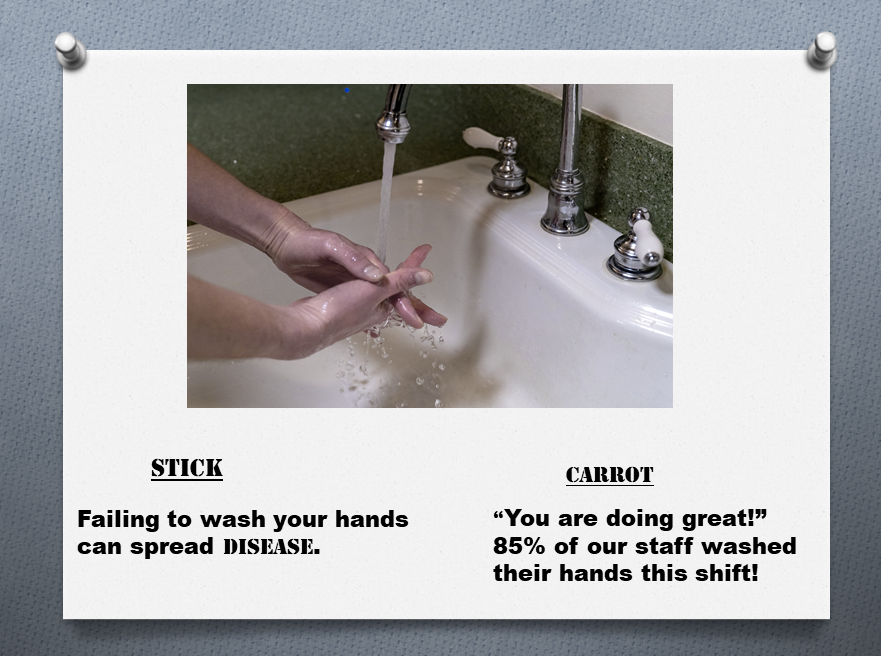
Several years ago, long before the coronavirus pandemic, researchers found that restaurant workers and hospital staff members were very negligent about washing their hands. This article discusses a clever study that was conducted to find a way to reverse this trend by comparing positive and negative messages. The results from the study can give us some interesting insights into how we might best motivate people in general.
2 We expect doctors and nurses to be aware of how important it is to wash their hands after they have examined or helped a patient. They understand that if they don’t, they could spread a disease from one patient to another. Surprisingly though, a researcher found that only 39% of hospital workers washed their hands properly. That is almost the same as the 38% of restaurant workers who do.
11 In sum, the researchers found that using a positive approach with the electronic board was much more effective than the negative signs about spreading disease. Every time the staff members washed their hands, they received immediate positive feedback. This positive feedback triggered a pleasure signal in their brains which they enjoyed getting. In other words, they tended to repeat this action in order to experience that pleasure signal. After a while, it became a habit, and they continued to do it even after the electronic boards were removed.

(This posting includes a handout which you are welcome to use with your students.)
In this video, I discuss how teachers can provide valuable feedback to students about how they are carrying out pair/small-group activities. I explain how the teacher can be observing students and keeping brief (realistic) notes for each student, even in large classes. I also share some user-friendly feedback forms which teachers can fill out and give to each student. See link below. This process can provide students with specific information about how they can improve their conversation skills when working in pairs/small groups.
Here is the link to the feedback forms that I had discussed in the video which you can download for free to use you’re your students:
For more video discussions about teacher ESL, visit my YouTube channel: . Student-Centered Teaching ESL by David Kehe
David Kehe
 Common Sense Teaching ESL