Tag Archives: handouts

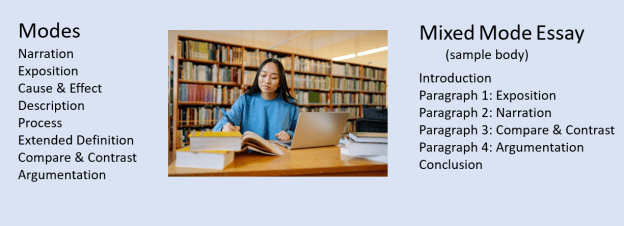
• Why We Teach the Modes in ESL Writing Courses and a Mix-Mode Essay

Cover Modes shot

(This posting includes a handout which you are welcome to use with your students.)

I was left speechless after reading Sayo’s essay. I didn’t know where to start because I couldn’t figure out exactly what she was trying to say.

When I asked her how a specific detail was connected to her topic, she said that she purposely didn’t explain that because she was showing respect to the readers who would figure it out without her explicitly saying it.

I also asked her about why she included an unrelated personal experience. She responded that she thought it would make her paper more interesting to read.

She concluded with a vague question that she hoped would give the reader something to ponder. It only left me pondering how the question was related to her essay.

I realized that Sayo’s essay demonstrated a cultural difference with regard to reader- versus writer-responsibility.  Apparently, English is a “writer-responsible” language; as such, it is the writer’s job to communicate ideas clearly to the reader.  On the other hand, in “reader-responsible” languages, (like Sayo’s) the burden is on the reader to understand what the writer is trying to say.  In reader-responsible cultures, it is presumed that the writer already shares with the reader certain knowledge that can, thus, be left unsaid. However, since readers in English are not accustomed to that role, frustration and communication breakdown can result.

What researchers have found about other cultural differences in writing papers.

Continue reading

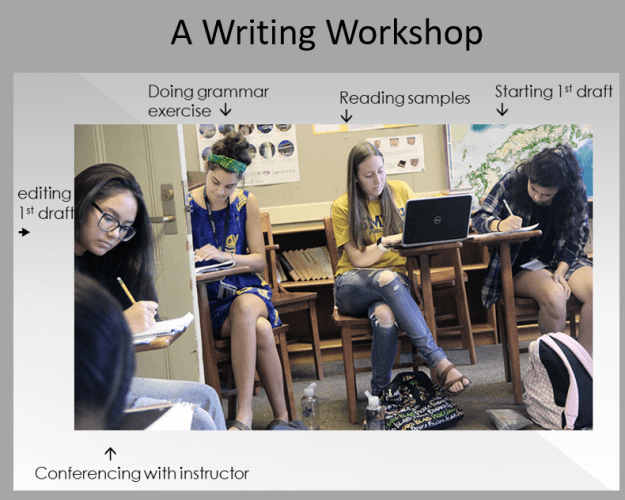
• The Writing Workshop: Countless Benefits for ESL Students and Teachers

Cover workshop revisited Shot

This posting includes sample lessons of a Writing Workshop that give students a lot of autonomy.*

This posting is an update of my February 1, 2019 post:  Most Important Motivator of Students: How You Can Do It

Since posting this back in 2019, I’ve heard from teachers who decided to try out a Writing Workshop with their ESL Writing classes even though they were skeptical at first. Their hesitation seemed to be doubtful that their students would actually be productive without more direct teacher control. However, they reported that their initial skepticism was quickly dispelled after seeing the same great benefits that I had described in the post below. Almost all of them stated that they couldn’t imagine teaching a Writing class in any other way in the future.

Here is that posting.

Continue reading

• Developing Paraphrasing Skills: Oral Paraphrasing Before Written.

Cover paraphrasing shot

(This posting includes a handout which you are welcome to use with your students.) *

YouTube I discuss this posting in this video: Developing ESL Paraphrasing Skills Naturally: Start with Oral Paraphrasing Exercise

A good paraphrase can demonstrate to the teacher that the student truly understood the source. And if it is clearly written in the student’s normal style and level of vocabulary, the teachers can feel reassured that the writer wasn’t plagiarizing.

Paraphrasing may be a new concept for many of our ESL student. However, we can help them understand how to do it in a way that will let them “experience” what a good paraphrase is through a very natural process.

Continue reading

• A Simple Technique for Writing Focused, Short Answers and Paragraphs on Tests

Cover essay questions shot

(This posting includes a handout which you are welcome to use with your students.) *

Advice from academic instructors: Give your ESL / ELL / International students practice writing short paragraph answers to test questions.

Academic instructors report that these types of questions tend to cause problems for our students:

  1. They are unable to finish within the time limit.
  2.  They don’t actually answer the questions.

Here is a simple technique that students can use which can actually resolve those two issues.

Continue reading