Tag Archives: engaging students

• Introducing any ESL Lesson: FIVE Effective Ways

COVER Intros

I need to start by making a confession. After I had been teaching ESL for about 10 years, I suddenly realized that I had become a bit careless about something important.

Here is what happened. As I mentioned, I was in my 10th year of teaching ESL, and I was asked to teach a course to American university students who wanted to become ESL teachers. One day, I planned to demonstrate a lesson. The first thing I decided that I need to tell them is that it’s really important to have a good introduction to the lesson. You don’t just want to tell students, open your books to page 23. Your assignment is to do Ex 4 and 5.
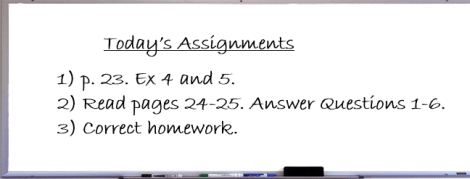
Slide 1

But wait! That is exactly how I had been starting my ESL classes recently. I realized that in my effort to get the lesson started, I had stopped doing a very important first step. And as a result, I missed an opportunity to stimulate and motivate my student.

So as I prepared to show my teacher-training students ways that they could introduce lessons, I returned to my days as a beginning teacher and started to use them once again with my ESL students. And I have to tell you, the results were amazing. I could see it in my students’ faces how much more energized and eager they were to do the activities. And I felt not only excited about teaching them but also confident in the importance of the activities they were about to do.

Perhaps the greatest motivator for students is feeling like they are working toward something worthwhile and are doing something important. We can satisfy this need in students by explaining the reason for the assignment.

So here are four great techniques that you can use to introduce your lessons.

Continue reading

• Going Beyond Learning Language Skills in ESL Courses.

Cover Integ Revised going beyondIt’s understandable that ESL teachers would like to include something more than language-skill development in their courses. However, this desire can become a mission which can override the real needs of the students.

Teachers who have a passion about a topic, for example, the environment, social justice, animal rights, racism, and technology, can feel, as one colleague explained, “This topic is very important for all students to know about.” This can lead to a theme for a course in which the focus of each lesson is about that topic as students read, write and talk about it and learn the specialized vocabulary connected to it.

A problem can arise when the theme starts to overshadow skill building. For example,
when working on reading skills, if a reading passage has “important” content but is above the students’ reading levels, the teacher will “orally” explain what they read. Students are evaluated on how much they knew about the content rather than on their language-skills development.

As another example, if the conversation or discussion skill that is supposed to be developed during the course isn’t naturally applicable to the theme, it may not be practiced.

Teachers at the next level might find students with a lot of knowledge about causes of air pollution or the challenges of recycling or discrimination in hiring practices or the potential of AI or social media, but weak language skills.

Fortunately, it doesn’t have to be an either-or situation; in other words, we don’t have to choose between skill development or content.

Engaging content and skills development. It is possible to have both.

Continue reading

• Effective Two-Way Tasks at Higher as Well as Lower and Intermediate Levels

Cover 2 way SHOT

(This posting includes a handout which you are welcome to use with your students.)*

This posting is an updated version of a post from Feb. 2, 2017: Conversation class: Necessary ingredients for successful pair work (from research)

Early in my career, I became a big fan of two-way tasks in my lower- and intermediate-level Conversation classes.

After several terms of teaching those levels, I was assigned to teach an Advanced Discussion class for the first time. In keeping with the spirit of student-centered teaching, I (as the teacher) wanted to avoid being the one to lead the discussions, so I put students in groups with a list of questions to discuss. However, I soon realized that some students were sitting passively and others tended to monolog.

Then I had an epiphany. By applying the two-way task principle to discussions, I could assure that every student would be equally active.

Basically, each student in a group is given different information. For discussions, every group has a Student A, B and C (and sometimes D and E) and the discussion questions are divided among them. Just as in a two-way task activity, this requires every group member to be involved in asking the questions, in active listening and responding.

For sample activities of how a variation of the two-way-task format can be applied to discussion, see *ESL Discussions: Free Small-Group Discussion Units

We can also use this format to help Advanced-level student develop discussion skills such as:

Continue reading

• LINCS Topic 4: What are some ways that we can include interactive activities in ESOL Writing class?  

Cover 4 interactive REV

 (This posting includes a links handouts which you are welcome to use with your students.) 

This posting is a more detailed response to my interview question on Day 4 LINCS Discussion: Student-Centered Approach to Teaching Writing Skills. .

Below in blue, you’ll find the details that I’ve added to the Day 4 LINCS’ posting.

I have some interactive activities that I include during each writing unit.

They do give variety to a writing class, but more importantly, they are effective in helping students develop their writing and editing skills.

1) Writer-in-control peer editing. Type 1: Writers prepare questions.

In traditional peer-editing activities, the students read a classmate’s essay and give feedback by filling out a teacher-provided questionnaire, rubric or checklist. (For example, “Is the topic sentence clear?” “Are the verb tenses correct?”)

For this non-traditional approach below, the writers have control over the type of feedback they want. Here are the steps:

Step 1: (A model) Sample essay and peer editing questions. In order to demonstrate to students how they will peer-edit with a classmate and the type of questions that they can ask, they work with a model essay with peer editing questions that the “writer” has asked.
(See link to a model exercise below.) After working with a sample, they then apply this technique to their own essays, starting with the Preparation Step.

Step 2: Preparing for Peer Editor. After students have written their essays, they identify specific parts of it in which they’d like a peer’s advice.  These could be about the grammar in some sentences, clarification of an example, a need to add details etc. On a separate piece of paper, they write questions about these parts that they will ask a peer-editor. For example, “Look where I wrote #1. Is my example clear?” “Look where I have #4. Is there a problem with this sentence?” “Look at #8. How can I improve my conclusion?”

Continue reading