Tag Archives: engaging students

• Great Whole-Class Game for ESL Listening Skills (Revisited)

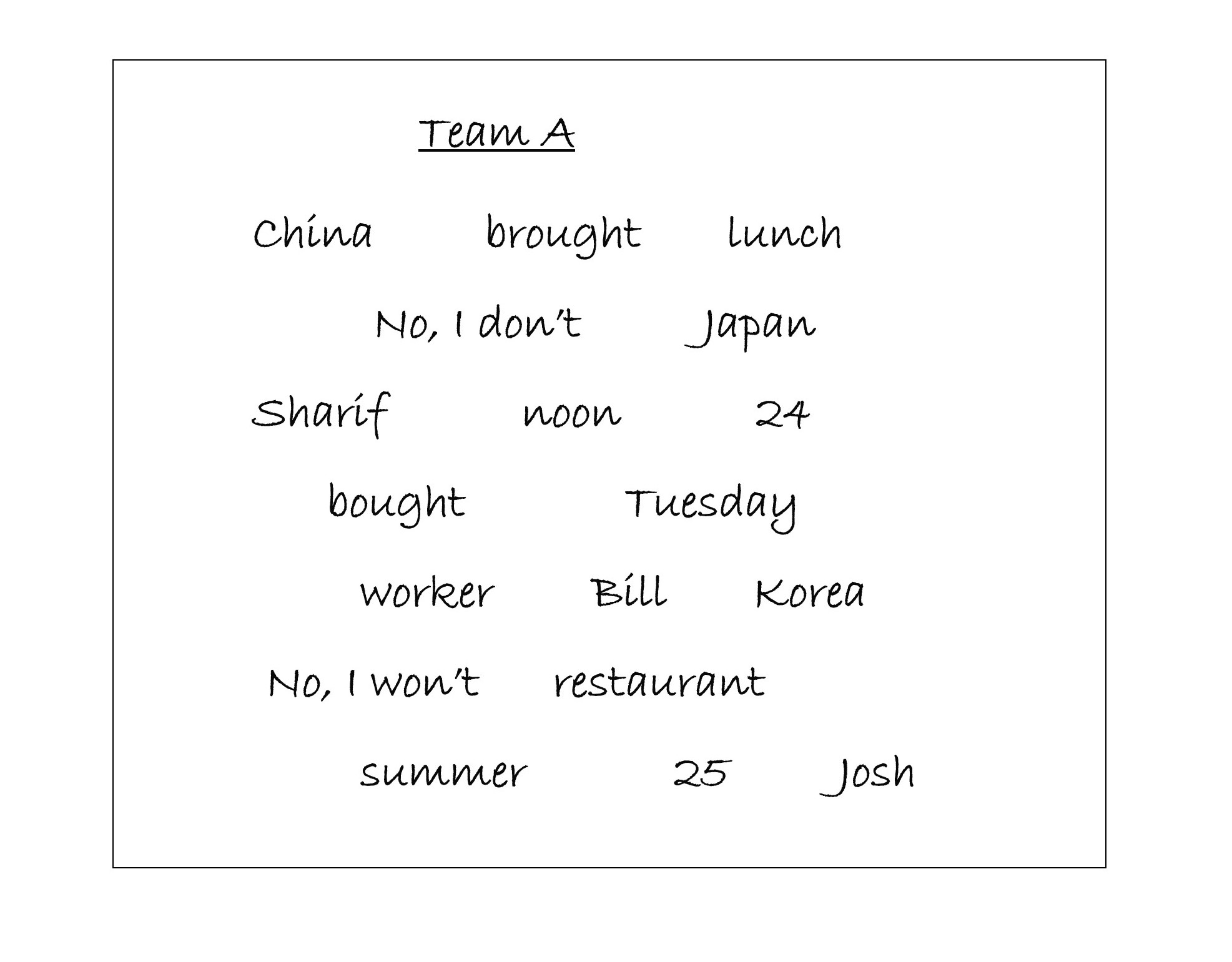
Cover Team A shot

This game has it all:

  • Motivates listening skills.
  • All students focused.
  • Students are up and out of their seats.
  • Easily customized to the interests and level of a specific class of students.
  • Organized with minimal teacher work.
  • Stimulating with a lot of laughing.

Here is how it works.

Continue reading

• Short, High-Interest Articles for Extensive Reading: # 14: “Why It’s Hard to Apologize”

(This posting includes a handout LINK AT THE END OF THIS POST which you are welcome to use with your students.) *

Last week, Emily took her driver’s test but failed. At dinner, she told her family but asked them all to promise not to tell anyone because she felt embarrassed. Yesterday, a friend, Jay, said to her, “Your sister, Kara, told me that you failed your driver’s test. Are you going to take it again?” That afternoon at home, Emily was upset and told Kara, “Kara, I asked you not to tell anyone one about my test, but Jay said that you told him.” At that moment, Kara knew she should say sorry, but she didn’t want to. There is a common saying, “Three of the most difficult words for people to say are, ‘I am sorry.’”

(See complete article below.)

For background information about these articles and for suggestions for how to use them with your students, see  • Introducing “Short, High-Interest Readings”  Also, I’ll be adding more of these articles in the right-hand column: ESL Reading> Short, High Interest Articles for Extensive Readings

Here is the 13th article. You can download the article for your students by clicking on the link at the end. Also included are three optional exercises: True-False Questions; Paraphrasing Exercise; Reflection Exercise.

Continue reading

• Motivating Students Through Flow Experiences

It was a teacher-experience that I would have paid good money for. My students had been working individually. With one minute left in the class, I softly told them that it was time to stop for the day. Some of them sort of jumped when they heard my voice and looked at the clock. Then a few of them slowly started to pack up their stuff. But most of them continued to read and write, finally standing up a few minutes later.

On my way home, reflecting on what I had just observed in that class, I realized that my students were probably in a state of flow. Deconstructing the lesson, I noticed that it contained many of the characteristic that researchers say promote flow. And after seeing my students’ responses, I became determined to apply as much as I could to future lessons. And that is what I have tried to accomplish in the sample activities below.

Why should we care about flow? Research has found that people who reportedly experienced flow in an activity tend to spend more time doing it and do it better. Also, they do it for intrinsic reasons; in other words, they felt enjoyment and satisfaction from the activity itself.

My students who seemed to have been in a flow state were probably experiencing characteristic described by researchers. They lost a sense of time; what they were doing seemed effortless; and they were especially focused.

Setting up activities to encourage flow experiences Continue reading

• Short, High-Interest Articles for Extensive Reading: # 13: “The Types of People Who Drive Loud Cars And Motorcycles That Bother Other People”

(This posting includes a handout LINK AT THE END OF THIS POST which you are welcome to use with your students.) *

You and a friend are sitting in an outdoor café next to a street lined with stores and shops. Suddenly, you can’t hear your friend because a car with a loud muffler drives past. After a minute, you are able to continue your conversation. However, five minutes later, a loud motorcycle stops next to the café waiting for the traffic light to change. While waiting, the driver revs his motor. In other words, he makes his motorcycle sound loud without moving it. You and your friend finally decide to move inside the café to escape the noise.

Researchers have conducted studies to try to understand the reasons why some people want their cars or motorcycles to be so loud. They found four different reasons. Most of these noisy drivers are young men between 18-35 years old. Perhaps they haven’t been very successful in school or sports or in a job or in dating, so nobody notices them. Loud vehicles can change that.

(See complete article below.)

For background information about these articles and for suggestions for how to use them with your students, see  • Introducing “Short, High-Interest Readings”  Also, I’ll be adding more of these articles in the right-hand column: ESL Reading> Short, High Interest Articles for Extensive Readings

Here is the 13th article. You can download the article for your students by clicking on the link at the end. Also included are three optional exercises: True-False Questions; Paraphrasing Exercise; Reflection Exercise.

Continue reading