Tag Archives: engaging students

• I Stopped Trying to Catch AI Plagiarism. Here’s What I Do Instead.

Dealing with students who plagiarize now seems like a piece of cake compared to ones who now use AI to write their papers. I could usually deter students from plagiarizing by demonstrating how easy it is for teachers to find it.

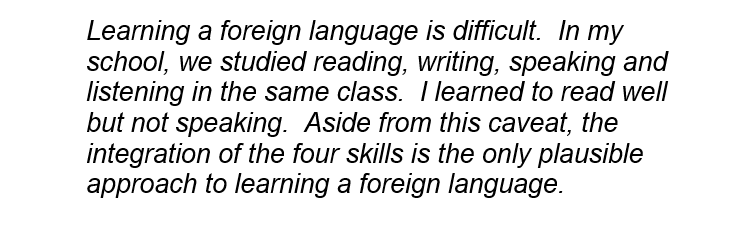
Early in a term, I would show this paragraph that may have been written by a student:

I’d ask them if they thought the writer had copied any of the sentences from a source. Unsurprisingly, they always spotted the last one. It was a clear signal: if a student can identify it, a teacher definitely can.

However, the rise of AI has shattered that approach.

Why the old technique doesn’t work anymore

Now, I can no long claim that it’s easy to find plagiarism using the sentence, “Aside from this caveat….” If a student plugged that into AI, it could come out as, “Even with this problem, I still think that learning the four skills together is the best way to study a foreign language.”

The vocabulary is simpler, the tone is conversational, and it is incredibly difficult to prove the student didn’t write it themselves.

According to reports from NPR and other outlets, many schools are spending thousands of dollars on AI-detection software. Yet, research shows these tools are far from reliable and frequently produce false positives. Few things are more discouraging for students than working hard on a paper and then being accused of not writing it themselves.

The “Incentive” Approach

Continue reading

• Entering a Lesson with Predictions (Part 1: Pre-Listening Activities) (Updated)

Cover pre listening Pt 1 slide

(This article was originally published in MET (Modern English Teaching) in Spring 1986.)  MET website

It may come as a surprise to any number of teachers to realize that most students do not view their ESL class as the number one preoccupation in their lives. Students come into the class with a myriad number of matters on their minds: weekend plans, family problems, the test in the next class. To foster a classroom atmosphere conducive to students’ leaving behind their outside world and to their focusing attention on the lesson at hand (not to speak of their becoming personally involved in the subject material!) can be an exacting task. Many of us as teachers have seen the otherwise well-planned lesson go “awry”, or just not fulfill our expectations. It may always remain open to speculation as to the reasons why, but most would probably agree that a thoughtfully-prepared lesson does indeed deserve a proper “entry”.

In order to help students to focus on a particular day’s material and to become personally involved in its content, I have found a “prediction process” useful as just such an “entry” into listening and speaking activities. In brief, in the “prediction procedure,” my students make predictions about the content of an upcoming activity and then share their predictions, first in small groups and then with the class as a whole. By so doing, students end up not only focusing on the topic of the material at hand, but also investing a part of themselves in it; they have a “stake” in what follows

Following are detailed examples of this procedure as it was used in four actual classroom settings.  In this Part 1. the two  examples portray the “prediction procedure” acting as an “entry” to listening activities.

In my next posting, Part 2, the two examples describe the procedure as it leads into discussion activities.

Continue reading

• Great Whole-Class Game for ESL Listening Skills (Revisited)

Cover Team A shot

This game has it all:

  • Motivates listening skills.
  • All students focused.
  • Students are up and out of their seats.
  • Easily customized to the interests and level of a specific class of students.
  • Organized with minimal teacher work.
  • Stimulating with a lot of laughing.

Here is how it works.

Continue reading

• Short, High-Interest Articles for Extensive Reading: # 14: “Why It’s Hard to Apologize”

(This posting includes a handout LINK AT THE END OF THIS POST which you are welcome to use with your students.) *

Last week, Emily took her driver’s test but failed. At dinner, she told her family but asked them all to promise not to tell anyone because she felt embarrassed. Yesterday, a friend, Jay, said to her, “Your sister, Kara, told me that you failed your driver’s test. Are you going to take it again?” That afternoon at home, Emily was upset and told Kara, “Kara, I asked you not to tell anyone one about my test, but Jay said that you told him.” At that moment, Kara knew she should say sorry, but she didn’t want to. There is a common saying, “Three of the most difficult words for people to say are, ‘I am sorry.’”

(See complete article below.)

For background information about these articles and for suggestions for how to use them with your students, see  • Introducing “Short, High-Interest Readings”  Also, I’ll be adding more of these articles in the right-hand column: ESL Reading> Short, High Interest Articles for Extensive Readings

Here is the 13th article. You can download the article for your students by clicking on the link at the end. Also included are three optional exercises: True-False Questions; Paraphrasing Exercise; Reflection Exercise.

Continue reading