Tag Archives: activities

• IMPROVING Six Popular ESL Activities: Making Them More Than Just Talking PART 2

Cover Pt 2 shot

In this Part 2 of IMPROVING Six Popular ESL Activities, I’ll discuss how three popular activities are traditionally used and ways that they can be made more stimulating and conducive to conversation-skills development. Here is the link to Part 1. How to IMPROVE Six Popular ESL Activities: Making Them More Than Just Talking PART 1

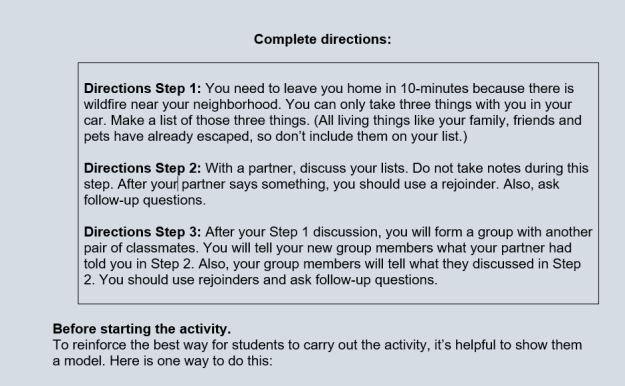
 Activity 4: Desert Island

Desert Is 1 shot

Desert Is 2 RE Rev shot

Desert Is 3 shot

RECOMMENDATION: It’s helpful to tell students a day or two in advance that they will be doing this activity so that they have time to think about the items that they would want to take in their cars.

Her is a link to a short video where you can see a demonstration of how this “better” activity works and more explanation about its many improvements over traditional Desert Island: A Better Way to do Desert Island

Activity 5: Ask a Partner Questions

Continue reading

• How to IMPROVE Six Popular ESL Activities: Making Them More Than Just Talking PART 1

Better Way Pt 1 Cover SHOT

You’ve probably seen some of these activities demonstrated at ESL teaching conferences or on some internet sites or on YouTube videos with titles like: “The 10 Best Speaking Activities.” The activities are usually promoted as a way to get students to talk. However, professional teachers don’t assign activities just to get students talking. They try to make sure that students are developing some specific technique or conversational strategy during the activity. There are ways to make these activities more than just talking, and there are ways to alter them to facilitate conversational skill-building, and there are ways to format them to be more stimulating for the students.

In this posting (Part 1), I’ll discuss three of the six activities, and in (Part 2), IMPROVING Six Popular ESL Activities: Making Them More Than Just Talking PART 2  I discuss the other three.

The postings will have two sections:
 Section 1: I’ll describe the activities
 Section 2: I’ll describe conversational skills that students could apply during the  activities and three different ways that you can model the conversational techniques which they should use during the activity.

Section 1: Activities

20 Quest Chart shot

Her is a link to a short video where you can see a demonstration of how this activity works and more explanations about its many improvements over traditional 20 Questions: Video A Better Way to do 20 Questions

Continue reading

• ESL Students Won’t Progress In Conversation Skills Without This Technique.

Cover blah pt 1 shot

YouTube This posting is discussed on my YouTube video YouTube ESL Students Won’t Progress In Conversation Skills Without This Technique

(This posting includes a handout which you are welcome to use with your students.)

In her book, What Shamu Taught Me About Life, Love, and Marriage: Lessons for People from Animals and Their Trainers,  Amy Sutherland describes how “progressive” animal trainers help animals who may feel nervous about anything new or that they are not accustomed to. One way is called desensitizing. She explains, “When you counter-condition, you take a negative experience and make it a positive one by pairing it with something good.”

cavy shot

She gives the example of a cavy, which is a South American rodent, who was terrified of the humans at the animal training school. Anytime that it needed vet care, it had to be caught, which meant chasing it around its cage, and this made it even more terrified of humans. The animal trainer set up a counter-conditioning. Each day she would enter the cavy’s cage and move just an inch closer. If the cagy didn’t hide behind a bush, the trainer would reward it with an alfalfa pellet. Overtime, the cavy allowed the trainer to come closer and closer, until one day the animal ate some pellets right out of the trainer’s hand.

I realized that desensitizing our ESL students to a “negative experience” could help them become more open to using an important technique, just as it helped the cavy.

“I’m sorry. I didn’t understand that.”

For many language learners, it seems so hard to say this or a similar phrase. For some, it can be embarrassing to appear less proficient than others (e.g. classmates) seem to be. Some don’t have confidence that they’ll understand even if their interlocutor repeats slower or rephrases what was said. Others don’t want to take up the other person’s time having to explain or simplify what they had just said.

I, myself even as an adult, was like this when I was trying to navigate my way around France or Japan. If the situation wasn’t dire, I usually just nodded like I understood and thanked them. But at times, when I really needed the information, I put aside my ego when I couldn’t understand and said in French or Japanese, “Excuse me. Could you repeat that?”  To my amazement, nine out of ten times, the people adjusted their speech by speaking more slowly, and/or used easier vocabulary, pantomimed, and sometimes even used some English. Over time, I became desensitized to those negative emotions I had felt about saying, “I didn’t understand.”

Classroom activities to make it easier and natural to ask for clarification. (Handout included.)

Continue reading

• Four-Part Series: Why, How And When to Teach ESL Integrated- and Discrete-Skills Courses. 

Revised Cover 4 parts shot

(This posting includes a handout which you are welcome to use with your students.)

This posting expands on the discussion in the most visited posting on Common Sense Teaching ESL:  Integrated vs Discrete Skills ESL Courses: Advantages of Discrete Skills

In that posting, I explained the many advantages there are for both students and teachers when Conversation, Reading, Writing and Listening are taught in separate classes.

However, it may not be possible to teach them separately due to the structure of the ESL program. And on top of that, there is a situation in which integrating the skills around one subject or topic in one course has several important advantages for students.

YouTube To explore this more, I put together a four-part YouTube video series.

In PART 1, I discuss the best way to teach students in a LOW- or INTERMEDIATE-LEVEL class in which all four skills need to be taught in one class due to the program’s design. Here is the link to the video: Teach All ESL Skills in a Class But NOT Integrating Around a Topic-PART 1 Integrated/Discrete Skills

In PARTS 2, 3 & 4, I focus on ADVANCED-LEVEL classes. At this level, especially in Academic ESL programs, an integrated-skills course that revolves around a topic or subject area can best mirror the types of mainstream (non-ESL) college classes which student will be taking.

About PARTS 2, 3 and 4. (Including a link to two academic, integrated-ESL skills units for advanced levels which you can download for free to use with your students.)

Continue reading