• ESL Teachers See The World Differently

I’ve experienced envy. I’ve witnessed my friend pick up a sheet of music and soon begin nodding his head in rhythm with what he saw on the page. Similarly, I’ve seen my wife stifle tears as she watched scenes of horses competing in show jumping. Also, I once happened to be riding on a country road in my uncle’s pick-up truck driving from his farm to town and noticed him slowing down to stare out at neighbors’ fields of corn.

They were all looking at the same thing as I was, but what they saw was a world that I couldn’t imagine. And I was sure that this ability of theirs was enriching their lives. Why couldn’t I have something similar in my life?

Then one day at school, I discovered that I actually did have something but just never realized it.

Continue reading

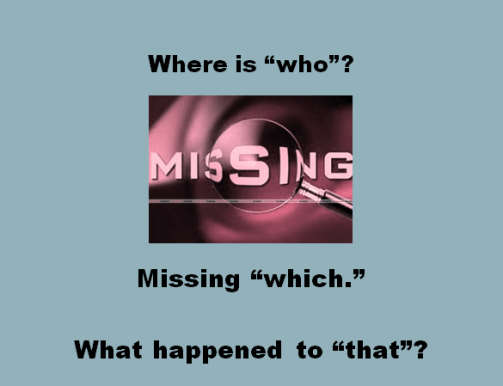
• Missing WHO and WHICH/THAT: Common ESL Problem and Solution (Revisited)

Cover missing who Shot

*(This posting includes a handout which you are welcome to use with your students.)

Sometimes I get the feeling that some of my ESL students (including advanced ones) believe that there are a limited number of “who” and “which” out there, and they are afraid of using them all up before they die.

The problem happens when students are trying to write more advanced styles with a dependent and independent clause in a sentence.

Some examples:

Mistake: The people are walking their dogs should keep them on a leash.
Correction: The people WHO are walking their dogs should keep them on a leash.

Mistake: I try to give money to scholarships help low-income students.
Correction: I try to give money to scholarships WHICH help low-income students. *

I’ve also notice that this mistake often happens when students start a sentence with there”.

Mistake: There was an accident happened near my house.
Correction: There was an accident WHICH happened near my house.

* We could substitute the word THAT for WHICH in these sentences.

Solution: Helping students with this. (Handout included.)

Continue reading

• A Case For Marking Every Mistake On Essays

Lane was worried that her students would become discouraged if they saw a lot of mistakes marked on their papers. So to help them develop confidence in their writing skills, for the first essays that they turned in at the beginning of each term, she was very selective about which mistakes she marked. Thus, their first grades were all relatively high. Unfortunately, this approach had some less-than-desirable outcomes, not only for her students, but also for their teachers at the next level.

First of all, the message to the students was, “You don’t have to carefully edit—you can still get a good grade.”

Also, as the term progressed, she realized that several of the students were still making many mistakes, whether from poor editing and/or from lack of knowledge. At the end of the term, she had to decide to either fail those students, which would be a shock to them since they wouldn’t be expecting that, or pass them, which would be a burden for their next teacher, who would have to deal with students who didn’t have the skills necessary to be successful at that level.

A better approach has been to mark every mistake as long as the teacher is strategic when dealing with essays.

Continue reading

• ESL Conversation Class: What If They Make Mistakes In Pairs? Myths About Pair Work. (REVISITED)

Myths pair work cover shot

A teacher once said that she avoided pair work during conversation lessons because she wouldn’t be able to monitor all the students to catch their grammar mistakes.  Is this a legitimate reason?  Researchers have studied what, in fact, happens when students work in pairs with other students and when they work with non-native speakers which can dispel some of the mis-assumptions about the drawbacks to pair work.

Continue reading