Category Archives: *MOTIVATING ESL STUDENTS AND TEACHERS

These posting include techniques for motivating ESL students and perspectives for motivating teachers.

• Shaping a Student’s Behavior: A Solution-Focused Approach

Situation: Rob, an ESL student, had developed a reputation. During the past two terms, he tended to come to his classes late every day and turn in assignment late or didn’t do them. The quality of his work was so poor that he failed his Level 3 Writing course twice and was about to start his third time in it. It was the beginning of a new term, and as a program coordinator, I was asked for advice by Rob’s new Writing teacher about how to work with him.

In their book, Switch: How to Change Things When Change Is Hard, Chip and Dan Heath discussed an interesting approach that could help teachers redirect their ESL students like Rob. The approach is called Solutions-Focused Therapy (SFT).

 I decided to try this approach with Rob when I met with him after his class. In SFT, there is an assumption that there is an exception to every problem. In Rob’s case, we assume that there was an exception to his coming to class late and doing poor work. The exception would be a class in which he had come on time and performed well. Once we can identify that class (the exception to the present problem pattern), we can analyze it like a game film of a sporting event. We can replay it to see where things were working well. What was happening? How did he behave? How did he feel?

In my meeting with Rob, we had a conversation something like this:

Me: Tell me about a class that you’ve had when you usually came on time.
Rob: I always went to Ms. Sandy’s class on time.
Me: What do you think was different about Ms. Sandy’s class?
Rob: She’s nice.
Me (Trying to get more specifics.):What did she do that was nice?
Rob: She always said hi to me when I came to class. Other teachers kind of ignored me when I arrived.

Me: That is nice. Did she do anything else that you liked?
Rob: After she told us our assignments, she often came to my desk and asked me if I understood it and if I needed any help.
Me: Did you tell her if you were confused?
Rob: Yes. And sometimes she gave me a different assignment to help me.  I liked that.

Me: What did you do differently in her class from your other classes recently?
Rob: I always came to class on time. And I think I understood the assignments better and did them.
Me: How did you do in her class?
Rob: I think I did well. I passed it.

Me: Do you think that you could do the same thing that you did in Ms. Sandy’s class in your Level 3 class this term?
Rob: I think maybe I can come on time. And I can ask for help if I don’t understand.

The follow up

Continue reading

• Avoiding Writing-Teacher Burnout: Save Your Time And Energy With This Effective Method For Giving Specific Feedback.

Many teachers mistakenly believe that spending their precious time and energy writing long comments at the end of students’ papers is what Writing teachers should do.  As one instructor wrote in The Chronicle of Higher Education: “I am an English professor, and responding to student writing is what we English professors do…For 25 years, I have diligently, thoughtfully, and fastidiously written comments on my students’ essays. In my neatest hand, I’ve inscribed a running commentary down the margin of page after page, and at an essay’s conclusion I’ve summarized my thoughts in a paragraph or more.”

This instructor decided to stop writing comments on her students’ paper after she came to this realization: “Most students seemed to spend little time taking in my comments on their papers. They quickly skimmed, looking for the grade, and then shoved the papers into their bags.” Her solution: Instead of writing comments, she decided to meet in her office to discuss her students’ papers one-on-one.

For most ESL Writing instructors, meeting with students in their offices is not a realistic option. At the same time, writing long comments at the end of papers is often a waste of time and energy, just as that professor discovered.

It seems that there are two approaches to giving feedback to each student

General Feedback Approach

Part of problem with giving general feedback at the end of an essay is that the comments tend to be so generalized that there is little for students to apply to future writing assignments.  For example, here is what one teacher wrote:

Continue reading

• Enjoyable and Effective Awareness Activity for Changing ESL Students Classroom Behavior

Cover skits Shot

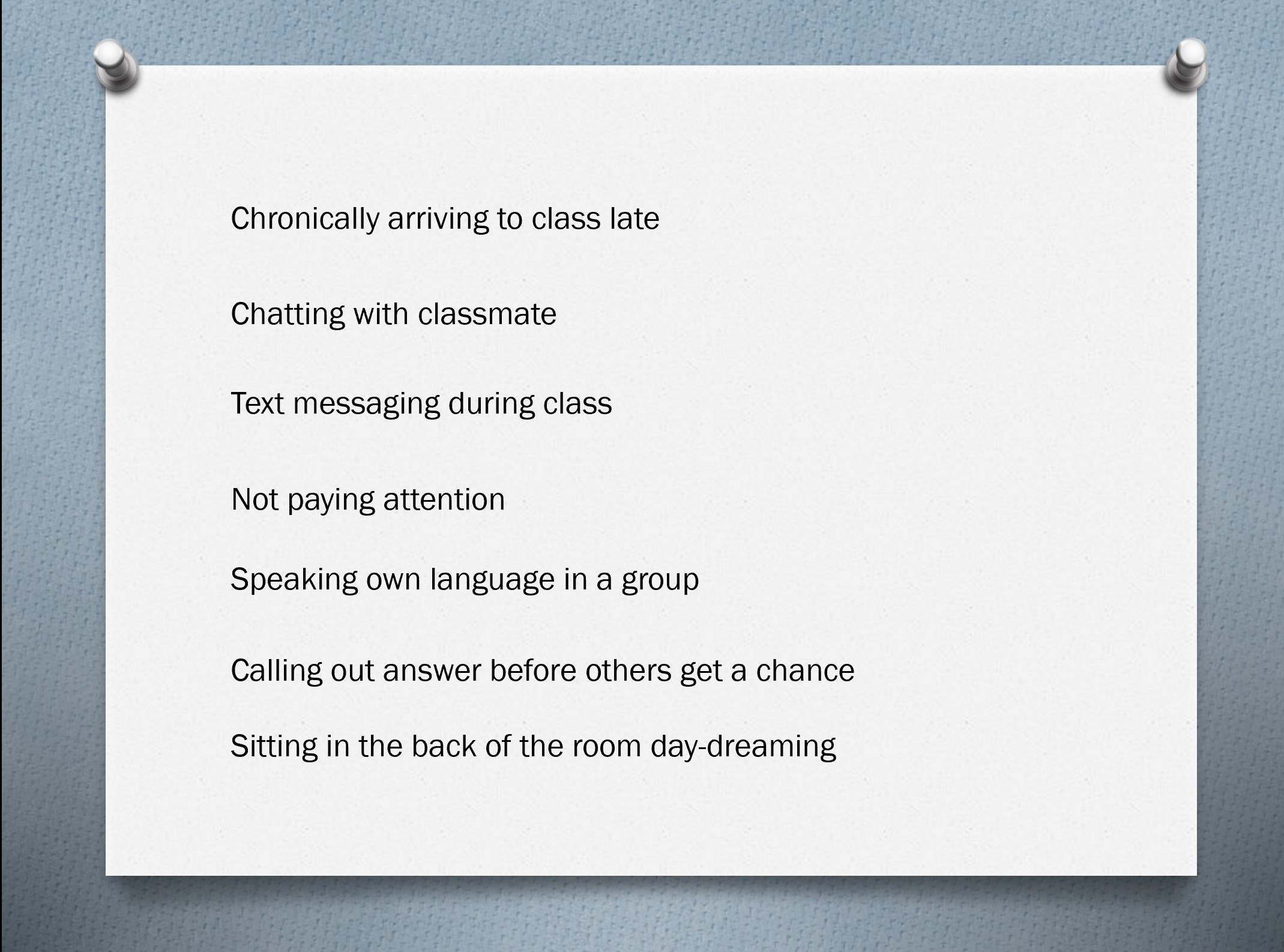
Most ESL students don’t do goofy things just to irritate the teacher. Usually, they are unaware of how they are coming across or not aware that they are acting differently from the other students or even what is expected of them.  These are some of the habits students tend to bring to our classes:

  • Chronically arriving to class late
  • Text messaging during class
  • Not paying attention
  • Chatting with classmate
  • Not participating in a group
  • Calling out answer before others get a chance
  • Sitting in the back of the room day-dreaming
  • No eye contact to teacher or classmates in a group
  • Speaking own language in a group
  • And more

To circumvent these habits and help students develop an awareness of expectations, in the two most recent ESL programs that I’ve taught in, we included some skits during our orientation of new students or during a workshop for students after the term had started. Not only did the students seem to enjoy them, but also we noticed far fewer students coming to our classes with these behaviors.

Here is how we did it.

Continue reading

• ESL Writing Workshop: Tremendous Benefits for Students and Teachers

Blog Workshop Cover Shot

(This posting includes a handout which you are welcome to use with your students.)

In this YouTube video, I describe the Writing Workshop Approach to teaching ESL writing skills. This approach has been successfully used by a large number of teachers. Some of the many benefits include motivating students by giving them autonomy and allowing teachers to conference one-on-one with students during the class time rather than outside class.

Here is the link to the YouTube video:ESL Writing Workshop on YouTube

Here is a link to where you can read more about the steps in the workshop approach and find a specific model lesson plan with free downloadable exercises/activities.

Continue reading