Category Archives: * MAKING ESL TEACHERS’ LIVES BETTER

• Saving Mental Energy: Give Two Grades on Essays

Thinking

(This posting includes a handout which you are welcome to use with your students.) 

Imagine that you read Mari’s essay in which she developed her ideas exactly the way that you had hoped she would.  But her grammar was very weak and even caused some confusion.  You are torn about what grade to give her.  You know that her grammar skills are not strong enough to succeed at the next level, so you don’t want to mislead her.  But you also don’t want to discourage her since her content was so good.

What grade should you give Mari?

Continue reading

• Most Effective Technique for Marking Grammar on Essays to Develop Self-Editing Skills

Cover codes in margin shot

(This posting includes a handout which you are welcome to use with your students.)*

Because this technique gives students a chance to discover their grammar errors, we have found students have greatly improved their self-editing skills.  And self-editing skills will be of great value to them as move beyond ESL courses.

Here is a description of the technique along with a handout exercise that will introduce students to it.

Continue reading

• For Large-Class Conversation Instructors, You Can “See” if Students are Using Techniques

Cover seeing shot

(This posting includes a handout which you are welcome to use with your students.)

You,the conversation teacher, are happy because the noise level in the room is high.  That means that the 12 pairs of students (24 total) are engaged in the conversation activity.   At the start of the next class, you want to give them feedback on their performance today, especially because you want to give positive comments to those who are very active.  There are also a couple of pairs who need some “re-direction.”

Needless to say, you’re not going to be able to give each student specific feedback specifically on what they said because you can’t actually hear them above all the talking.  But you can actually see whether or not they are using conversational techniques.

(See previous posts of two important techniques Conversation magic: Two most important conversation techniques (Part 1) and Conversation magic: Two most important techniques. (Part 2)

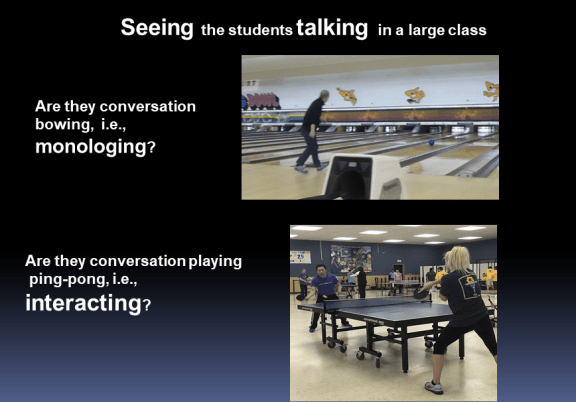
Even if you can’t hear them, you can see if they are engaging in a natural conversation; it looks like ping-pong, in which they are reacting to each other, asking follow-up questions and giving understanding responses.  You can also see if they are more like bowling, in which one monologs for a while while the other “zones out,” then the other monologs.  You can see if someone is dominating and if someone is very passive.  Interestingly, you can even see if they have switch from English to their native language; often when they do this, their voices lower and their faces aren’t as animated perhaps to “hide” from the instructor.

If you suspect that a pair isn’t using natural conversation techniques or isn’t speaking in English, there are things that you can do.

Continue reading

• Pleasures of “Marking” a Stack of Essays (Flow)

Experience flow Cover shot

Early in my career, I had a whisper conversation with two of my novice colleagues.  We had often heard several of our other colleague lament the fact that they had just picked up a set of essays and would have to spend several hours marking them.  To them, it seemed like drudgery, and they assumed all of us felt the same.  In private, the two novice colleagues and I were a bit surprised and relieved to find that we actually enjoyed the process of marking our students essays and giving them feedback.  We weren’t weird for feeling this way.   Over 35 years later, I still find this a rewarding experience.  One of the reasons is that it allows me an opportunity to experience flow.

A well-known research psychologist, Mihalyi Csikszentmihalyi (he has humorously explained that his name is pronounced “chicks send me high”) has described this state as having several characteristics.  Amazingly, in our job as ESL instructors, we often get to experience this.

Look at what happens when we are checking a set of essays and how that activity can lead to the euphoric experience of flow:

Continue reading