Category Archives: *FUN ACTIVITIES

• Entering a Lesson with Predictions (Part 1: Pre-Listening Activities) (Updated)

Cover pre listening Pt 1 slide

(This article was originally published in MET (Modern English Teaching) in Spring 1986.)  MET website

It may come as a surprise to any number of teachers to realize that most students do not view their ESL class as the number one preoccupation in their lives. Students come into the class with a myriad number of matters on their minds: weekend plans, family problems, the test in the next class. To foster a classroom atmosphere conducive to students’ leaving behind their outside world and to their focusing attention on the lesson at hand (not to speak of their becoming personally involved in the subject material!) can be an exacting task. Many of us as teachers have seen the otherwise well-planned lesson go “awry”, or just not fulfill our expectations. It may always remain open to speculation as to the reasons why, but most would probably agree that a thoughtfully-prepared lesson does indeed deserve a proper “entry”.

In order to help students to focus on a particular day’s material and to become personally involved in its content, I have found a “prediction process” useful as just such an “entry” into listening and speaking activities. In brief, in the “prediction procedure,” my students make predictions about the content of an upcoming activity and then share their predictions, first in small groups and then with the class as a whole. By so doing, students end up not only focusing on the topic of the material at hand, but also investing a part of themselves in it; they have a “stake” in what follows

Following are detailed examples of this procedure as it was used in four actual classroom settings.  In this Part 1. the two  examples portray the “prediction procedure” acting as an “entry” to listening activities.

In my next posting, Part 2, the two examples describe the procedure as it leads into discussion activities.
Continue reading

• Managing the “Awkward Silence”: The Escape Technique

(This posting includes an attachment teacher’s script which you are welcome to use.)*

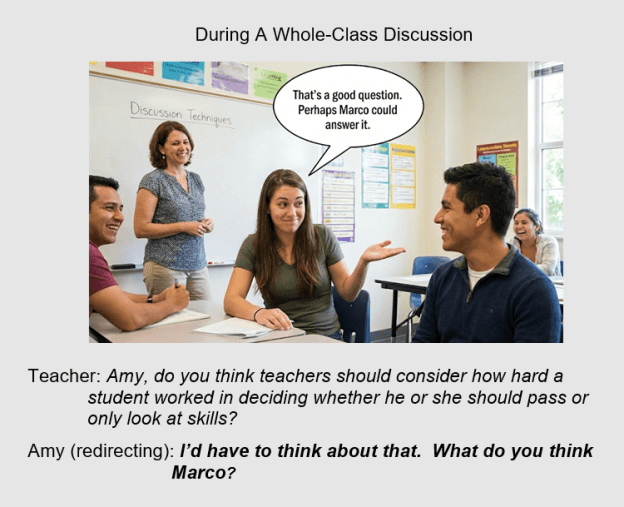
Many of us have been there: you call on a student during a whole-class discussion, and instead of an answer, you’re met with total silence.

Whether they don’t know the answer, are struggling to translate their thoughts, or simply lack the confidence to speak, the result is the same: the student feels stressed, the teacher isn’t sure whether to wait or move on, and the rest of the class starts to get restless.

The “Escape Technique” provides students with a safety net. If they can’t answer within a reasonable amount of time, they are taught to use specific expressions to “pass the mic” to a classmate.

The “Escape” Phrases

  • That’s a good question. I’d like to think about it first. Perhaps (a classmate’s name) could answer it.
  • I’m not sure, but (classmate’s name), what do you think?
  • I have no idea. How about you, (classmate’s name)?

When students use this technique, it can actually turn into a humorous situation.  Almost any time a student has used one of these expression, it has elicited a lot of friendly laughter by the classmates and teacher.  The classroom tension is immediately released.

To help your students become comfortable with this technique, you can use the handout and attached script, which I’ll explain about below.

Continue reading

• Great Whole-Class Game for ESL Listening Skills (Revisited)

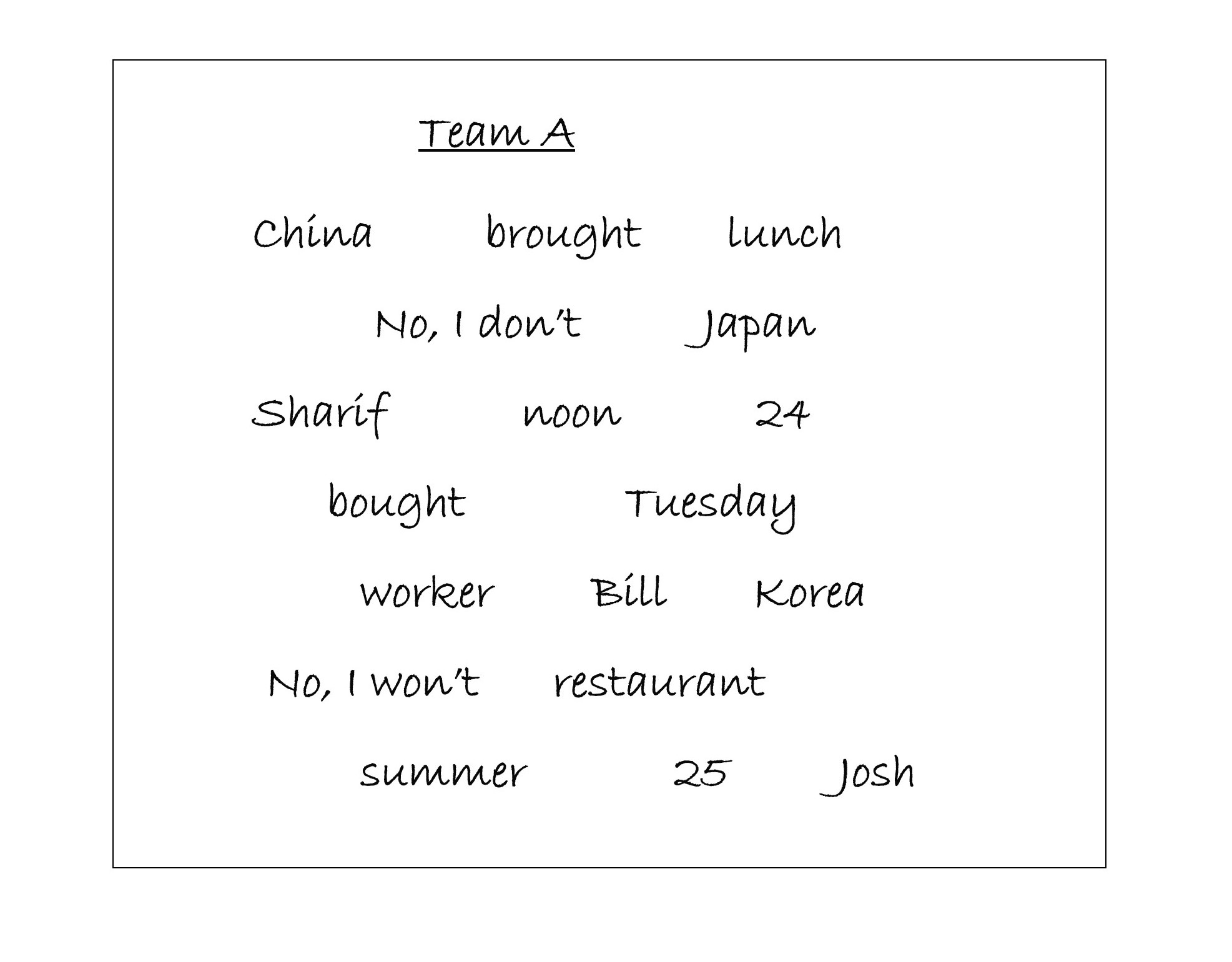
Cover Team A shot

This game has it all:

  • Motivates listening skills.
  • All students focused.
  • Students are up and out of their seats.
  • Easily customized to the interests and level of a specific class of students.
  • Organized with minimal teacher work.
  • Stimulating with a lot of laughing.

Here is how it works.

Continue reading

• Fun Activity To Reduce Irritating Classroom Behavior

(This posting includes a handout which you are welcome to use with your students.)

 (This is a revision to an earlier posting: Enjoyable and Effective Awareness Activity for Changing ESL Students Classroom Behavior)

Most ESL students don’t do goofy things just to irritate the teacher. Usually, they are unaware of how they are coming across or unaware that they are acting differently from the other students or even what is expected of them.  These are some of the habits students tend to bring to our classes:

  • Chronically arriving to class late
  • Chatting with classmate
  • Text messaging during class
  • Not paying attention
  • Not participating in a group
  • Calling out answer before others get a chance
  • Sitting in the back of the room day-dreaming
  • No eye contact to teacher or classmates in a group
  • Speaking own language in a group
  • And more

An effective approach to circumventing these habits is one in which students become aware of the effects these habits have on the teacher and other students. In this post, I’ll explain how programs that I’ve taught in were able to help students see how their behavior is viewed by others. Not only was the process enjoyable for the students, but also, we noticed far fewer students engaging in these behaviors.

Here is how we did it. 

Continue reading