Category Archives: • Writing Techniques

• Easy Editing-Awareness Technique for ESL Students

Cover edit ICE shot

This can drive a teacher crazy. You remind students to proof-read their paper before turning them in. However, after class, as you read them, you continually see basic grammar mistakes that you are sure they should have been able to have caught.

It’s quite common for ESL students to have a distorted view of their writing skills. They think that they can adequately edit their papers as they are writing, and thus, feel little need to re-read them before turning them in.  Little do they realize that a plethora of simple grammar and spelling mistakes on a paper can give the reader/teacher a lower opinion of the students’ skills.

I have found that the following little requirement has greatly transformed students into much more diligent self-editors.

Continue reading

• Powerful Tool for ESL Writers: Giving Examples in Essays.

(This posting includes a handout which you are welcome to use with your students.)*

A researcher asked people in a retirement home what they regret.  He found that older people regret not the things that they did, but rather the things they didn’t do, for example, never learning to salsa dance, never traveling the world or never learning to play a musical instrument.

That paragraph, from Brain Briefs by Markman and Duke, I think illustrates the importance of examples. Imagine what we’d wonder about had they not included those three examples.

I have found a great improvement in the clarity of my students’ writing and in my enjoyment of reading their papers after they’ve practiced using examples and then applied that tool. I’ve often noticed that they seem liberated by this tool. If they are struggling with how to explain something, they can almost always come up with an example to do it.

In this post, I’ll include:

  • Samples of places in a paper where an example would be helpful.
  • Samples of how students at different writing-skill levels successfully used examples to explain everything from simple ideas to abstract ones.
  • Effective and simple ways for teachers to indicate to students where to include them in their papers and to encourage their use.
  • Exercises to help students develop this tool that you can use with your students.
Continue reading

• Getting Students to Write More Interesting and Unique Ideas in Essays

Argumentation list

(This posting includes a handout which you are welcome to use with your students.)*

After your students do this exercise, reading their essays will be much more stimulating for you.

I felt a bit deflated while reading an essay by Jojo, one of my higher-level students. His title was “It’s Best to Marry Someone from a Foreign Country.” From reading his previous essays, I knew he had the potential to be a very good writer with interesting ideas, but on that essay, he just supported his opinion with content that I would expect from students at lower levels.  For example, here is his list of simple support for marrying someone from a foreign country:

  • We can learn a foreign language more easily.
  • We can enjoy eating different kinds of food.
  • We can go easily to a foreign country for vacations.

Although I don’t believe that we, as ESL instructors, should expect our students to keep us stimulated with deep ideas,  (see my posting “Wow” is not Necessarily the Goal in Students’ Essays) we should encourage those students who have the potential to push themselves to write beyond the mundane. This is especially true for our students who are planning to take English Comp and other academic classes with native speakers.

An exercise to help students develop awareness for writing more advanced and unique ideas (handout)

Continue reading

• The Huge Advantage International Student Writers Have Over Their American Classmates

COVER REV shot

(This posting includes a handout which you are welcome to use with your students.)*

YouTube This posting is discussed on my YouTube video  Huge Advantage International Student Writers Have Over Their American Classmates—A Writing Technique

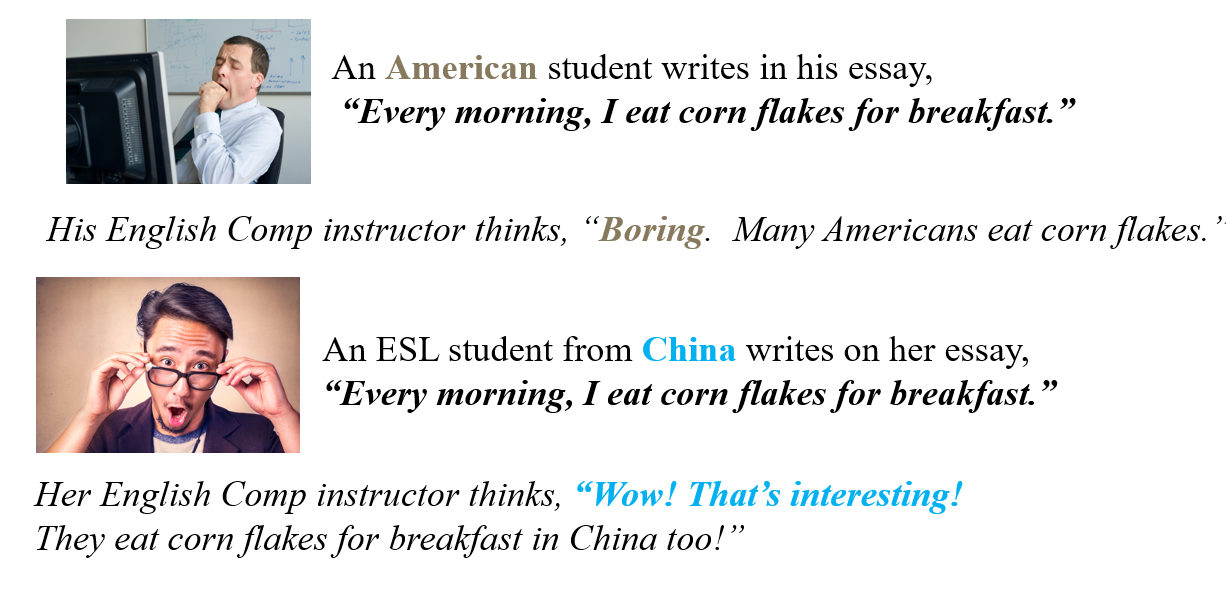
It can be liberating to ESL students to realize that almost anything that they can include in their essays/papers about their culture and country will probably be interesting to their American instructors.  This is a great advantage that they have over their American classmates.

However, just encouraging them to include this kind of information in their essays often results in paragraphs like this one from an essay about raising children:

In addition to teaching skills, parents sometimes need to discipline a child who misbehaves. Some people will spank their children in order to get their attention and redirect them.  However, in my country, parents very rarely do this.

The writer did include information from his country, but he missed an opportunity to exploit this information and make it more remarkable.  After being asked for more details, the writer revised the end of the paragraph:

… However, in my country, parents very rarely do this.  Instead, if a child refuses to listen to his mother or throws a tantrum, his mother will tell him to stand outside the house. The worse thing that can happen to someone in my culture is to be excluded from the group, so this type of punishment can be very effective.

An Inductive Approach to Teaching this Technique (and handout exercises)

Continue reading