Category Archives: *ESL WRITING

These postings include writing activities, teaching techniques and strategies for evaluating writing skills.

• Recommended Treasure Chest for Writing Your Own ESL Materials

Treasure Cover shot

I wanted to encourage my Writing students to include information from their own country to support their ideas in their essays. If done well, this kind of information can be very enthralling for anyone who reads their papers. (See • The Huge Advantage International Student Writers Have Over Their American Classmates )

The problem was that, when they tried to do this, the information was often too general, which made it sound kind of trite. So, I decided to write an exercise in which they would see how effective detailed information could be.

For the exercise, I wanted to juxtapose weak short paragraphs with few details to strong ones with more , and then have students identify each type. The challenge for me was to come up with stimulating content for these short paragraphs.

Fortunately, I had a treasure chest filled with interesting content that I could draw from. And as I’ll demonstrate below, this treasure chest has been my go-to place when writing materials for all the other skills too.
Here is what is in my treasure chest.

Continue reading

• Effective, Stress-Free Approach to Dealing with Plagiarism.

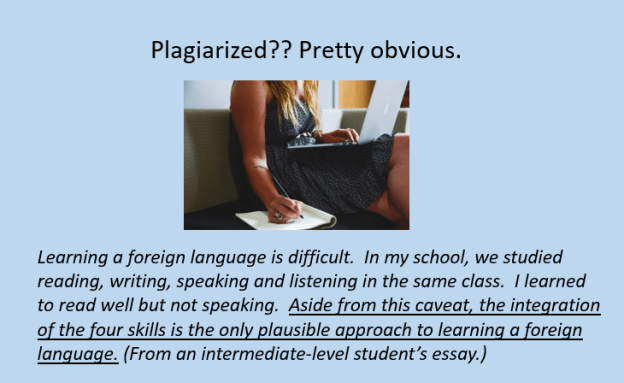
Cover plagiarized Revisit shot

This posting is an updated version of a post from November 2016: Writing Class: Dealing with Plagiarism (Don’t Take It Personally) 

In October 2016, Tiffany Martínez, a Latina student at Suffolk University in Boston, was accused of plagiarism by her sociology professor in front of the entire classHuffington Post plagiarism story   What caused him to be suspicious?  The word “hence.”  On her paper, he circled the place where she had written the word “hence” and wrote in the margin, “This is not your word.”

In my many years as an ESL instructor, I’ve witnessed instructors over-reacting in suspected plagiarism situations.  It seems as if those instructors were taking it personally, feeling like they were being disrespected.  Too often instructors seem to see it as a “gotcha” opportunity.

Plagiarism Learning Opportunities

Unless there is proof, the instructor shouldn’t accuse the student.  It would be more damaging to falsely accuse a students of plagiarizing who had worked hard than to “let” a students who actually plagiarized slip by.  If the student actually plagiarized, and the instructor has proof, it can be viewed as a learning opportunity.

Here are some options depending on the situation.

Continue reading

• How We Can Develop Intrinsic Motivation in Our ESL Students. Specific Examples. (Part 2)

REV Cover Intrinsic Pt 2

As I mentioned in Part 1, it is possible for our ESL students to be intrinsically motivated to learn English.  And there are ways that we can help them develop this. I discussed the first two recommendations based on research: 1) Give Students Autonomy and 2) Explain the Purpose of the Assignment.. Here, in Part 2, I explain the other three recommendations along with specific examples.

 According to research, how we can promote intrinsic motivation.

Continue reading

• How We Can Develop Intrinsic Motivation in Our ESL Students. Specific Examples. (Part 1)

REV Cover Intrinsic Pt 1


As I was leaving the hardware store with some light bulbs, I asked the very helpful clerk, Rich, what his plans were for that evening. He said, “I get to go home and play with my tools.” He was going to help his neighbor with some plumbing project.

I now realize that I was witnessing someone with pure intrinsic motivation. Even after spending all day selling tools, he enjoyed them so much that he was looking forward to working with them just for the pleasure and satisfaction that he got from them.

It is possible for our ESL students to be similarly intrinsically motivated to learn English.

 And there are ways that we can help them develop this.

Continue reading