Category Archives: *ESL WRITING

These postings include writing activities, teaching techniques and strategies for evaluating writing skills.

• LINCS Topic 2 What instructional strategies have you found to be motivating for English learners? 

Cover Motive Blog June 2023 REV

(This posting includes a handout which you are welcome to use with your students.) 

This posting is a more detailed response to my interview question on Day 2 .LINCS Discussion: Student-Centered Approach to Teaching Writing Skills. .

Below in blue, you’ll find the details that I’ve added to the Day 2 LINCS’ posting.

I have found six ways to motivate students.

1) Give Students Autonomy

According to psychologist Edward Deci, the most important ingredient for motivating students is autonomy. 1

Having autonomy doesn’t mean that students decide what is taught in a lesson.  Instead, students can experience autonomy if the lesson is set up so that they can individually choose which exercise to do first, second etc., how fast to work, when to ask the teacher a question or for help and even when to take a break.

A writing-workshop approach is an excellent way to give students autonomy. Here is how it can be done:

Step 1) The teacher briefly explains the assignments that student will be working on during the class.

Step 2) S/he returns any homework assignment that students had turned in and which the teacher had marked. They will correct these and show the teacher, but they DO NOT start writing yet.

Step 3) If there is a group-activity, the students do that.  As each group finishes, they don’t have to wait for the others to finish.  Instead, they start the assignments from Steps 1 and 2 individually.

Step 4) AUTONOMY!  Students start the assignments by individually choosing which one they want to do first, second, third.   At any time, they can ask the teacher any questions they might have and show him/her corrections from the returned assignment.

Some of the benefits of the Workshop

Continue reading

• LINCS Topic 1: What are your thoughts about implementing a process approach to teaching writing? 

Cover Blog June 2023

(This posting includes a handout which you are welcome to use with your students.)

This posting is a more detailed response to my interview question on Day 1.LINCS Discussion: Student-Centered Approach to Teaching Writing Skills. .

Below in blue, you’ll find the details that I’ve added to the Day 1 LINCS’ posting.

The key to a productive process approach is to have a clear purpose for each of the drafts. Here is the process that I’ve found to be the most effective, time-efficient, and user-friendly for the students and teacher. And it involves only three drafts.

Before starting the writing process, the teacher briefly introduces the type of writing that the students will be working on, for example a mode like Narration or Exposition.

Step 1. Preparation for 1st draft. The teacher gives students a list of 5-15 topics to choose from. It works well to include topics that they’ll be able to think of details to write about and also ones that would be enjoyable for others to read. If a student has a topic not on the list that they’d like to write about, they first have to have it approved by the teacher. Each student chooses one of the topics.

I knew a teacher who was under the assumption that process approach meant students needed to find their own topics. I found out that many of those students spent a lot of time trying to come up with a topic or would write about topics that they had written about in the past. Also, some would decide on a topic only to discover that it wasn’t appropriate for that assignment.

After they have chosen a topic, they write a list of ideas. It’s important to be flexible about how many details to expect in this step. I know some native-speakers who are great writers but actually hate to write an outline in advance. They discover what they want to write as they are writing. However, I think that without us requiring a list, student will just start writing and miss the opportunity to see how helpful a list can be, especially considering that they may be working with a pattern of organization that is different from the ones in their own culture.

After they write their lists, the teacher briefly looks them over and, if necessary, makes some suggestions. This usually takes less than two minutes per student.

Continue reading

• Discussion: Student-Centered Approach to Teaching ESOL Writing Skills

LINCS invite blog shot

During the week of March 6-10, I was interviewed online (in written form) about teaching writing skills in the LINCS’ “English Acquisition” Discussion Group.

LINCS (Literacy Information and Communication System) is a division of the U.S. Department of Education. In addition to discussion groups, it contains many resources for teachers.

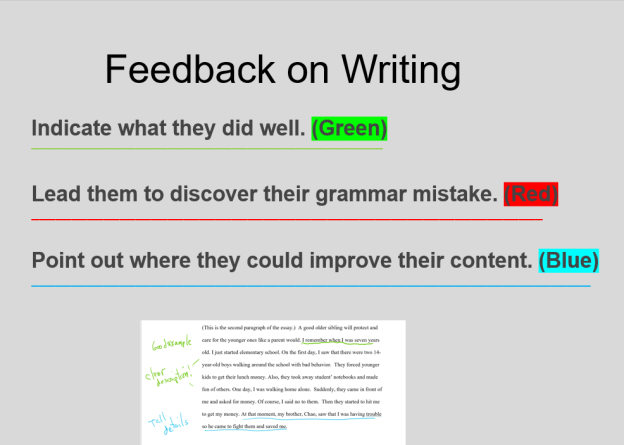
Each day of the week, the interview was focus on a different aspect about teaching writing to ESOL students, including how to motivate students and how to provide meaningful feedback.

Continue reading

• Why We Teach the Modes in ESL Writing Courses and a Mix-Mode Essay

Cover Modes shot

(This posting includes a handout which you are welcome to use with your students.)

I was left speechless after reading Sayo’s essay. I didn’t know where to start because I couldn’t figure out exactly what she was trying to say.

When I asked her how a specific detail was connected to her topic, she said that she purposely didn’t explain that because she was showing respect to the readers who would figure it out without her explicitly saying it.

I also asked her about why she included an unrelated personal experience. She responded that she thought it would make her paper more interesting to read.

She concluded with a vague question that she hoped would give the reader something to ponder. It only left me pondering how the question was related to her essay.

I realized that Sayo’s essay demonstrated a cultural difference with regard to reader- versus writer-responsibility.  Apparently, English is a “writer-responsible” language; as such, it is the writer’s job to communicate ideas clearly to the reader.  On the other hand, in “reader-responsible” languages, (like Sayo’s) the burden is on the reader to understand what the writer is trying to say.  In reader-responsible cultures, it is presumed that the writer already shares with the reader certain knowledge that can, thus, be left unsaid. However, since readers in English are not accustomed to that role, frustration and communication breakdown can result.

What researchers have found about other cultural differences in writing papers.

Continue reading