Category Archives: • Marking papers & Assessing Writing

• Most Important Process that You can do for Yourself, Your Students, Your Program (Part 1)

Cover Most important process

This process will give you, your colleagues, administrators, and most of all, your students great confidence in what you and your colleagues are teaching your students.  It will serve as a legitimate basis for the goals and outcomes of your courses.

This empowering process is called a needs analysis.  It is one of the most important things I have ever done as a professional, and I’ve done this everywhere I’ve taught.

And on top of all that, it can be stimulating and rewarding to do.

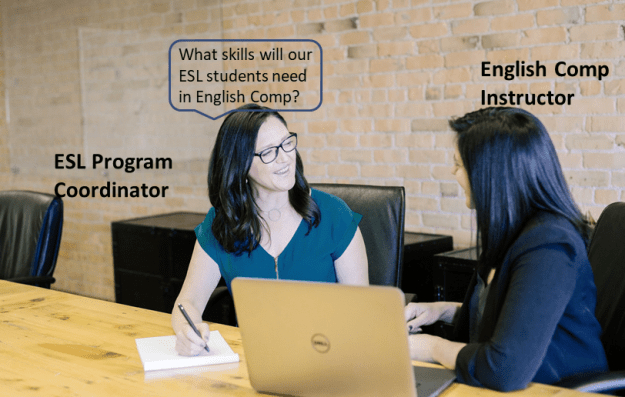
In brief, a needs analysis in an ESL context means finding out what skills students will need in order to be successful in the future.  The future can be the following term when they will be in the next level of a program; it can be when they finish their ESL instruction and will be in college courses (e..g. English Comp); it can be when they are traveling abroad; it can be when they enter the workforce.

These range from simple surveys of a small group of former students to more involved interviews with college instructors.

How to find out what skills students need to know once they leave our course or our program

Continue reading

• Saving Mental Energy: Give Two Grades on Essays

Thinking

(This posting includes a handout which you are welcome to use with your students.) 

Imagine that you read Mari’s essay in which she developed her ideas exactly the way that you had hoped she would.  But her grammar was very weak and even caused some confusion.  You are torn about what grade to give her.  You know that her grammar skills are not strong enough to succeed at the next level, so you don’t want to mislead her.  But you also don’t want to discourage her since her content was so good.

What grade should you give Mari?

Continue reading

• How to lead ESL Students to Discover their Grammar Mistakes on Writing Assignments

tutoring-writing

One-on-one conferencing

Example of telling, not leading a students: “I see that you have a mistake in this sentence in your essay.  Instead of writing, ‘He was gave a reward,’ you should write, ‘He was given a reward.'”

All over the world and on almost every campus, there is a need for well-qualified teachers/tutors who understand grammar terms and who can “lead” ESL students to discover and correct their own mistakes, and by so doing, become better at self-editing.  Unfortunately, many teachers/tutors merely tell students what their mistakes are and how to correct them.  This approach has been proven to be ineffective at making students aware of their mistakes and at helping them become independent. The purpose of this posting is to give a brief introduction to an innovative and at the same time straight-forward techniques which teachers/tutors can use when conferencing individually with students about their writing assignments.

Continue reading