
Category Archives: *ESL CONVERSATION & DISCUSSION TECHNIQUES

These postings include conversation activities, teaching techniques, strategies for groupings and evaluations.

• Want Your Students to Seem More Likeable? Research Says: Teach Them Follow-up Questions

Likeable

(This posting includes a handout which you are welcome to use with your students.) ,*

This could be one of the most useful researched-backed techniques that your students can learn.  If they want to make a positive impression on others during a conversation, they should ask a lot of questions, especially a lot of follow-up questions.

Karen Huang and her research team at the Harvard Business School analyzed more than 300 online and face-to-face conversations between people getting to know each other.  In one study, participants engaged in a 15-minute conversation with a randomly assigned person.  Some of the participants were told to ask many questions (at least nine) and others were told to ask few questions (less than four).  After the conversations ended, the participants told the researchers how much they liked their conversation partner.  The results showed that the people who asked more follow-up questions were considered more likeable.

A second study and activity for students continues below.
Continue reading

• For Large-Class Conversation Instructors, You Can “See” if Students are Using Techniques

Cover seeing shot

(This posting includes a handout which you are welcome to use with your students.)

You,the conversation teacher, are happy because the noise level in the room is high.  That means that the 12 pairs of students (24 total) are engaged in the conversation activity.   At the start of the next class, you want to give them feedback on their performance today, especially because you want to give positive comments to those who are very active.  There are also a couple of pairs who need some “re-direction.”

Needless to say, you’re not going to be able to give each student specific feedback specifically on what they said because you can’t actually hear them above all the talking.  But you can actually see whether or not they are using conversational techniques.

(See previous posts of two important techniques Conversation magic: Two most important conversation techniques (Part 1) and Conversation magic: Two most important techniques. (Part 2)

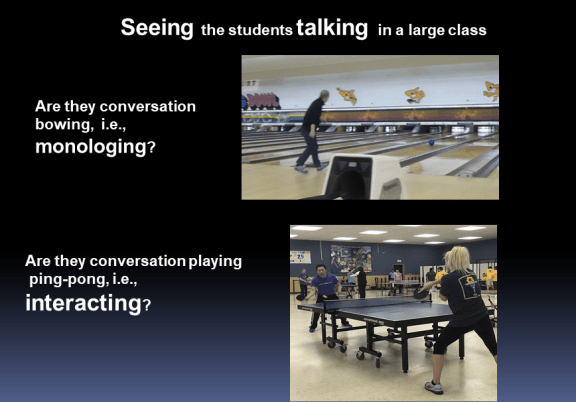
Even if you can’t hear them, you can see if they are engaging in a natural conversation; it looks like ping-pong, in which they are reacting to each other, asking follow-up questions and giving understanding responses.  You can also see if they are more like bowling, in which one monologs for a while while the other “zones out,” then the other monologs.  You can see if someone is dominating and if someone is very passive.  Interestingly, you can even see if they have switch from English to their native language; often when they do this, their voices lower and their faces aren’t as animated perhaps to “hide” from the instructor.

If you suspect that a pair isn’t using natural conversation techniques or isn’t speaking in English, there are things that you can do.

Continue reading

• Discussion Technique to Get Quiet Students Involved (Part 1)

Quiet students Part 2 Cover shot

(This posting includes a handout which you are welcome to use with your students.)*

There are techniques which guarantee that all students will be engaged in a discussion.  In other words, the discussion will look like a game of table tennsi, in which students react and respond to what their group members have said.  It doesn’t look like bowling, in which one member tell his/her opinion, followed by a second member, then by a third etc., without necessarily even listening to the other members.

Some of the techniques that compel students to listen to each other and actively interact are:

  • asking follow-up questions
  • seeking and giving clarification
  • using comprehension checks
  • soliciting more details from others
  • interrupting others during a discussion
  • helping the leader of a discussion

A great technique to practice early in a discussion course is “seeking and giving clarifications.”  This involves using expressions such “Did you say …?”  “I didn’t understand …”  “Can you explain … more?”

After students have used the two attached handout-activities, they usually find the technique to be a “tool” that they can use not only in group discussions but also when interacting with teachers and others outside the classroom.

Continue reading

• Making the Perfect Mixture of Structure and Autonomy in Conversation Activities (Customizing Exercises)

Cover SIM shot

(This posting includes a handout which you are welcome to use with your students.)*

YouTube This posting is discussed on my YouTube video:   Perfect Mixture Structure and Autonomy

“Ms. Brown, do we really have to do anything we want to do again today?”**  Ms. Brown is probably an extreme case of instructors who try to give their students autonomy because they believe students know best what they are interested in.

The chances are that you are from a different culture, different generation and/or different socio-economic group from your students.  You probably have a different marital status, different interests and/or different goals.  So how can you tap into what will be most stimulating for your students to talk about when they are practicing conversational techniques?  In other words, how can you customize the exercise for your current group of students?

A key phrase in the question is “conversational techniques.”  Students should be learning techniques that they can apply in conversational situations.  Some technique examples are: beginning a conversation, giving understanding responses, clarifying something, politely interrupting someone, rephrasing something, soliciting details, giving opinions, summarizing what was said, ending a conversation.

Let’s say Ms. Brown wants her students to practice giving opinions.  To customize the activity, she tells the students to think of topics that are interesting to them, get into groups and tell their opinions.  But, without any kind of structure, the students will probably just take turns monologuing, not actually engaging in a conversation.

The “perfect mix” of structure and customizing involves three parts:

Continue reading