Category Archives: • Lower & Intermediate Levels

• Another Conversation Activity: Listen to Partner and Ask Questions to Complete Information-Gap Chart

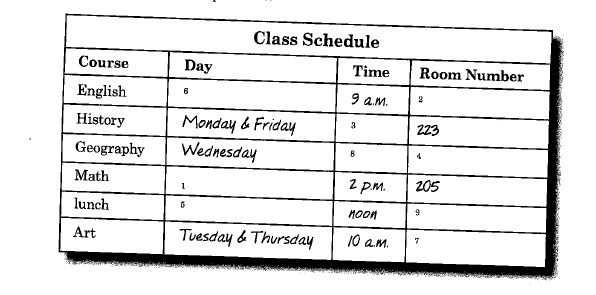
image schedule chart

(This posting includes a handout which you are welcome to use with your students.)*

At first, this pair-work activity looks like it’s about getting students to talk a lot by filling information in a chart.  But that’s not the most important value of it.

Yes, students will talk a lot during this.  But by including a short pre-exercise, they will see how they should ask clarification questions when they need more information or if they didn’t understand.  Asking clarification questions is the strategy that they can use in future conversation situations in and outside the classroom.

In this activity, the students will be filling in information about a class schedule.  They’ll need to listen to their partners tell them the name of courses, days, times and room numbers.  They’ll have many chances to ask questions, especially if they don’t understand.

There are three steps in this activity:

  • Step 1: Brief work with a model showing how to do Step 2.
  • Step 2: Pair activity (Student A/ Student B)
  • Step 3:  Exercise to do if they finish before other pairs have finished.

Continue reading

• Conversation Activity: Stimulating Students to Listen and Respond to Each Other

conversation listen respond

(This posting includes a handout which you are welcome to use with your students.)*

(I discuss this posting in this video:  Stimulating Conversation Activity)

Students are going to make the most progress in their conversation skills if they get into the habit of doing two things:
(1) Listen carefully to what the other person is saying and
(2) Respond to what was said.

This information-gap activity is great practice for a couple of reasons.  First, students will immediately know if they hadn’t understood clearly what their partner had said.  And second, it provides an example of  how to respond to what the partner had said.

There are three exercises in this activity.

Continue reading

• Taking TPR to Another Level of Engagement: Two Fun Lower-Level Activities (Part 2: Movie Directors)

Excerpt from directors’ script:

Movie Director script

(This posting includes a handout which you are welcome to use with your students.)*

This activity is not only great for skill building, but also offers an opportunity for students to be creative.  It’s also very entertaining and a complete change from other activities that students usually do in class.

After students have done the TPR (Total Physical Response) activity which I had describe in Part 1 , Taking TPR to Another Level of Involvement: Two Fun Lower-Level Activities (Part 1: Triads) they’ll be prepared for this one, “Movie Directors.”

In brief, these are the steps and the handout.

Continue reading

• Customized Speaking/Listening “Game” (Actually, more than just a game.)

Three classmates are playing the game.

Vy: Here are the names of four classmates.  Which one is special? Julie,  Mai,  Saura, Thi.
Katya: Could you repeat that again?
Vy: Sure. Julie,  Mai,  Saura, Thi.

Alessa: I know.  Julie is special.
Vy: OK.  Why?
Alessa: Because she is not Asian, but the other three are.
Vy:  That’s right!  But there is another one.
Katya:  Let me see.  Oh, I got it.  Thi is special.  She is the only one who knows how to drive.
(Everyone laughs.)
Vy: You got it.
Danica: I know another one.  Saura is special.

Katya: Really?  How come?
Danica: She is the only one who finished her homework for today.

(Eruption of laughter.)
Vy: Now it’s your turn, Alessa.

(This posting includes a handout which you are welcome to use with your students.  See below.)  *

YouTube This posting is discussed on my YouTube video More than just an ESL Game

While the students were in engaged in this activity in triads, I was standing on the perimeter.  I could overhear the list that Vy read, but couldn’t think of anything special about the four names except the obvious one that Julie was the only non-Asian.  A minute later, I heard the sudden explosion of laughter and talking from them.  I realized that they had shared an inside joke.

The basis of this game (Odd Man Out) might sound familiar to many of you.  But by exploiting it more, it turns into a great interactive activity that is not only fun but also a chance to internalize many useful expressions and produce a lot of conversation.  And students are intent on listening to each other.

In its simplest format, student read a list of four words to their partners.  The partners have to choose which word is strange or odd or special and explain why.  For example:
cat, lion, dog, fish

Most of us would probably identify “fish” as being odd because it is the only one that lives in water.  However, another choice could be “lion,” since the others are common pets.

Making this a good learning tool and customizing it

Continue reading