Category Archives: • Lower & Intermediate Levels

• The Eyes Have It: Keeping Students Focused During Group Work

Eyes image

I once had a colleague who was feeling distraught because her students didn’t seem to take group work seriously.  Her students tended to chat instead of doing the task and often finished early without completing it.  She asked me to observer her class to see if I could come up with any suggestions.

Within a few minutes of observing her class, I was reminded of a social psychology study that seemed related to her situation.  As you read the summary of the study below, you may wonder how this could be connected to ESL students working in groups.  Bear with me.

The study

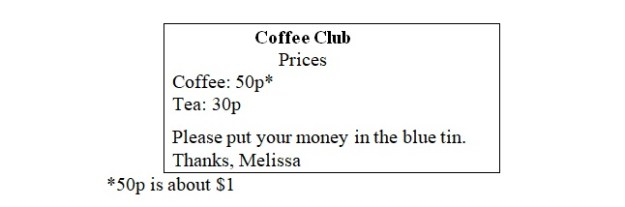
The Psychology Department at Newcastle University conducted this interesting study using their coffee station.  There was a sign above the coffee station:
Smaller coffee station screenshot

As you can see, it operates on an honor system.  For the 10-week study, researchers taped a picture of flowers for a week over the coffee station and then switched to a picture of a pair of staring eyes for a week.  They continued to alternate these pictures each week.

This is where it gets interesting

During the weeks that the poster of the eyes was staring, coffee and tea drinkers contributed almost three times as much money as in the weeks that the flower picture was on the wall.  What’s so amazing is that it was just a PICTURE of eyes, not an actual person, which seemed to make people more honest.

The researchers conducted a similar study to see if the flowers or eyes pictures could motivate people to clean up after their meals.  In that study, the number of people who cleaned up doubled when the eye picture was present compared to when the flower picture was.

How this social psychological study is connected to teaching ESL

Continue reading

• Conversation Activity: Getting Students to Say More Than the Minimum

Cover more than minimum Shot

(This posting includes a handout which you are welcome to use with your students.)*

 We might think that the students who say little in a conversation are lazy or just quiet by nature.  That’s not necessarily the case.  Some students have told us that they are trying to be polite and let others talk.  Others just don’t know what to say, so they say the minimum.  And some just aren’t aware that they should speak more.

This activity is designed to help these types of students. It “gives permission” to the polite students to talk more.  It “requires” the lazy or quiet ones to contribute to the conversation.  And it “pushes” everyone to think of something, anything, to say.

The activity is call Responding with Details. In groups of three, students ask each other the supplied questions (in a Student A, B, C format).  Every time the members respond, they have to answer with “and, but, so, because or with two sentences.

Example

  1. Marit: Where was the best place you ever lived?
  2. Lucien: I like warm weather, so I really loved living in California. (Answered with “so”.)
  3. Marit: When did you live there?
  4. Lucien: When I was in high school.  We moved there when I was 16 and stayed for three years. (Answered with two sentences and “and.”)

Steps in the activity (and the handout)

Continue reading

• Another Conversation Activity: Listen to Partner and Ask Questions to Complete Information-Gap Chart

image schedule chart

(This posting includes a handout which you are welcome to use with your students.)*

At first, this pair-work activity looks like it’s about getting students to talk a lot by filling information in a chart.  But that’s not the most important value of it.

Yes, students will talk a lot during this.  But by including a short pre-exercise, they will see how they should ask clarification questions when they need more information or if they didn’t understand.  Asking clarification questions is the strategy that they can use in future conversation situations in and outside the classroom.

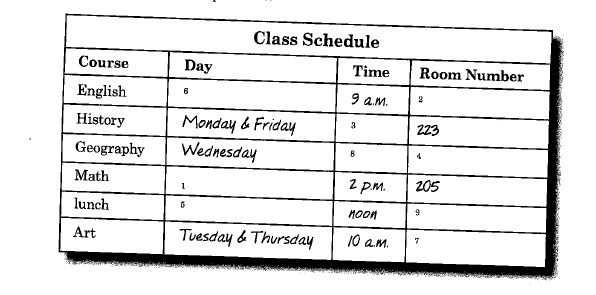
In this activity, the students will be filling in information about a class schedule.  They’ll need to listen to their partners tell them the name of courses, days, times and room numbers.  They’ll have many chances to ask questions, especially if they don’t understand.

There are three steps in this activity:

  • Step 1: Brief work with a model showing how to do Step 2.
  • Step 2: Pair activity (Student A/ Student B)
  • Step 3:  Exercise to do if they finish before other pairs have finished.

Continue reading

• Conversation Activity: Stimulating Students to Listen and Respond to Each Other

conversation listen respond

(This posting includes a handout which you are welcome to use with your students.)*

(I discuss this posting in this video:  Stimulating Conversation Activity)

Students are going to make the most progress in their conversation skills if they get into the habit of doing two things:
(1) Listen carefully to what the other person is saying and
(2) Respond to what was said.

This information-gap activity is great practice for a couple of reasons.  First, students will immediately know if they hadn’t understood clearly what their partner had said.  And second, it provides an example of  how to respond to what the partner had said.

There are three exercises in this activity.

Continue reading