Category Archives: • Lower & Intermediate Levels

• Teach Reduced Forms for Comprehension Not for Speaking.

Cover reduced forms shot

*(This posting includes a handout which you are welcome to use with your students.)

Here is a link to a short video about this posting: Teach Reduced Forms for Comprehension NOT Speaking

A student, Tim, once came to my class all excited and asked me, “Hey David, wha ya gonna do di wee-en? I wanna gedouda taw.” 

I was pretty sure that he was trying to say something in English, but I had no idea what it was. After repeating the sentences several times, he became embarrassed and decided to write them down. “What are you going to do this weekend? I want to get out of town.”

He told me that the teacher in his previous class was doing lessons on reduced forms of speaking and had encouraged them to use them when speaking. So this student whose pronunciation was often hard to understand because he tended to drop final consonants of words (e.g. wee = week / taw = town) was being encouraged to do something that would make him even harder to understand.  Crazy!

How to work with reduced forms. (Handout exercise included)

Continue reading

• The Teacher’s Role During Student-Centered Conversation Activities (on YouTube)

Cover t-role Blog wt Youtube logo shot

(This posting includes a handout which you are welcome to use with your students.)

Here is the link to the YouTube video: The Teacher’s Role During Student-Centered Conversation Activities

In this video, I discuss how teachers can provide valuable feedback to students about how they are carrying out pair/small-group activities. I explain how the teacher can be observing students and keeping brief (realistic) notes for each student, even in large classes.  I also share some user-friendly feedback forms which teachers can fill out and give to each student.  See link below.  This process can provide students with specific information about how they can improve their conversation skills when working in pairs/small groups.

Here is the link to the feedback forms that I had discussed in the video which you can download for free to use you’re your students:

Feedback forms for Conversation Classes 3

For more video discussions about teacher ESL, visit my YouTube channel: . Student-Centered Teaching ESL by David Kehe

David Kehe

• Conversation Technique for Lighting Up the Pleasure Centers in Your Students’ Brains

Cover Lighting up shot

Maybe this is why students tend to love their ESL classes.

We can actually include something in our lessons that will fire up the reward brain circuits in our students’ brains.  However, there can be a downside to this.

Neuroscientists at Harvard found that people’s brain reward circuits lit up when they were talking about themselves.  Amazingly, doing this can trigger the same sensations of pleasure in the brain as food, money or sex.

In other words, talking about ourselves feels good.  In fact, it feels so good that participants in a study were willing to accept 25% less money if it meant that they could talk about themselves rather than talk about someone else.

This research has interesting implications for our ESL classes.

We now know how to help our students enjoy conversation activities, and that’s good.  However, it’s not as easy as it sounds. Apparently, some students like the brain pleasure they feel so much that they can’t stop themselves from dominating conversations talking about themselves.

Techniques to encourage conversations/discussions but that keep students from dominating the activities.

Continue reading

• Whole Class Conversation Mixer Activity: Good for Students’ Skills, Brains and More

Cover mixer shot

(This posting includes a handout which you are welcome to use with your students.)*

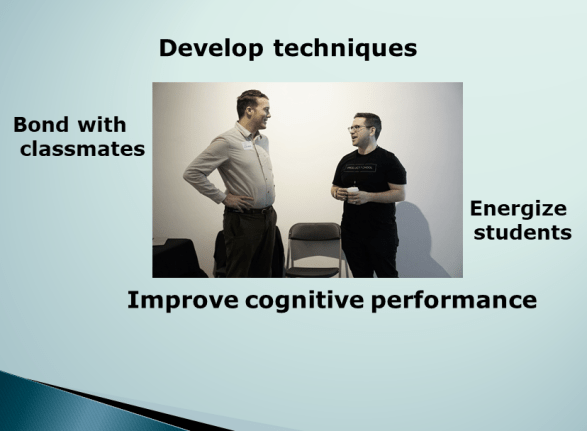
Develop techniques, bond with classmates, improve cognitive performance all in one activity!

The first time I used this type of activity, I was a relatively new ESL Conversation teacher and just wanted something to get my students talking.  Over the years, I’ve developed it more to involve additional conversational techniques.  And from cognitive psychology, I discovered why students are so energized by it.

You may be familiar with a simple version of this activity called “Find someone who” in which students are given a list of items and directed to talk to their classmates and find someone who has that item or has done that activity.  For example, find someone who has a pet or has lived in Europe or has gone backpacking.  However, that simple version has limited value.

A much improved version of this type of activity with great benefits (and handout)

Continue reading