Category Archives: • Lower & Intermediate Levels

Entering a Lesson with Predictions (Part 2: Pre-Discussion Activities)

Cover pre speaking Pt 2 slide

In Part 1 ( • Entering a Lesson with Predictions (Part 1: Pre-Listening Activities) , I introduced how we can help student to focus on a particular day’s materials and to become personally involved in its content. We can do it through a “prediction process.” I also described two prediction activities as entries to listening activities.

In this Part 2, I’ll share two sets of “prediction activities” as entries to speaking/discussion activities. In the first one, the prediction activity is indirectly related to the speaking activity. In the second one, it is directly related to what they will be discussing in their groups.

Example of predictions as an indirectly-related “entry” to a speaking activity

Lesson plan:  The students were going to have group discussions about “fun.”

Prediction procedure (which preceded the discussion.) I found online a ranking of the 10 most fun countries in the world.

Step 1: A list of 10 countries in alphabetical order was given to each student. They then individually predicted the ranking of each one according to how fun the online survey found.  Next, they formed groups of three or four and shared their guesses (predictions) with the group members.

Step 2: The teacher read the rankings, as they had been listed in the online source. Students jotted the answers on their lists.

Step 3: Still in their groups, they compared how well they had predicted.

Step 4: The students then formed new groups of three or four. The students were given a list of discussion questions about “fun.” For example
1) Did you have fun last weekend
2) When you were a child, what did you do that was fun?
3) Do you think computers are fun?
4) Is there a country or city you want to go to for fun?
etc.

Observation: Even though the ranking of fun countries had no direct bearing on the discussion that followed, students appeared to automatically think broadly about the topic of fun.

Example of predictions as a directly- related “entry” to a speaking activity

Lesson plan: Students were going to discuss cheating. Before the discussion, they were first going to read an article about students cheating.

Prediction Procedure (which preceded the above plan)

Step 1: Before handing out the articles, a list of True-False questions concerning the information in the soon-to-be-distributed article was given to each student. For example:

According to the article …
1. 50% of college students said cheating was wrong.
2. 90% of college students said that they had cheated at some time.
3. Very young children cheat more than high school students.
4. Most parents think cheating is less serious than fighting.
etc.

Each student predicted what the article would say in response to questions such as these. Then in groups, they discussed the questions and their answers and arrived at a group decision regarding each. These were then put on the board

Step 2: Students were given copies of the article, which they then read silently.

Step 3:  Individual students summed up briefly for the class what the article had said in regard to each question. An acknowledgment went to that group which had most accurately predicted the article’s contents.

Step 4: In groups of three or four, students discussed cheating (using teacher-provided discussion questions) and shared their experiences.

In summary, the success of a language activity depends to a great extent on how involved students become in it. It has been our experience, and it is hoped that other ESL teachers will find the same, that by helping students to invest a part of them-selves at the “entry” into a lesson, such as was done with the “prediction procedure,” the chances for student engagment are enhanced.

David Kehe
Faculty Emeritus

• Teacher-Friendly Technique to Keep Conversation Items Current, Relevant and Personalized for Students

Cover shot

Imagine that you are teaching an ESL Conversation class. You put students in groups of three and give each member a different list of discussion questions to ask each other. Which of these questions do you think would be most relevant and interesting to answer today, December 16, 2023?
     -Do you like to go to concerts?
     -Are you a fan of Taylor Swift?
Or which of these two:
     -Do you worry about money these days?
     -Next term, our college’s tuition will increase. Will this be a problem for you?
Or which of these two:
     -What is the best age to get married?
     -Did you hear that our classmate, Silvia, got engaged yesterday?

Naturally, we’d like to make our discussion questions as relevant and personalized as possible for our students.  But that can be a special challenge for a couple of reasons:
    1) It would take a lot of time and mental energy to write up a new list of 15 current and personalized discussion questions every term.
    2) In the short time that we spend with a new group of students who are often from a different generation from us, it’s very difficult to know what they are currently interested in or what are recent trends among them.

Surprisingly, there is an easy way to make exercises current and personalized. And best of all, the teacher DOES NOT have to revise or update the items in the exercise every term.

This DOES NOT mean that we just tell students to get into groups and talk about anything they want. Instead, we still include structure to the activity.

Here is how we can do that.

Continue reading

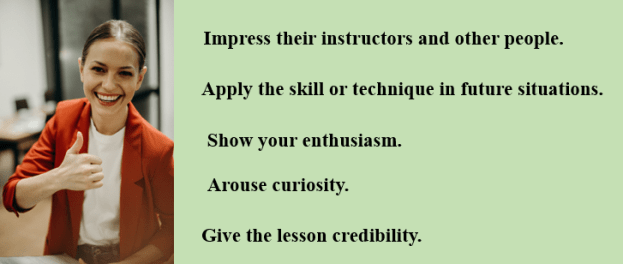
• Introducing any ESL Lesson: FIVE Effective Ways

COVER Intros

I need to start by making a confession. After I had been teaching ESL for about 10 years, I suddenly realized that I had become a bit careless about something important.

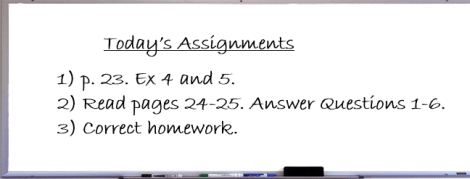
Here is what happened. As I mentioned, I was in my 10th year of teaching ESL, and I was asked to teach a course to American university students who wanted to become ESL teachers. One day, I planned to demonstrate a lesson. The first thing I decided that I need to tell them is that it’s really important to have a good introduction to the lesson. You don’t just want to tell students, open your books to page 23. Your assignment is to do Ex 4 and 5.

Slide 1

But wait! That is exactly how I had been starting my ESL classes recently. I realized that in my effort to get the lesson started, I had stopped doing a very important first step. And as a result, I missed an opportunity to stimulate and motivate my student.

So as I prepared to show my teacher-training students ways that they could introduce lessons, I returned to my days as a beginning teacher and started to use them once again with my ESL students. And I have to tell you, the results were amazing. I could see it in my students’ faces how much more energized and eager they were to do the activities. And I felt not only excited about teaching them but also confident in the importance of the activities they were about to do.

Perhaps the greatest motivator for students is feeling like they are working toward something worthwhile and are doing something important. We can satisfy this need in students by explaining the reason for the assignment.

So here are four great techniques that you can use to introduce your lessons.

Continue reading

• Effective Two-Way Tasks at Higher as Well as Lower and Intermediate Levels

Cover 2 way SHOT

(This posting includes a handout which you are welcome to use with your students.)*

This posting is an updated version of a post from Feb. 2, 2017: Conversation class: Necessary ingredients for successful pair work (from research)

Early in my career, I became a big fan of two-way tasks in my lower- and intermediate-level Conversation classes.

After several terms of teaching those levels, I was assigned to teach an Advanced Discussion class for the first time. In keeping with the spirit of student-centered teaching, I (as the teacher) wanted to avoid being the one to lead the discussions, so I put students in groups with a list of questions to discuss. However, I soon realized that some students were sitting passively and others tended to monolog.

Then I had an epiphany. By applying the two-way task principle to discussions, I could assure that every student would be equally active.

Basically, each student in a group is given different information. For discussions, every group has a Student A, B and C (and sometimes D and E) and the discussion questions are divided among them. Just as in a two-way task activity, this requires every group member to be involved in asking the questions, in active listening and responding.

For sample activities of how a variation of the two-way-task format can be applied to discussion, see *ESL Discussions: Free Small-Group Discussion Units

We can also use this format to help Advanced-level student develop discussion skills such as:

Continue reading