Category Archives: • Lower & Intermediate Levels

• Teach Reduced Forms for Comprehension Not for Speaking (Revisited)

Cover reduced forms shot

*(This posting includes a handout which you are welcome to use with your students.)

Here is a link to a short video about this posting: Teach Reduced Forms for Comprehension NOT Speaking

A student, Tim, once came to my class all excited and asked me, “Hey David, wha ya gonna do di wee-en? I wanna gedouda taw.” 

I was pretty sure that he was trying to say something in English, but I had no idea what it was. After repeating the sentences several times, he became embarrassed and decided to write them down. “What are you going to do this weekend? I want to get out of town.”

He told me that the teacher in his previous class was doing lessons on reduced forms of speaking and had encouraged them to use them when speaking. So this student whose pronunciation was often hard to understand because he tended to drop final consonants of words (e.g. wee = week / taw = town) was being encouraged to do something that would make him even harder to understand.  Crazy!
How to work with reduced forms. (Handout exercise included)

Continue reading

• ESL Conversation Class: What If They Make Mistakes In Pairs? Myths About Pair Work. (REVISITED)

Myths pair work cover shot

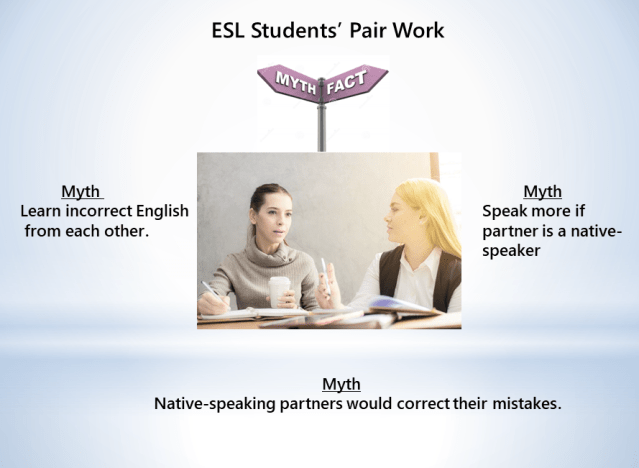
A teacher once said that she avoided pair work during conversation lessons because she wouldn’t be able to monitor all the students to catch their grammar mistakes.  Is this a legitimate reason?  Researchers have studied what, in fact, happens when students work in pairs with other students and when they work with non-native speakers which can dispel some of the mis-assumptions about the drawbacks to pair work.

Continue reading

• Helping Our Students Who Feel Invisible (REVISITED)

triads

In the documentary, Becoming, about Michele Obama, Michele is asked about feeling invisible. Her description made me think more about how many of our ESL/International students probably feel invisible in classes, on campus and in society, and how we can help them.

My personal experiences with feeling invisible are quite trivial compared to what some of our students experience, but a recent episodes gave me a bit of a taste of how it feels.

I was talking to a colleague (we’ll say his name was Ben) outside the library when a young woman whom I didn’t know walked up to us with a smile on her face. The two of them obviously knew each other and started talking animatedly, without Ben introducing us. After a couple of minutes, they walked off together across campus.

That experience had little effect on me other than feeling a tad off balance or slightly irritated momentarily. But for International and minority students, being treated as invisible can be quite disheartening.

One young man described it this way, “The problem is that to many people, I am simply invisible. Nobody says ‘hello’ to me. Nobody nods to me. Nobody recognizes me as a person with something to say. Nobody listens to me. People make assumptions about me on the basis of my color and where I come from…But I am a person and have something to say — both as an individual and on the basis of my distinctive experience.”

In our classrooms, we can see the students who are probably feeling invisible. They are the ones who are not greeted by others who look past them and start talking to more familiar friends. Or the ones overlooked when their classmates are told to find a partner for an activity. Or the ones who sit silently seemingly unnoticed in group discussions.

How to help our ESL students feel visible.

Continue reading

• Another Conversation Activity: Listen to Partner and Ask Questions to Complete Information-Gap Chart (REVISITED)

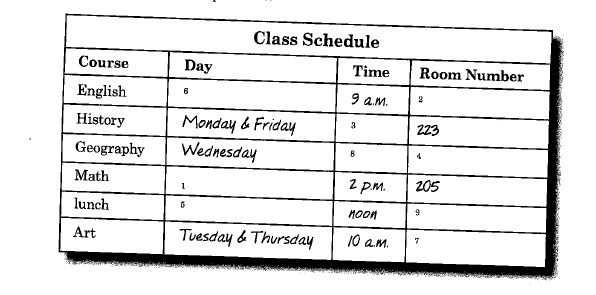
image schedule chart

(This posting includes a handout which you are welcome to use with your students.)*

At first, this pair-work activity looks like it’s about getting students to talk a lot by filling information in a chart.  But that’s not the most important value of it.

Yes, students will talk a lot during this.  But by including a short pre-exercise, they will see how they should ask clarification questions when they need more information or if they didn’t understand.  Asking clarification questions is the strategy that they can use in future conversation situations in and outside the classroom.

In this activity, the students will be filling in information about a class schedule.  They’ll need to listen to their partners tell them the name of courses, days, times and room numbers.  They’ll have many chances to ask questions, especially if they don’t understand.

There are three steps in this activity:

  • Step 1: Brief work with a model showing how to do Step 2.
  • Step 2: Pair activity (Student A/ Student B)
  • Step 3:  Exercise to do if they finish before other pairs have finished.

Continue reading